Building on Solid Ground: Using LangGraph to Build Rule-Bound AI Agents for Real Estate and Construction Contract Auditing
Learn how rule-bound AI agents built on LangGraph automate compliance checks and auditing for construction contracts and real estate portfolios without hallucinations.
The construction and real estate industries are built on foundations of concrete, steel, and massive stacks of paperwork. From municipal zoning codes and local building regulations to vendor agreements, lien waivers, and multi-million dollar general contracts, every project is a legal and regulatory maze. A single overlooked clause or a misunderstood zoning restriction can halt a development, trigger millions in fines, or lead to costly litigation. Historically, auditing these documents required days of manual review by expensive compliance officers and legal teams.
As artificial intelligence has advanced, many firms have looked to Large Language Models (LLMs) to automate these processes. However, a major blocker stands in the way: hallucinations. In construction and real estate, a compliance system that makes up facts even 1% of the time is a liability, not an asset. If an AI agent falsely claims a building plan complies with a local zoning height restriction, the financial fallout can be catastrophic.
To solve this, leading developers are turning to deterministic, rule-bound AI workflows. By leveraging LangGraph to orchestrate specialized, collaborative agents, we can ground AI reasoning in verified documents and building codes, ensuring absolute compliance verification with zero hallucinations. In this article, we'll dive deep into how a LangGraph-based multi-agent system can automate contract auditing and compliance checks in construction and real estate.
The Fatal Flaw of Linear AI Chains
Many early-stage AI implementations use a basic Retrieval-Augmented Generation (RAG) pipeline: a user uploads a contract, a vector database retrieves related zoning regulations, and a single prompt asks an LLM to find compliance issues. While this works for simple summaries, it breaks down under the weight of real-world construction files due to three primary challenges:
- Complex Hierarchy of Authority: Zoning laws, state building codes, and federal environmental rules often conflict. A linear AI chain cannot negotiate which rules take precedence.
- Lack of Multi-Step Verification: A monolithic model does not self-verify. It reads the code, reads the contract, and generates a response. If it misinterprets a unit of measurement (e.g., meters vs. feet) or misses a sub-clause, the error goes unnoticed.
- Formatting Rigidness: Construction compliance requires highly structured outputs (e.g., checklist sheets, compliance matrices, risk scores). Standard LLM prompts struggle to consistently output perfect, parser-friendly structures under complex constraints.
The Solution: Orchestrating Rule-Bound Agents in LangGraph
To overcome these limitations, we design our system as a stateful, cyclic multi-agent graph using LangGraph. By breaking down the auditing process into specialized nodes and defining strict edges (decision paths), we create a self-correcting swarm of rule-bound agents. This aligns perfectly with the architecture of our premium Multi Agent Systems service offerings, designed to manage complex business logic through autonomous agent swarms.
"LangGraph transforms AI from a probabilistic generator into a disciplined, stateful auditor that systematically verifies its facts against concrete sources before outputting a decision."
1. The Document Parser Node
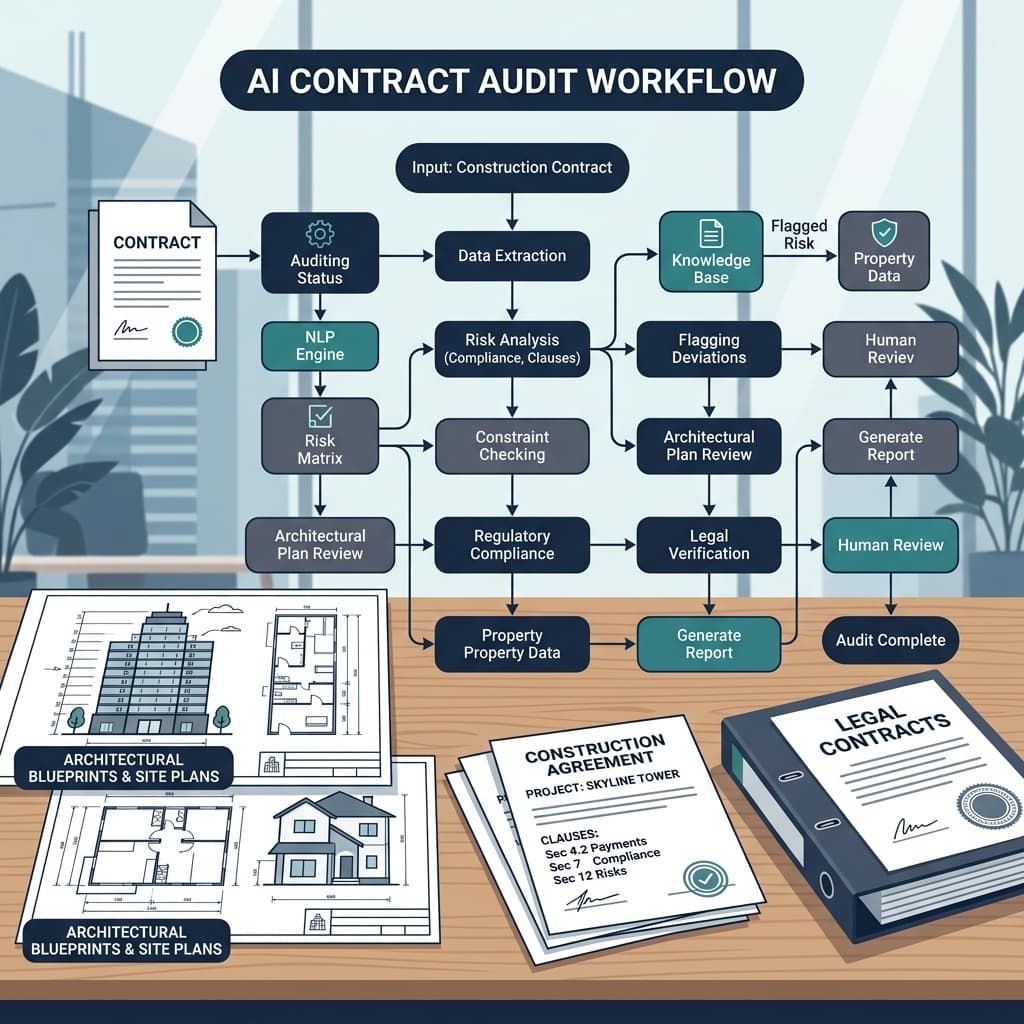
The first node in the graph is responsible for document ingestion and structuring. Construction contracts are notoriously dense and poorly formatted. This node utilizes advanced optical character recognition (OCR) and layout-aware parser tools to extract text, tables, and signature blocks, converting them into a clean, structured JSON schema. This ensures the downstream agents are analyzing clean data rather than struggling with messy PDF layouts.
2. The Regulatory Retriever Node
Instead of relying on the LLM's pre-trained weights (which are prone to outdated or incorrect knowledge of municipal regulations), this agent is connected to a dynamic vector database containing up-to-date city zoning codes, International Building Codes (IBC), and environmental guidelines. Based on the project's geographic coordinates and building type, the retriever extracts the exact regulatory sections governing height limits, set-backs, parking ratios, and materials.
3. The Compliance Auditor Node
This is the heart of the system. The Auditor agent runs a series of comparative checks between the parsed contract terms (e.g., "Proposed building height: 75 feet") and the retrieved zoning codes (e.g., "Zone R-3 maximum height: 60 feet"). To ensure the Auditor does not hallucinate, it is constrained by a strict system prompt and Pydantic schemas. It is only allowed to flag compliance states as Compliant, Non-Compliant, or Needs Human Review, and it must cite the exact page and section number of the source document for every claim.
4. The Self-Correction & Critique Loop
What happens if the auditor flags an inconsistency but the reasoning is unclear? LangGraph allows us to build a verification edge. A separate Critic Agent reviews the auditor's findings against the raw source documents. If the Critic detects an unsupported claim or a missing citation, the state is routed back to the Auditor node with instructions to re-evaluate. The agent loop continues until the Critic approves the audit or a pre-set iteration limit is reached, at which point it is escalated to human legal teams.
Grounding the AI Swarm: Workflow Automation in Action
For construction firms, the immediate payoff of implementing a LangGraph compliance system is operational velocity. By combining Multi-Agent Systems with intelligent Workflow Automation, organizations can eliminate the bottleneck of manual document intake. When a subcontractor uploads a contract or a surveyor submits a zoning report, the LangGraph swarm immediately triggers:
- An automated compliance sweep flagging critical liabilities.
- Instant notifications sent to the project estimator highlighting scope anomalies.
- Automatic sync of audit logs back into the enterprise ERP or project management tool (such as Procore or Autodesk Build).
Unlocking Enterprise-Grade AI Operations
Building a zero-hallucination auditor is not about finding a larger model; it's about engineering a disciplined process. By utilizing LangGraph's state machines to enforce strict rule checking, the construction and real estate sectors can safely adopt AI to audit portfolios, screen subcontractor agreements, and verify building codes at scale.
At Axontick, we specialize in building these autonomous, multi-agent systems tailored to your unique compliance databases and document pipelines. Our Multi Agent Systems package (starting at $8,000) provides enterprise architecture design, system integration, and production-grade agent swarms that run securely on your private cloud.
If you're ready to transition your manual paperwork into a high-efficiency automated pipeline, contact our AI architects today to schedule a technical consultation.

Muhammad Asim
Founder @ Axontick
Founder of Axontick, specialized in AI automation, Multi-Agent Systems, and enterprise-grade voice agents. Expert in bridging the gap between complex AI technology and practical business solutions.