Solving the Unsolvable: Harnessing Multi-Agent Systems for Complex Business Logic
Learn how autonomous AI swarms collaborate to solve complex business problems that traditional automation cannot handle.

Traditional automation has always followed a rigid, linear path: "If A happens, then do B." While this works for simple data entry or basic notifications, it fails miserably when faced with the messy, dynamic reality of modern business logic. What happens when the path is non-linear? What if the 'next step' depends on a creative decision or a complex data synthesis?
This is where Multi-Agent Systems (MAS) come into play, representing the next frontier in artificial intelligence and enterprise automation.
The Death of the 'God-Model'
For the past year, most businesses have been trying to use a single, massive AI model—a 'God-Model'—to handle every aspect of a task. The problem? These models often suffer from 'context drift' or hallucinations when tasked with too many conflicting priorities at once.
Multi-Agent Systems flip the script.
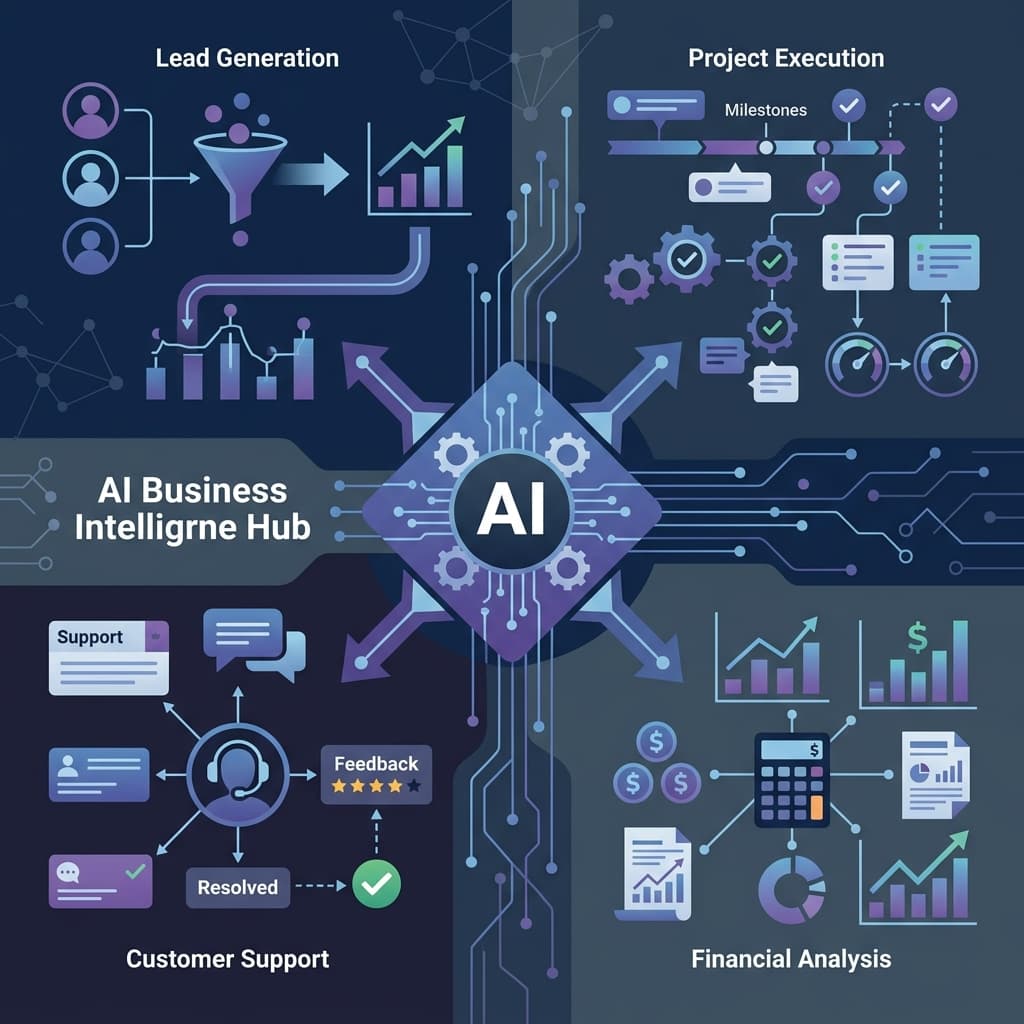
Instead of one model doing everything, MAS breaks complex workflows into a specialized AI Swarm. In this ecosystem, every agent has a specific job description, a unique set of tools, and a clear 'commander' to report to.
The Specialized Swarm:
- The Researcher: Scours live databases and the web for raw data.
- The Analyst: Interprets that data and identifies trends.
- The Architect: Designs a solution based on the Analyst's findings.
- The Writer: Drafts the final report or output.
"Multi-Agent Systems don't just automate tasks; they automate the decision-making process itself."
Solving the 'Unsolvable' Sequence
Consider a typical enterprise challenge: A customer wants a custom price quote for a project that involves volatile supply chain costs, regional tax laws, and historical client discounts.
A traditional system would break at the first sign of a price fluctuation. A Multi-Agent System, however, handles this by having the Researcher check current market rates while the Analyst cross-references tax codes, and the final Negotiator agent crafts the quote.
The Future of Enterprise AI
The shift toward MAS is not just a trend; it's an architectural evolution. Experts predict that 15% of daily work decisions will be made autonomously through agentic AI by 2028. Furthermore, research suggests that companies implementing MAS see efficiency gains of 40–60% compared to traditional monolithic AI implementations.
This technology is the perfect companion to Sales Workflow Automation, as it handles the logic that simple triggers cannot.
Ready to evolve? Start your transition to autonomous business logic today.

Muhammad Asim
Founder @ Axontick
Founder of Axontick, specialized in AI automation, Multi-Agent Systems, and enterprise-grade voice agents. Expert in bridging the gap between complex AI technology and practical business solutions.