Mastering Opus 5.5 in Project Management: Complete MCP Guide
Master Opus 5.5 in project management by linking Jira, Linear, and GitHub MCP servers to automate sprint backlog grooming and cross-system release tracking.
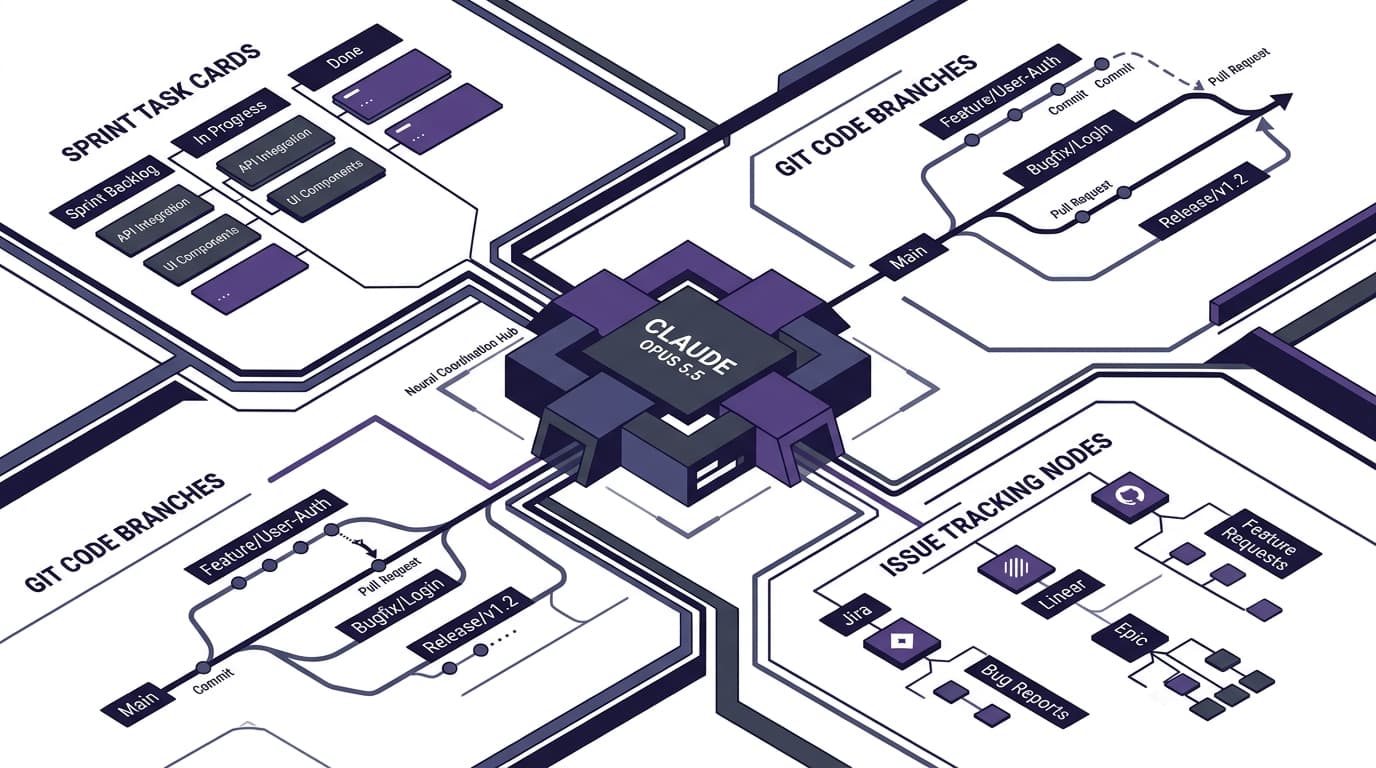
A technical blueprint for engineering managers and technical project managers connecting Claude Opus 5.5 to Jira, Linear, and GitHub via Model Context Protocol.
Deploying Claude opus 5.5 in project management requires linking your local or remote Model Context Protocol (MCP) servers directly to the model's runtime to automate backlog grooming, pull request reconciliation, and cross-system status reporting. Instead of pasting Jira exports into web chats, you configure JSON-RPC endpoints that grant the model direct, scoped access to issue trackers and version control. This architectural bridge eliminates manual ticket sync, keeps delivery state grounded in actual repository commits, and enables continuous backlog triage.
Here is the exact architecture, the configuration manifests, and the operational recipes to run autonomous delivery workflows without hallucinations or state drift.
Why Opus 5.5 in Project Management Outperforms Predecessors
Anthropic announced Claude Opus 5.5 on September 22, 2026, targeting complex, long-horizon agentic workflows and multi-step reasoning. Previous foundation models suffered from severe context thrashing when forced to parse hundreds of issue tickets, often hallucinating ticket keys or failing after three consecutive API tool calls. Opus 5.5 resolves these operational bottlenecks through three core engine upgrades.
First, Opus 5.5 introduces native adaptive thinking that dynamically scales internal reasoning depth without manual thinking token budgets. The model automatically evaluates task ambiguity before selecting which issue filter or branch query to execute. During complex dependency mapping, this internal scratchpad prevents premature API updates and catches circular blockers before writing changes to production boards.
Second, Anthropic's technical evaluation benchmarks demonstrate that Opus 5.5 achieves equivalent or superior task completion using 40% fewer tool calls and 50% fewer tokens per task compared to Opus 5. For delivery leads managing large backlogs, this efficiency translates directly into lower latency and fewer rate-limit timeouts on external APIs. The model chains searches, filters, and batch updates into consolidated requests rather than issuing single-item requests.
Third, Opus 5.5 features a 1,000,000-token context window paired with a 60% reduction in prompt cache read costs. Project managers can maintain complete system architecture documents, active sprint boards, and three weeks of Git commit logs inside the active prompt cache. Combined with list pricing of $4 per million input tokens and $20 per million output tokens, running automated daily triage across 500 tickets costs pennies instead of tens of dollars per run.
Opus 5.5 replaces manual thinking token heuristics with native adaptive thinking. When reconciling a release candidate branch across Git commits and Jira issue keys, Opus 5.5 autonomously reasons over edge cases without truncating outputs or requiring arbitrary token ceilings.
Core Architecture: Connecting MCP Servers to Claude Opus
Model Context Protocol is an open standard that decouples foundation models from custom API integration scripts. Rather than writing brittle bespoke Python wrappers for Jira, Linear, and GitHub, you configure an MCP host—such as Claude Desktop or Claude Code—which communicates with dedicated MCP servers over standard input/output (stdio) or Server-Sent Events (SSE).
The runtime topology follows a clean three-tier structure:
- Host Client: Claude Desktop or Claude Code manages authentication, local process lifecycles, and user authorization prompts.
- Protocol Layer: JSON-RPC 2.0 messages exchange standardized tool declarations, resource templates, and prompt workflows.
- MCP Servers: Lightweight containerized or node-based processes translate JSON-RPC tool calls into vendor-specific REST or GraphQL requests against Jira, Linear, or GitHub.
When Opus 5.5 initiates a project management task, it does not hold hardcoded tool implementations. Instead, the MCP server advertises its available tools—such as search_issues, create_ticket, or get_pull_request—during the initial protocol handshake. Opus 5.5 inspects the JSON schemas of these tools, executes adaptive thinking to construct the payload, and sends the call through the host.
The operational advantage is isolation. Your Atlassian API tokens, GitHub personal access tokens, and Linear API keys reside strictly inside your local host configuration file or cloud secret manager. Opus 5.5 sees only the standardized schema and the sanitized output returned by the host.
To configure this federated environment in Claude Desktop, define each server inside claude_desktop_config.json:
{
  "mcpServers": {
    "atlassian": {
      "command": "npx",
      "args": ["-y", "@atlassian/rovo-mcp-server"],
      "env": {
        "ATLASSIAN_HOST": "https://yourcompany.atlassian.net",
        "ATLASSIAN_EMAIL": "pm@yourcompany.com",
        "ATLASSIAN_API_TOKEN": "YOUR_ATLASSIAN_TOKEN"
      }
    },
    "linear": {
      "command": "npx",
      "args": ["-y", "@linear/mcp-server"],
      "env": {
        "LINEAR_API_KEY": "lin_api_your_key_here"
      }
    },
    "github": {
      "command": "npx",
      "args": ["-y", "@modelcontextprotocol/server-github"],
      "env": {
        "GITHUB_PERSONAL_ACCESS_TOKEN": "ghp_your_token_here"
      }
    }
  }
}
For teams standardizing workstation deployments, enterprise endpoint hardening and daemon configurations can be established using centralized configuration profiles and read-scoped token templates.
Key MCP Tools for Project Managers Across the Delivery Lifecycle
An autonomous delivery co-pilot requires access to work tracking, product documentation, and the code repository where work actually lands. Combining Jira, Linear, and GitHub covers the entire delivery surface area.
Atlassian Rovo MCP for Enterprise Jira and Confluence
Enterprise delivery environments depend on Jira for formal sprint tracking and Confluence for product requirement documents (PRDs). The official atlassian rovo mcp gateway exposes cloud-hosted endpoints supporting OAuth 2.1 authentication and fine-grained permission scopes.
Through this server, Opus 5.5 gains programmatic access to Jira Query Language (JQL) execution, epic breakdown, and Confluence page retrieval. Rather than requiring human operators to translate PRDs into tickets, the model reads functional requirements from Confluence spaces and checks existing Jira epics to spot unmapped deliverables.
When queried, the Atlassian bridge returns structured JSON containing issue status, assignee workloads, sprint velocity metrics, and parent-child hierarchy links. Because Opus 5.5 excels at structured data manipulation, it processes entire sprint boards containing hundreds of nested subtasks without losing ticket context.
Linear MCP Server for High-Velocity Product Teams
Product-led startups and high-velocity engineering teams predominantly track work in Linear. The official linear mcp server connects directly to Linear's GraphQL core, supporting both local stdio execution and hosted cloud endpoints.
This integration provides tools to manage cycles, apply project labels, adjust priority estimates, and query project milestones. Unlike older chat plugins that only fetched issue titles, the Linear client exposes thread comments, git branch associations, and cycle rollover data.
During sprint planning, Opus 5.5 queries active cycles to calculate team load versus historical completion rates. If an engineer is assigned three critical-path bug fixes alongside an infrastructure epic, the model highlights the bottleneck and suggests rebalancing before sprint commitment.
GitHub MCP Server for Code-Level Verification
The primary failure mode of traditional project management is divergence between ticket status and code reality. A ticket marked "In Review" in Jira often sits with no open pull request, while completed pull requests sit merged without ticket updates. The official github mcp server closes this gap.
The GitHub connector exposes repository tools including list_pull_requests, get_commit, get_issue_comments, and search_repositories. Opus 5.5 queries active feature branches, inspects diff summaries, and verifies whether code changes satisfy the acceptance criteria written in the tracking ticket.
By cross-referencing repository state with issue boards, delivery managers eliminate the manual overhead of daily standup chasing. If a pull request fails CI checks or lacks required approvals, Opus 5.5 flags the risk hours before release cut-off.
Recipe 1: Executing Automated Sprint Triage Across Complex Backlogs
Backlog hygiene is high-friction administrative work. Technical project managers routinely spend four to six hours every week deduplicating tickets, clarifying ambiguous bug reports, and verifying acceptance criteria.
With Opus 5.5 and MCP, automated sprint triage operates as an autonomous background audit. The workflow executes across four distinct operational steps:
[Fetch Backlog via MCP] ──▶ [Adaptive Deduplication & Clustering] ──▶ [Acceptance Criteria Validation] ──▶ [Draft Review Manifest]Step 1: Ingesting the Sprint Backlog
Initiate triage by instructing Opus 5.5 to scan unassigned tickets in the upcoming sprint cycle. The prompt instructs the model to inspect issue titles, descriptions, and reporter logs:
Execute JQL 'project = CORE AND sprint in openSprints() AND status = "To Do"' via Atlassian MCP.
Retrieve the full issue payload including comments and linked tickets.
Opus 5.5 issues a single call to the Jira search endpoint, retrieving up to 100 ticket objects. Because of its 50% token reduction efficiency, the model parses large JSON schemas without hitting payload constraints.
Step 2: Adaptive Clustering and Deduplication
Once the backlog is loaded, Opus 5.5 applies adaptive thinking to identify conceptual duplicates. For example, a customer support ticket titled "Login timeout on Safari iOS" and an engineering ticket titled "JWT refresh race condition in WebKit" are recognized as symptoms of the same root cause.
The model maps the relationships, identifies the primary ticket containing the most reproduction detail, and prepares link operations (relates to or duplicates) to clean up redundant items.
Step 3: Acceptance Criteria and Definition of Done Validation
Next, Opus 5.5 inspects each ticket description against your organization's standard Definition of Ready (DoR). It evaluates whether the ticket contains:
- Clear expected versus actual behavior.
- Scoped user personas.
- Explicit test criteria or automated verification instructions.
- Target deployment environments.
If a ticket lacks test criteria, Opus 5.5 reads the relevant Confluence product specification via the Atlassian server, drafts tailored Gherkin syntax acceptance criteria (Given / When / Then), and bundles them into an update proposal.
Step 4: Generating the Human-in-the-Loop Review Manifest
To maintain governance, Opus 5.5 does not silently mutate tickets without authorization. Instead, it generates a markdown triage manifest summarizing its proposed actions:
# Backlog Triage Proposal - Sprint 42
| Issue Key | Action | Proposed Change / Justification |
|---|---|---|
| CORE-1042 | Link Duplicate | Mark duplicate of CORE-981 (WebKit JWT refresh); close CORE-1042 |
| CORE-1088 | Enrich DoR | Added 3 Gherkin acceptance criteria from Confluence PRD 'Auth v2' |
| CORE-1102 | Flag Blocker | Blocked by API-304; recommend moving out of active sprint |
The delivery manager reviews the manifest, approves the recommendations with a single command, and permits Opus 5.5 to execute the batch updates across the Jira or Linear API.
Recipe 2: Cross-System Release Tracking from Commits to Stakeholder Updates
Releasing software across distributed teams requires reconciling code commits, issue tickets, documentation, and stakeholder communications. Doing this manually across GitHub, Jira, and Slack consumes hours and invites omission errors.
This recipe uses Opus 5.5 to trace every merge commit in a release branch back to its original tracking issue, verify test evidence, and produce tiered release notes for engineering, product, and executive stakeholders.
Step 1: Release Branch Diff Reconciliation
When engineering cuts a release candidate branch (e.g., release/v2.14.0), Opus 5.5 queries GitHub via MCP:
Compare branch 'main' with 'release/v2.14.0' in repository 'backend-core'.
Extract all merged pull requests, commit messages, and author handles.
The model receives the git log, extracts ticket keys embedded in branch names (e.g., feature/CORE-892-stripe-webhooks) and commit titles, and builds a comprehensive commit-to-ticket lookup table.
Step 2: Verification of Tracking Status
For each identified ticket key, Opus 5.5 queries Jira or Linear:
- Does the ticket status reflect "Done" or "Ready for Release"?
- Has quality assurance signed off in the ticket comments?
- Are there any open high-severity bugs linked to this epic?
If Opus 5.5 finds a pull request merged into the release branch whose corresponding Jira ticket is still marked "In Progress," it flags an anomaly. In our engineering audits, this automated reconciliation caught unverified database migration scripts before they reached staging environments.
Step 3: Automated Multi-Tier Release Notes Generation
Different stakeholders require different communication formats. Opus 5.5 generates three distinct documentation artifacts in a single execution pass:
- Engineering Changelog: Granular list of pull requests, database migration alerts, dependency upgrades, and breaking API schema changes.
- Product Release Notes: Customer-facing summary describing new capabilities, resolved user bugs, and performance enhancements written in clean product language.
- Executive Summary: High-level bullet points outlining delivery on strategic milestones, total velocity delivered, and remaining roadmap risks.
For teams looking to benchmark multi-agent coding speed and terminal autonomy, see our in-depth analysis on Claude Opus 5.5 Architecture & Benchmarks.
Managing Cost, Token Hygiene, and Security Boundaries
Operating foundation models at enterprise scale requires strict cost controls and defensive security boundaries. Granting an AI agent direct write access to your team's project tracking boards introduces operational risks if guardrails are missing.
Token Economics and Prompt Cache Strategy
Opus 5.5 costs $4 per million input tokens and $20 per million output tokens. While cheaper than Opus 5, naive agent loops can accumulate substantial token bills if tools dump unfiltered JSON payloads into the prompt context.
To minimize token burn:
- Configure Server Filtering: Avoid running broad
get_all_issuescommands. Pass strict query boundaries (such as updated dates, sprint IDs, and project keys) directly to the MCP server. - Leverage Prompt Caching: Tool definitions and system prompts should remain static at the start of your conversation. Anthropic provides a 60% discount on cached tokens, meaning repetitive tool calls cost $1.60 per million tokens rather than $4.00.
- Enforce Output Limits: Instruct Opus 5.5 to return markdown summaries and tables rather than echoing back raw JSON responses.
Least-Privilege Access Control
Never connect MCP servers using administrative API keys. Apply the principle of least privilege across all connected systems:
| System | Role / Token Scope | Permitted Actions | Prohibited Actions |
|---|---|---|---|
| Jira (Rovo) | Project Contributor | Read issues, add comments, edit descriptions | Delete issues, alter project schemes, manage users |
| Linear | Member (API Key) | Query cycles, update issue state, link PRs | Delete workspaces, export workspace data |
| GitHub | Fine-Grained PAT | Read pull requests, read issues, write comments | Force push, delete branches, modify repository settings |
Defensive Confirmation Boundaries
Configure your MCP host client to require human approval for all state-mutating operations. Claude Desktop natively supports user confirmation prompts whenever a tool initiates a POST, PUT, or DELETE request.
Keeping read actions automated and write actions confirmed gives delivery managers total transparency while retaining 90% of the speed advantage of autonomous execution.
Operational Comparison: Opus 5.5 vs Legacy LLM Project Workflows
The following specification table compares standard LLM project management workflows against Opus 5.5 paired with a federated MCP architecture:
| Operational Dimension | Legacy Chatbot Copy-Paste | Opus 5 with Ad-Hoc Scripts | Opus 5.5 with Federated MCP |
|---|---|---|---|
| Data Freshness | Stale; depends on manual CSV exports | Semi-live; runs scheduled batch sync | Real-time; queries live APIs on demand |
| Tool Protocol | None; manual copy-pasting | Custom proprietary REST scripts | Open Model Context Protocol (JSON-RPC) |
| Context Capacity | 128k - 200k tokens | 200k tokens | 1,000,000 tokens |
| Prompt Cache Economics | Standard API rates | Standard API rates | 60% discount on cached reads |
| Multi-Step Tool Efficiency | Fails after 2-3 chained prompts | High token churn, prompt thrashing | 40% fewer tool calls, 50% fewer tokens |
| Security Surface | High risk; sensitive data pasted to web | Raw API tokens exposed in scripts | Scoped local client host tokens |
| Cross-Tool Correlation | Human-managed across browser tabs | Brittle database joins | Semantic reconciliation across Jira and Git |
| Human Governance | 100% manual labor | Unsupervised scripts or hard stops | Granular host-level confirmation prompts |
Frequently Asked Questions
How do I connect Claude Opus 5.5 to Jira and Linear simultaneously?
Add both the Atlassian Rovo and Linear server definitions to your claude_desktop_config.json configuration file. Upon startup, Claude Opus 5.5 queries both server endpoints, registers their distinct tool definitions, and automatically routes multi-step queries across both issue trackers within a single conversational prompt without manual context switching.
What are the best MCP servers for project managers today?
The highest-leverage servers for technical delivery are the official Atlassian Rovo server for enterprise Jira and Confluence, the official Linear server for fast-cycle issue tracking, the GitHub server for repository status verification, and the community Slack server for automated broadcast notifications to cross-functional stakeholders.
Can Opus 5.5 execute automated sprint triage without breaking tickets?
Yes. By provisioning read-only API scopes for diagnostic scans and enabling host-level confirmation prompts in Claude Desktop before write operations, Opus 5.5 produces an inspectable markdown triage manifest. Technical project managers review every duplicate link or acceptance criteria update before any change commits to live boards.
How does Opus 5.5 handle multi-step ticket triage across repositories?
Opus 5.5 leverages native adaptive thinking and its 1,000,000-token context window to chain multi-system operations. It queries multiple repository endpoints, compares pull request diffs against Confluence specifications, and synthesizes cross-ticket dependencies without experiencing context degradation, rate-limit timeouts, or hallucinated ticket identifiers.
Is Opus 5.5 cheaper than Opus 5 for day-to-day project management?
Yes. Opus 5.5 list pricing is $4 per million input tokens and $20 per million output tokens, while completing tasks with 50% fewer tokens and 40% fewer tool calls. Paired with Anthropic's 60% prompt cache discount on tool schemas, daily triage costs drop by more than half.
Transform your team's delivery velocity by adopting Claude opus 5.5 in project management. Download our production-tested claude_desktop_config.json PM bundle, link your engineering trackers, and automate your first backlog grooming session today.

Muhammad Asim
Founder @ Axontick
Founder of Axontick, specialized in AI automation, Multi-Agent Systems, and enterprise-grade voice agents. Expert in bridging the gap between complex AI technology and practical business solutions.