
An architectural blueprint for decoupling audio transport, streaming inference, and speculative execution to achieve human-grade conversational response times.
Achieving human-grade conversational flow requires reducing AI agent latency from multi-second pauses down to a sub-600ms budget. Traditional sequential processing across speech recognition, model inference, tool execution, and synthesis accumulates 1,500ms to 3,000ms of lag. Meeting conversational thresholds demands pipelined streaming, speculative intent pre-computation, edge WebRTC transport, and sub-100ms Time-to-First-Audio (TTFA) neural synthesis.
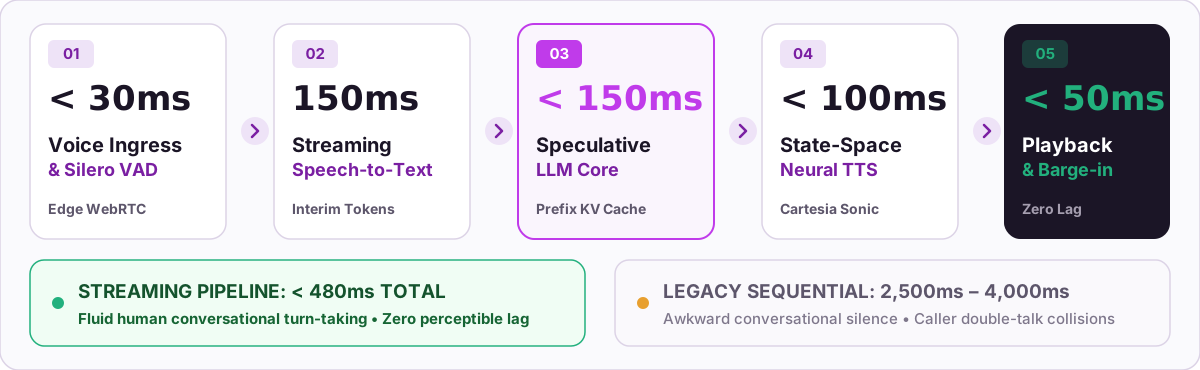
The Conversational Threshold: Why Latency Destroys Voice Immersion
In human communication, silence carries immense weight. A landmark study by Stivers et al. (PNAS) established that the universal human turn-taking gap is 200ms to 300ms.
When conversational lag extends beyond 600ms, human listeners perceive cognitive hesitation or reluctance. At 1,200ms, callers frequently speak over the agent ("Hello? Are you there?"), triggering destructive "double-talk" collisions that corrupt dialogue state. Managing real time voice AI latency is the primary determinant of whether users trust or abandon an automated conversational agent.
Deconstructing the Latency Stack: Anatomy of an Audio-to-Audio Loop
Total round-trip voice latency (Ttotal) is governed by five sequential stages:
| Stage | Unoptimized | Tuned Production Stack |
|---|---|---|
| 1. VAD & Turn Detection | 600ms – 1,000ms | 200ms – 280ms (Silero VAD + Deepgram Flux) |
| 2. Speech-to-Text (STT) | 400ms – 800ms | 120ms – 180ms (Streaming WebSocket ASR) |
| 3. LLM Inference (TTFT) | 600ms – 1,400ms | 90ms – 220ms (Static Prefix KV Cache) |
| 4. Text-to-Speech (TTS) | 500ms – 900ms | 50ms – 120ms (State Space Model TTFA) |
| 5. Network & Transport | 150ms – 300ms | 30ms – 70ms (WebRTC UDP) |
| Total Round-Trip Latency | 2,250ms – 4,400ms | 490ms – 870ms |
1. Neural VAD and Semantic Endpointing (TVAD)
Production voice agent latency optimization pairs lightweight Silero VAD (20ms frames) with grammatical closure models that trigger endpointing within 250ms, replacing clumsy 1,000ms silence timers.
2. Streaming Speech-to-Text (TSTT)
Streaming ASR engines maintain persistent WebSockets to emit partial transcripts at 150ms, finalizing text within 120ms to 180ms of the endpointing signal.
3. LLM Time to First Token (TTTFT)
In conversational voice, time to first token TTFT dictates responsiveness. Achieving sub-150ms TTFT requires static prefix key-value (KV) caching and specialized inference silicon.
4. Streaming Neural TTS (TTTS)
Streaming State Space Models (Cartesia Sonic) synthesize audio on the first 3 to 5 tokens, keeping Time-to-First-Audio (TTFA) under 100ms and eliminating sentence-buffering lag.
5. WebRTC Transport (Ttransport)
WebSockets suffer from TCP head-of-line blocking. Real-time platforms deploy WebRTC (UDP/Opus) with dynamic jitter buffers, delivering sub-50ms transport and instant barge-in cancellation.
Speculative Execution & LLM Response Optimization
Database queries and CRM lookups often inject 400ms to 2,000ms. In sub second AI systems, engineering teams eliminate this bottleneck through speculative intent pre-computation.
As callers speak, background classifiers inspect streaming interim transcripts. If a caller says "Can you check the balance on my account...", the pipeline speculatively queries the database in parallel. When speech ends, the pre-fetched record is injected directly into the LLM context, dropping tool latency to zero.
Complementing speculative execution, LLM response optimization anchors system directives into static prompt prefixes. Caching invariant prefix states skips 90% of pre-fill compute, driving TTFT down to under 120ms.
Monolithic Multimodal Models vs. Modular Streaming Pipelines
When choosing between monolithic multimodal APIs and modular streaming pipelines, engineering teams must evaluate operational control against vocal inflection:
| Dimension | Monolithic APIs (e.g. GPT-4o Audio) | Modular Streaming Pipeline |
|---|---|---|
| Median Latency | 450ms – 750ms under ideal conditions. | 420ms – 520ms consistently achievable. |
| TTFT Control | Opaque; pre-fill tokens cannot be cached. | Sub-100ms TTFT via prefix caching and LPUs. |
| Tool Execution | High; agent pauses during synchronous tools. | Near zero; speculative queries run in parallel. |
| Operating Cost | High ($0.06 – $0.12+ per audio minute). | Ultra-low ($0.02 – $0.05 per audio minute). |
| Barge-in | Sensitive to ambient room noise in cloud decoders. | Local edge VAD dumps playback buffer cleanly. |
While monolithic models offer vocal inflections, modular streaming pipelines deliver the deterministic control, tool acceleration, and cost efficiency essential for enterprise production.
FAQ: Real-Time Voice AI Latency & Optimization
Why is latency reduction critical for enterprise telephony?
Human turn-taking operates within a 200ms to 300ms window. Surpassing 600ms causes callers to repeat themselves and trigger disruptive double-talk. Dedicated latency engineering ensures conversational naturalness, directly protecting containment rates.
What is the difference between TTFT and TTFA in voice AI?
Time to First Token (TTFT) measures how fast an LLM outputs its first generated text token. Time to First Audio (TTFA) measures how quickly a text-to-speech engine outputs playable sound. Minimizing time to first token TTFT and pairing it with low-TTFA streaming synthesis ensures sound reaches callers before conversational hesitation thresholds are breached.
Engineering Sub-Second Voice Systems with Axontick
Eliminating latency in conversational AI requires rigorous systems engineering across network transport, neural streaming decoders, and hardware-accelerated inference clusters. When deploying mission-critical voice automation, reducing AI agent latency is the boundary between an awkward prototype and a fluid conversational asset.
At Axontick, we build high-performance conversational infrastructure. Through our AI voice agents practice and 4-step process, we engineer sub second AI systems with sub-500ms latency, speculative CRM querying, and custom neural vocal profiles.
Explore project scoping with our interactive AI Pricing Calculator or contact our engineering team to schedule an architecture review today.
Want this deployed for your enterprise?
Axontick engineers architect, benchmark, and deploy custom enterprise autonomous systems with guaranteed uptime, sub-second latency, and 100% IP ownership.

Muhammad Asim
Founder @ AxontickFounder of Axontick, specialized in AI automation, Multi-Agent Systems, and enterprise-grade voice agents. Expert in bridging the gap between complex AI technology and practical business solutions.