Why conversational chatbots were only the first wave, and how autonomous agentic systems execute multi-step business operations without human handholding.
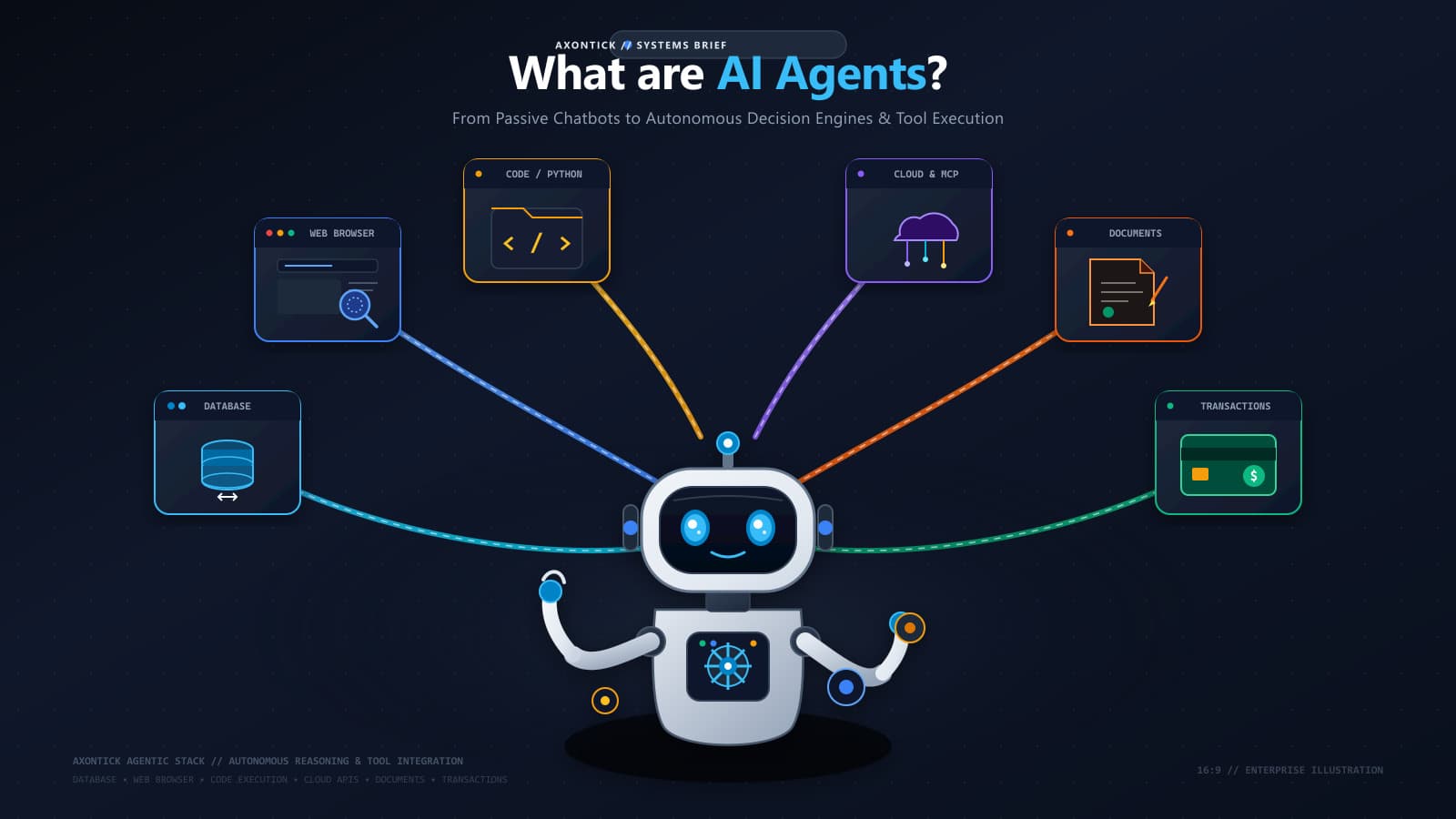
To understand what are AI agents, think of them not as conversational software, but as digital employees equipped with tools, memory, and executive judgment. An AI agent is an autonomous software system that perceives its digital environment, evaluates complex objectives, breaks high-level goals into multi-step execution plans, and uses external software tools (such as APIs, databases, and CRMs) to achieve tangible outcomes without human intervention. While standard AI models predict text, autonomous agents take real-world action.
The real enterprise differentiator is not conversational fluency, but deterministic state change: the ability to plan, call external APIs, self-correct errors, and conclude multi-step transactions under strict security guardrails.
The Chatbot Era Is Over: Introducing Agentic Systems
For the past three years, the corporate world has fixated on chatbots. Organizations embedded conversational widgets across customer portals and internal documentation, celebrating whenever a model produced fluent, human-sounding paragraphs.
Yet beneath that conversational surface, businesses quickly uncovered a frustrating limitation: chatbots cannot do anything.
To grasp the magnitude of this shift, corporate leaders must look beyond marketing hype to examine what are AI agents from an engineering perspective. A traditional chatbot operates in a purely reactive, single-turn loop. You provide a prompt, the underlying language model predicts the most statistically probable sequence of tokens, and the process terminates. If a customer asks, "Can you reschedule my appointment to Thursday at 3 PM and update my invoice?", a standard chatbot apologetically explains how you can perform those actions yourself. It acts like an encyclopedia that can talk, but cannot touch the machinery of your business.
Agentic systems fundamentally flip this equation.
Instead of generating text about a task, an AI agent takes responsibility for task completion. When given that same customer request, an agentic system checks calendar availability via Google Calendar API, validates client cancellation rules in PostgreSQL, updates HubSpot records, reissues a Stripe invoice, and dispatches a confirmation SMS—all in a matter of seconds. The conversation is merely the transmission medium; autonomous execution is the actual deliverable.
AI Agents vs. Chatbots: Key Differences
To select the right architecture for your organization, leadership teams must understand the foundational differences separating AI agents vs chatbots.
Chatbots rely on prompt-response loops. When comparing AI agents vs chatbots, conversational interfaces merely predict next words, whereas agents execute continuous cycles of perception, reasoning, tool selection, action execution, and self-reflection. When a chatbot encounters an unexpected error or missing data, it hallucinates an answer or stops dead. An autonomous agent detects the error, re-evaluates its execution plan, attempts an alternative API route, and iterates until the objective is fulfilled.
The following matrix illustrates the functional distinctions between legacy conversational chatbots and modern autonomous systems:
| Architectural Dimension | Traditional Chatbot | Autonomous AI Agent |
|---|---|---|
| Primary Objective | Information retrieval and conversational dialogue | Goal achievement, task completion, and state change |
| Operational Mode | Purely reactive (prompt in, text out) | Proactive (reasons, plans, and loops iteratively) |
| Software Tool Access | None (isolated within the prompt window) | Native (APIs, SQL queries, web scrapers, webhooks) |
| Memory Architecture | Ephemeral (resets with session or sliding window) | Dual-tier (Working context memory + persistent vector RAG) |
| Error Handling | Hallucination or generic failure response | Self-reflection, retry loops, and fallback pathways |
| Autonomy Level | Low (requires continuous human prompting) | High (executes multi-step workflows independently) |
| Enterprise Impact | Reduces surface-level FAQ volume | Automates end-to-end operational workflows |
Understanding these distinctions prevents companies from pouring capital into superficial conversational wrappers when their operational bottlenecks require transactional systems.
The 4 Core Organs of Agentic AI Architecture
Building a production-ready digital worker requires far more than connecting an API key to an open-source model. When dissecting what are AI agents made of under the hood, engineers look at systems architecture rather than simple prompt text. A robust agentic AI architecture mirrors an autonomous decision-making organism, structured around four interconnected layers:
┌────────────────────────────────────────────────────────┐
│                   1. PERCEPTION LAYER                  │
│    Webhooks, User Prompts, API Payloads, SQL Streams   │
└──────────────────────────┬─────────────────────────────┘
                           │
┌──────────────────────────▼─────────────────────────────┐
│                 2. DUAL MEMORY SYSTEMS                 │
│  Short-Term Context Window  │ Long-Term Vector Memory  │
└──────────────────────────┬─────────────────────────────┘
                           │
┌──────────────────────────▼─────────────────────────────┐
│              3. REASONING & PLANNING ENGINE            │
│  Goal Decomposition │ The ReAct Loop │ Self-Correction │
└──────────────────────────┬─────────────────────────────┘
                           │
┌──────────────────────────▼─────────────────────────────┐
│                4. TOOL EXECUTION ENGINE                │
│    REST APIs, CRM Connectors, Database Mutations, MCP  │
└────────────────────────────────────────────────────────┘
1. Perception Layer (Sensory Inputs & Webhooks)
An agent cannot act in an environment it cannot perceive. The perception layer standardizes unstructured information streaming from external enterprise channels into structured state objects.
These inputs extend far beyond chat messages. In modern enterprise deployments, perception includes inbound telephony audio streams, ERP webhooks, unread email queues, PDF attachments, server error logs, and database mutation triggers. The perception layer normalizes this noisy data, extracts intent, and feeds it into the agent's cognitive core.
2. Dual Memory Systems (Context Window vs. Persistent Vector RAG)
Human professionals do not operate with blank slates on every assignment; they leverage both immediate focus and years of institutional memory. High-performance agents replicate this through dual memory architecture:
- Working (Short-Term) Memory: Maintained within the model's active context window. It tracks the current conversation turn, intermediate scratchpad thoughts, tool execution responses, and temporary variables.
- Persistent (Long-Term) Memory: Stored in specialized vector databases (such as pgvector, Pinecone, or Qdrant) and relational databases. This layer stores historical customer interactions, corporate policy documents, domain knowledge bases, and records of past successful task executions.
When an agent receives a task, semantic retrieval pulls relevant institutional context into its working memory, ensuring consistency across months of operations.
3. Reasoning and Planning Engine (The ReAct Loop)
Within a modern agentic AI architecture, the cognitive engine is where foundational Large Language Models (LLMs) operate not as encyclopedias, but as reasoning processors. Rather than jumping straight to an output, the agent leverages structured planning paradigms such as the ReAct (Reasoning + Acting) framework.
When presented with a complex instruction, the planning engine:
- Deconstructs the overarching objective into a directed acyclic graph (DAG) of logical subtasks.
- Identifies prerequisite dependencies (e.g., "I cannot generate an invoice until I verify payment terms in the contract").
- Continuously reflects upon intermediate outputs to verify whether the initial hypothesis succeeded.
If an API returns a 404 error or unexpected JSON schema, the reasoning engine detects the mismatch, updates its plan, and explores alternative routes.
4. Tool Execution & Environment Manipulation (APIs & MCP)
Reasoning without execution is merely philosophy. The tool execution engine gives the agent hands to interact with software systems.
Through protocols like Anthropic's Model Context Protocol (MCP) and standardized Function Calling, agents are equipped with defined interfaces:
- Database Tools: Querying PostgreSQL, mutating records, or running read-only analytical aggregations.
- Enterprise Connectors: Interfacing with Salesforce, HubSpot, Stripe, Jira, Zendesk, or Slack.
- Custom Scripts: Executing deterministic Python calculations, validating schemas, or rendering PDFs.
Every tool call is strictly governed by validation schemas to ensure that natural language instructions are translated into safe, structured API payloads.
How Do AI Agents Work in Production?
To demystify how do AI agents work in production environments, let us trace an actual autonomous execution cycle through an enterprise logistics workflow:
[Inbound Trigger: Vendor Disruption Notice Email]
                      │
                      ▼
        [Step 1: Perception & Ingestion]
   Agent extracts PO numbers, delayed items, and dates
                      │
                      ▼
          [Step 2: Database Cross-Check]
   Query warehouse ERP for affected customer orders
                      │
                      ▼
         [Step 3: Reasoning & Evaluation]
   Does delay breach SLA penalty clauses in contracts?
                      │
                      ▼
        [Step 4: Tool Calling & Execution]
   1. Re-route inventory from secondary distribution hub
   2. Update ERP delivery tracking dates
   3. Draft personalized updates for account managers
                      │
                      ▼
          [Step 5: Completion & Logging]
Audit trail logged in PostgreSQL; Slack summary sent- Trigger Event: An automated supplier notification arrives via email indicating a 72-hour manufacturing delay on a batch of critical electronic components, illustrating in real time what are AI agents capable of resolving independently.
- Perception & Entity Extraction: The agent parses the email body, identifies the vendor ID, extracts the impacted purchase order numbers, and maps the component serial numbers.
- Information Retrieval: The agent calls a database tool to query the enterprise resource planning (ERP) system, retrieving all downstream customer orders that depend on those specific delayed components.
- Autonomous Reasoning: The agent calculates the shipping delta against agreed client Service Level Agreements (SLAs). It identifies that three high-priority accounts will suffer missed delivery windows unless freight is expedited.
- Multi-Tool Orchestration:
- The agent invokes a freight logistics API to quote same-day air transport rates.
- It checks authorized expenditure thresholds; since the freight cost falls below its pre-approved $1,500 limit, it automatically books the shipment.
- It updates the ERP tracking numbers and delivery estimates.
- It composes a proactive briefing in the dedicated account manager's Slack channel detailing the disruption, the mitigation taken, and the revised tracking link.
- State Persistence & Audit: The entire decision tree, tool calls, and API responses are logged to an immutable audit database for compliance review.
This entire sequence completes in under 12 seconds, resolving an operational bottleneck before a human logistics coordinator would have even opened the unread email.
Deploying Autonomous AI Agents for Business Workflows
When executive teams evaluate autonomous AI agents for business, the most successful implementations focus on high-frequency, rule-guided, and data-dense operational bottlenecks.
Rather than attempting to build a general artificial intelligence that attempts everything, high-performing enterprises deploy specialized agents tailored to distinct business functions:
1. Inbound Customer Telephony & Reception
Modern voice agents operate with sub-500 millisecond response latencies, eliminating traditional interactive voice response (IVR) phone trees. These agents converse naturally with callers, triage emergency requests, qualify prospect inquiries, and book calendar appointments directly into scheduling platforms without human dispatchers.
Explore how this works in practice through our AI Voice Agents architecture.
2. Multi-Agent Collaborative Swarms
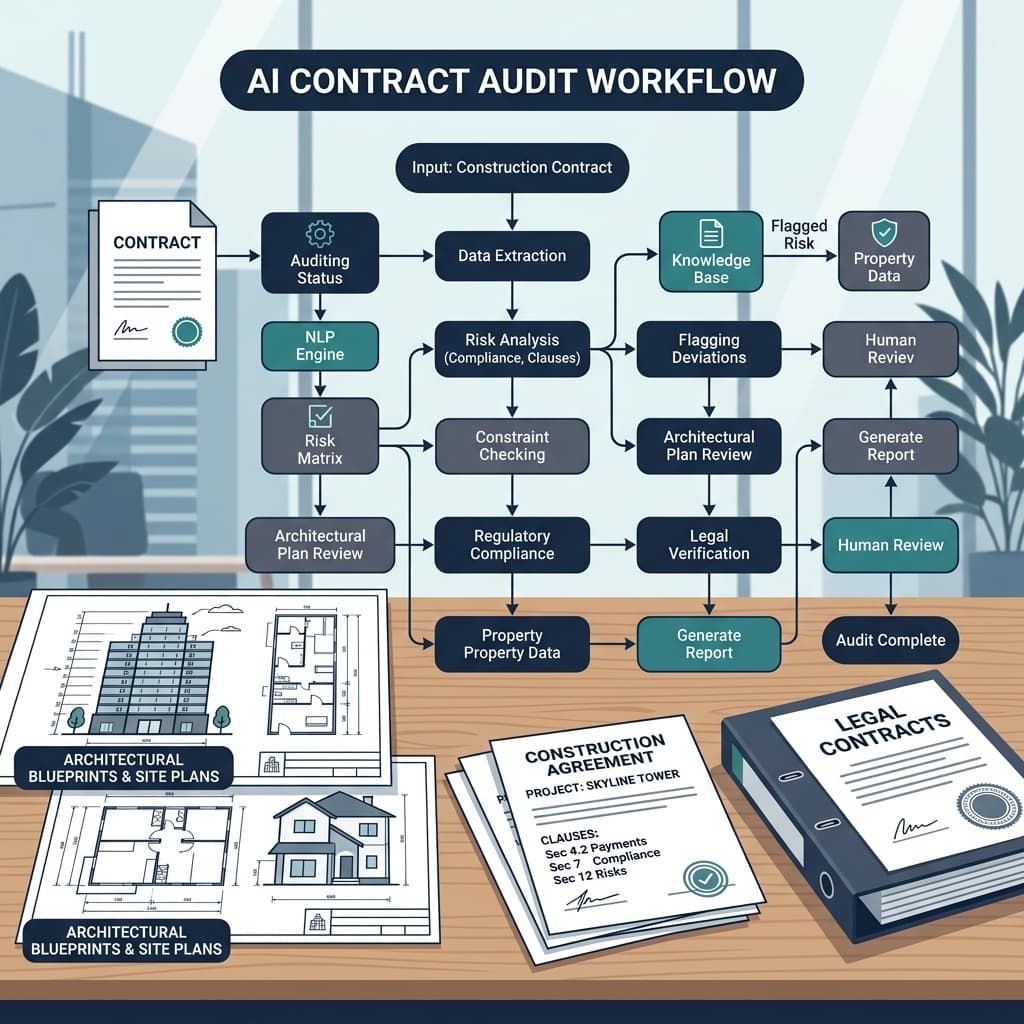
For complex workflows involving competing priorities—such as commercial credit underwriting, legal contract auditing, or financial reconciliation—organizations deploy multi-agent swarms. In this architecture, an orchestrator agent delegates discrete subtasks to specialized worker agents (e.g., a Document Extractor, a Compliance Validator, a Fraud Detector, and a Report Synthesizer). The team works collaboratively under strict stateful supervision.
Learn how to scale multi-agent swarms with our Multi-Agent Systems methodology.
3. Autonomous Lead Qualification & Pipeline Enrichment
Sales development representatives often spend 60% of their working hours copying data between LinkedIn, Apollo, and Salesforce. An autonomous outbound agent monitors inbound demo requests, enriches lead profiles with company headcount and funding histories, drafts personalized outreach strategies based on current news triggers, and routes hot opportunities directly to executive calendars.
From Predictive Text to Autonomous Decision Engines: Evaluating Reliability
The leap from predictive text generators to autonomous cognitive systems introduces substantial enterprise responsibility. If a language model writes an awkward email, the reputational cost is minor. If an autonomous agent erroneously triggers an unapproved refund or overwrites a database record, the business impact is severe.
Achieving enterprise-grade reliability requires moving beyond stochastic prompt engineering into rigorous systems design:
┌────────────────────────────────────────────────────────┐
│               ENTERPRISE RELIABILITY STACK             │
├────────────────────────────────────────────────────────┤
│  1. Deterministic JSON Schemas (Pydantic Validation)   │
│  2. Strict Role-Based API Scopes & Financial Caps      │
│  3. Human-in-the-Loop (HITL) Confidence Gateways       │
│  4. Comprehensive Observability & Step-Level Tracing   │
└────────────────────────────────────────────────────────┘- Deterministic Validation (Pydantic & JSON Schemas): An autonomous agent must never pass free-form natural language strings into external databases or API endpoints. Every tool argument must be parsed through strict, deterministic schemas with automated retry loops if validation fails.
- Programmatic Guardrails: Hard business rules must be enforced in code, not left to model discretion. An agent should operate under immutable parameters—such as transaction dollar limits, maximum discount allowances, and restricted data access zones.
- Human-in-the-Loop (HITL) Escalation: Complete autonomy is a spectrum, not an all-or-nothing switch. Mission-critical systems utilize confidence score routing. When an agent's confidence in an edge-case transaction falls below 95%, or when an action involves sensitive legal commitments, the system pauses execution and routes an approval ticket to a human manager via Slack or Teams.
- End-to-End Tracing & Observability: Every reasoning step, intermediate thought, and external tool interaction must be captured with telemetry frameworks like OpenTelemetry or LangSmith, providing complete auditability for regulatory compliance.
To calculate the exact infrastructure, licensing, and implementation investment required to deploy robust decision engines within your stack, use our interactive AI Pricing Calculator.
Frequently Asked Questions
AI Agents vs Chatbots: What Is the Real Difference?
When asking what are AI agents compared to conversational bots, the fundamental difference is agency and action. A chatbot is a conversational interface designed to talk, answer questions, and generate text based on user input. An AI agent is a goal-oriented software system designed to act: it reasons through multi-step objectives, plans execution paths, and calls external software tools (APIs, databases, CRMs) to modify system states without continuous human prompting.
How Do AI Agents Work Across Their Four Core Components?
The four structural pillars of an AI agent are:
- Perception Layer: Ingests and standardizes inputs from user prompts, webhooks, audio, and API payloads.
- Dual Memory: Combines short-term working context with long-term vector/database retrieval.
- Reasoning & Planning Engine: Deconstructs complex goals and executes iterative reasoning loops (e.g., ReAct).
- Tool Execution Engine: Interacts with external systems via APIs, SQL databases, and code execution environments.
Can an AI agent take actions in external software?
Yes. Modern agents utilize function calling and API integration standards (such as Anthropic's Model Context Protocol) to interact directly with third-party software. They can update CRM records in Salesforce, book calendar slots in Google Calendar, process transactions via Stripe, and run custom database queries securely.
Are AI agents fully autonomous or do they require human oversight?
Enterprise AI agents operate on a controlled spectrum of autonomy. Routine, deterministic tasks execute autonomously under hard programmatic guardrails. For high-stakes operations (such as wire transfers, legal contract approvals, or medical evaluations), agents utilize Human-in-the-Loop (HITL) checkpoints, pausing execution to request human approval whenever confidence falls below a defined threshold.
How do businesses calculate the ROI of an AI agent?
ROI is calculated by measuring direct labor hours saved on repetitive data entry, reduction in transaction turnaround times (e.g., reducing loan approval cycles from days to minutes), revenue captured through 24/7 instantaneous lead response, and error rate reductions compared to manual processes.
Author Note & Engineering Review
Muhammad Asim, Founder and Lead AI Architect at Axontick.
Muhammad specializes in enterprise multi-agent systems, deterministic LLM orchestration, and sub-second voice telephony pipelines. Axontick designs and deploys custom autonomous agent networks for scaling enterprises.
Last Updated: October 5, 2026. Reviewed for architectural accuracy against current LangGraph, Anthropic MCP, and OpenAI Function Calling specifications.
Conclusion: Moving Your Organization from Dialogue to Autonomous Action
The transition from passive chatbots to autonomous digital workers represents the most significant software shift since the migration from on-premise servers to cloud infrastructure. Organizations that rely solely on conversational wrappers will find themselves outpaced by competitors deploying coordinated agentic networks capable of executing operations at computational speed.
Now that enterprises recognize what are AI agents and how they fundamentally reshape operational velocity, the competitive imperative is clear. Whether your immediate operational bottleneck is triage of high-volume customer inquiries, continuous financial data reconciliation, or autonomous sales pipeline acceleration, the starting point is systems architecture, not prompt tinkering.
Ready to architect your first autonomous agent?
Explore estimated development, hosting, and API costs using our transparent AI Pricing Calculator, review our battle-tested 4-Step Engineering Delivery Process, or schedule an architecture review with our systems team today.

Muhammad Asim
Founder @ Axontick
Founder of Axontick, specialized in AI automation, Multi-Agent Systems, and enterprise-grade voice agents. Expert in bridging the gap between complex AI technology and practical business solutions.