
A clear guide to how automated safety boundaries and real-time validation keep autonomous AI systems safe, helpful, and dependable.
What are AI guardrails? Put simply, these are the programmatic checkpoints and deterministic boundary controls built around an artificial intelligence system. Think of them like highway guardrails or automatic car brakes. They do not steer the vehicle, but they guarantee that even if a driver steers too hard, the car will not go over the cliff.
In business, prompts are just polite suggestions. Models easily get confused by tricky inputs or edge cases. Guardrails place firm software rules around the AI—stopping dangerous inputs before they reach the model, and blocking bad answers before they reach customers.
The Physical World Analogy: What Avionics Fly-by-Wire Teaches Us About Guardrails
To see why prompt instructions fall short in production, look at modern commercial airliners. In an Airbus A350, the pilot's sidestick does not pull physical cables to the wings. It sends an electrical intent signal to flight computers.
If severe turbulence strikes and a startled pilot yanks full backstick, the computer overrides the command. It limits climb angles and prevents aerodynamic stalls—a safety system called flight envelope protection.
Aviation engineers build this safety net across three checkpoints that directly mirror modern enterprise guardrail systems:
Multiple airspeed sensors cross-check readings. If one freezes, the system ignores it. In AI, input checks do the same with user messages.
The plane refuses to bank past 67 degrees no matter the stick force. In AI, runtime checks block unauthorized refunds or database edits.
Hydraulic dampers physically slow extreme rudder shifts to protect the airframe. In AI, output filters catch bad responses before egress.
In autonomous systems, the model acts like that pilot—creative, yet prone to mistakes under pressure. What are AI guardrails in practice? They are the flight envelope keeping software from crashing.
The 2026 Threat Landscape: Why Safety Boundaries Are Urgent
Why are security teams prioritizing guardrails today? In October 2026, the Google Cloud Threat Intelligence Group (GTIG) published research analyzing the shifting AI agent threat landscape.
Monthly vulnerability disclosures doubled across 2026, jumping 107.7% from 5,045 in January 2026 to 10,477 in July, and reaching 10,740 in August. High-Risk flaws surged 167% from 131 to 350 monthly disclosures across the AI agent threat landscape.
Autonomous Tools Target System Takeovers
GTIG revealed that 50% of vulnerabilities found by AI tools cause Remote Code Execution (RCE), versus 26% from traditional tools. Automated scanners hunt directly for keys that take over servers.
Simultaneously, the AI stack is targeted. GTIG recorded over 1,500 vulnerabilities hitting AI software in 2026. Roughly 50% of those flaws (782 CVEs) struck agent orchestration frameworks connecting AI to databases. Without guardrails, attackers trick agents into running unauthorized code or leaking records.
The Three Structural Pillars: Data, Intelligence, and Runtime Protection
A dependable AI safety architecture relies on three practical defense layers:
1. Data Guardrails: Protecting Your Information
Information TierData guardrails act like digital security guards. Before text reaches the model, automated filters strip credit cards, passwords, and PII. In RAG setups, they verify the user has clearance to access retrieved company files.
2. Model Guardrails: Guiding the AI's Brain
Intelligence TierModel guardrails keep thinking on track. Instead of hoping a large model behaves, engineers place a tiny, fast safety filter in front of it. In under 20ms, it catches jailbreaks and blocks off-topic prompts before the main model runs.
3. Infrastructure Guardrails: Enforcing Zero-Trust Execution
Runtime TierEven if an agent runs a bad script, infrastructure guardrails prevent damage. Automated tools run in isolated sandboxes with strict network rules and spend caps, ensuring runaway loops cannot inflate cloud bills.
The Three Operational Checkpoints: Input, Runtime, and Output
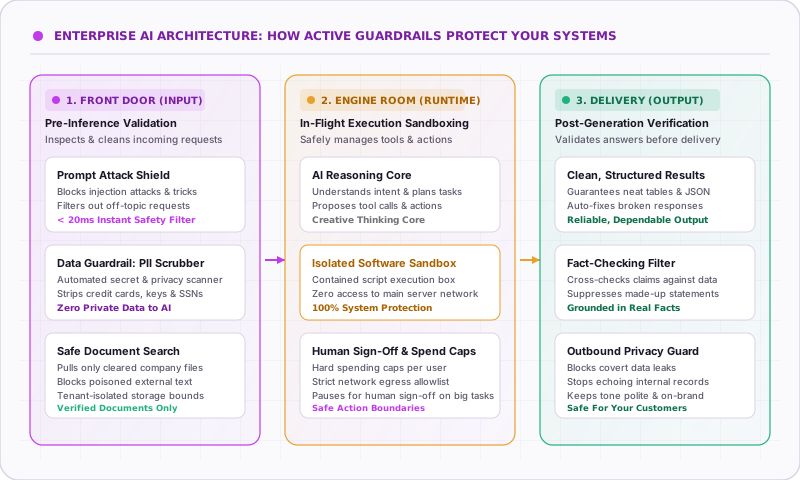
When orchestrating multi-agent systems, the complete AI safety architecture inspects work in three simple stages:
- 1. At the Front Door (Input Checkpoint): Scans user messages for attacks, strips sensitive data, and confirms the request is relevant before routing it forward.
- 2. In the Engine Room (Runtime Checkpoint): Monitors the agent as it queries databases or APIs. If it attempts large transactions or file deletions, it halts and requests human sign-off.
- 3. At the Delivery Counter (Output Checkpoint): Executes rigorous LLM output validation. It ensures answers are factually grounded, formats clean tables or JSON, and prevents private data from leaking out.
Comparing the Two Approaches: System Prompts vs. Guardrails
To see why growing enterprises are moving past simple prompt engineering, here is a quick side-by-side comparison:
| Evaluation Vector | System Prompt Instructions | Programmatic Guardrails |
|---|---|---|
| Enforcement Nature | Probabilistic (Model chooses whether to follow rules) | Deterministic (Hard software rules and safety switches) |
| Adversarial Resistance | Weak (Can be tricked with clever prompt injections) | Strong (Stops bad requests before the AI ever sees them) |
| Execution Safety | Zero protection against insecure script execution | 100% containment in isolated software sandboxes |
| Output Reliability | Varies from day to day with unpredictable phrasing | Guaranteed type-safe JSON schema enforcement |
Building Safe, Reliable AI Systems with Axontick
When testing a chatbot for fun, a basic system prompt is fine. But when AI handles customer orders, looks up accounts, or updates CRMs, "hoping for the best" is not a strategy. Understanding what are AI guardrails and applying them across data, models, and servers is what turns experiments into dependable software you can trust with your brand.
At Axontick, we build autonomous AI systems with built-in safety from day one—combining sub-second guard filters, sandboxed tools, and strict LLM output validation. Explore our enterprise implementation process or reach out to our team to audit your autonomous AI workflows.
Want this deployed for your enterprise?
Axontick engineers architect, benchmark, and deploy custom enterprise autonomous systems with guaranteed uptime, sub-second latency, and 100% IP ownership.

Muhammad Asim
Founder @ AxontickFounder of Axontick, specialized in AI automation, Multi-Agent Systems, and enterprise-grade voice agents. Expert in bridging the gap between complex AI technology and practical business solutions.