
An architectural blueprint for eliminating single-vendor dependencies, handling rate throttling, and deploying sub-second model failovers for enterprise agent systems.
Deploying an enterprise multi provider LLM architecture eliminates third-party AI outages, API rate limits, and vendor lock-in. When autonomous customer agents rely on a single foundation model, upstream downtime halts operations immediately. Resilient engineering requires abstracting model access through an intelligent reverse proxy gateway that automates capability-tiered failover, token-bucket queuing, and schema normalization.
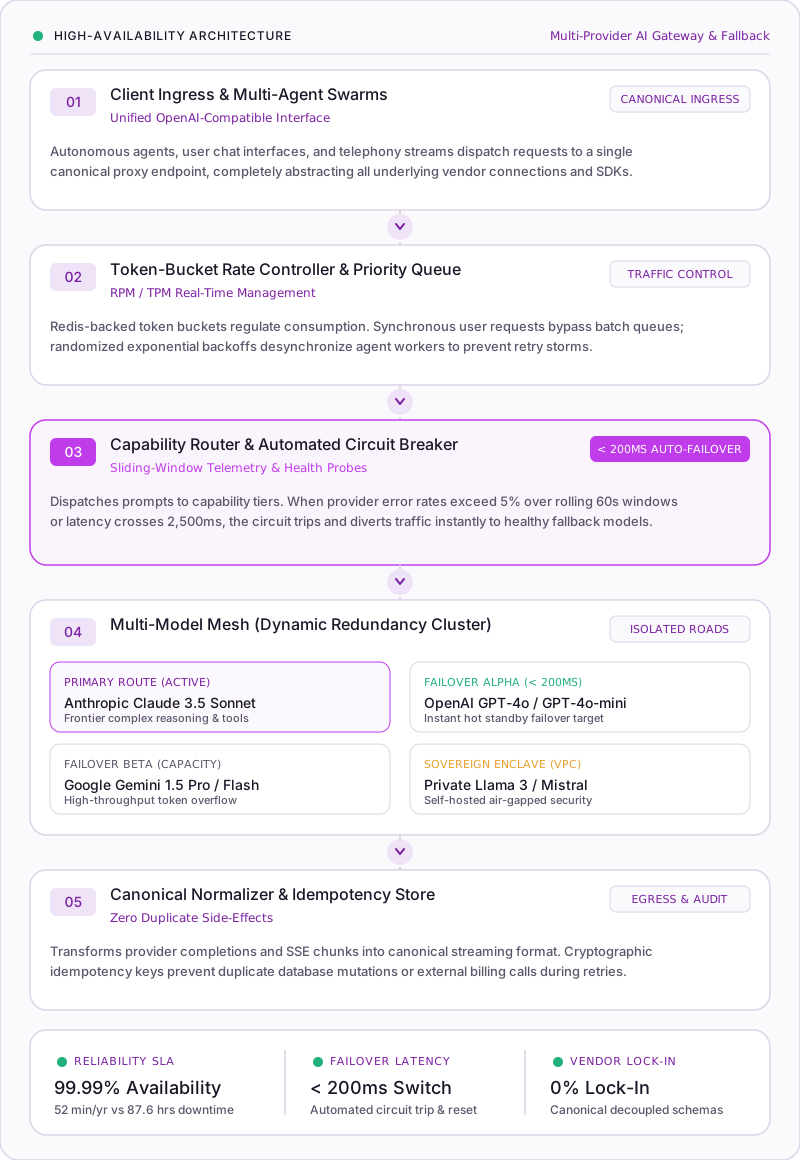
The Single-Provider Trap: Why Enterprise Agents Face Unplanned Downtime
Binding business agents directly to a single foundation model endpoint creates severe operational vulnerability. Commercial AI APIs operate with lower availability than enterprise cloud databases.
Standard SLAs from foundation model vendors guarantee 99.0% to 99.9% monthly uptime. Over a year, a 99.0% SLA permits up to 87.6 hours of cumulative downtime, while 99.9% allows nearly 8.8 hours of blackouts.
Furthermore, teams frequently face "soft downtime." During regional GPU congestion, providers throttle throughput, inflating Time-to-First-Token (TTFT) from 400ms to over 6 seconds. Per Gartner Research on API Management & Generative AI, 70% of teams building multi-model applications will deploy AI gateways by 2028.
Handling LLM Rate Limits: Preventing 429 Failures in Agent Swarms
Autonomous agent workflows accelerate token consumption. While a human generates a single prompt, a multi-agent swarm executing research and validation generates 12 to 35 API calls per task. Without traffic management, these surges trigger HTTP 429 Too Many Requests errors.
Successfully handling LLM rate limits requires moving beyond naive retries. High-throughput architectures implement a three-tier control plane for handling LLM rate limits:
Redis token-bucket algorithms track RPM and TPM limits in real time.
Synchronous customer requests bypass batch jobs queuing behind rate ceilings.
Randomized exponential backoffs desynchronize concurrent agent retries across workers.
This preserves application stability, ensuring production agents absorb traffic spikes without dropping transactions.
Mathematical Model of Compound Multi-Provider Availability
Deploying independent model providers in parallel fundamentally elevates system reliability. When routing requests across two isolated provider infrastructures with multi model redundancy, system unreliability becomes the product of individual failure probabilities.
Where Aprimary is primary provider availability (0.99 for 99.0% SLA), and Afallback is secondary availability (0.99 for 99.0% SLA).
The joint failure probability drops from 1.0% (0.01) to 0.01% (0.01 × 0.01 = 0.0001). This elevates platform availability to 99.99%, cutting annual downtime from 87.6 hours to approximately 52 minutes.
Achieving this establishes genuine multi model redundancy, ensuring workflows stay operational during provider outages.
Intelligent LLM Fallback Routing: Capability Tiers & Circuit Breakers
Hardcoding static fallback pairs creates brittle systems. Production gateways implement capability-tiered LLM fallback routing, dispatching prompts across standardized functional tiers:
1. Frontier Reasoning Tier: Routes strategic analysis between Claude 3.5 Sonnet, GPT-4o, and Gemini 1.5 Pro.
2. High-Throughput Balanced Tier: Routes extraction and classification between Claude 3.5 Haiku, GPT-4o-mini, and Gemini 1.5 Flash.
3. Sovereign Open-Weights Tier: Directs compliance workloads to dedicated Llama or Mistral instances within private VPCs.
Automated circuit breakers monitor error rates over rolling 60-second windows. If error rates exceed 5% or latency exceeds 2,500ms, the circuit trips. The gateway executes LLM fallback routing in under 200ms, running background health probes until primary recovery.
Architectural Trade-Offs: Single-Provider vs Gateway Fallback vs Hybrid Enclave
Selecting the optimal reliability model requires balancing engineering effort, operating costs, and availability requirements:
| Architecture Model | System Availability | Failover Latency | Engineering Complexity | Vendor Dependency |
|---|---|---|---|---|
| Direct Single-Provider | 99.0% – 99.9% | Manual (Hours) | Minimal (Single SDK) | High (Total Lock-In) |
| Multi-Provider Gateway | 99.95% – 99.99% | < 200 ms Automatic | Moderate (Reverse Proxy) | None (Dynamic Routing) |
| Hybrid Cloud + Self-Hosted | 99.99% – 99.999% | < 150 ms Automatic | High (VPC & GPU Ops) | Zero (Full Sovereignty) |
For most enterprise organizations, an automated routing gateway delivers optimal resilience without requiring dedicated GPU infrastructure management.
Preventing AI Vendor Lock In: Standardized Unified Schemas
Beyond network outages, commercial risk stems from vendor dependence. When codebases integrate vendor-specific parameters and function wrappers, migrating models requires costly refactoring. Crucially, preventing AI vendor lock in requires decoupling prompt contracts from infrastructure.
Engineering standards for preventing AI vendor lock in center on three implementation rules:
1. OpenAI-Compatible Ingress: Standardize request payloads across microservices, enabling gateways to route traffic across providers transparently.
2. Decoupled Tool Schemas: Define agent tools via JSON Schema, which the gateway maps to provider-native wrappers in flight.
3. Idempotency Locks: Attach unique idempotency keys to tool calls, preventing duplicate financial transactions or webhook triggers during retries.
Standardizing schemas preserves commercial leverage, letting enterprises switch models as pricing evolves.
FAQ: Multi-Provider LLM Architecture & Resiliency
What is an enterprise multi-provider LLM gateway?
A reverse proxy between applications and foundation models that unifies authentication, dynamic failover, rate throttling, and security guardrails through a single API endpoint.
How does dynamic fallback handle differing model prompt syntax?
The gateway normalizes system prompts and tool schemas into canonical structures, transforming parameters into vendor-specific wire protocols in flight.
What latency does a multi-provider proxy add to requests?
High-efficiency reverse proxies add negligible latency (15–35ms), easily offset by avoiding multi-second congestion spikes and vendor downtime.
Architecting Resilient Multi-Provider AI with Axontick
Enterprise operations cannot tolerate AI downtime. Architecting an intelligent multi provider LLM architecture transforms fragile single-vendor prototypes into bulletproof resilient AI systems capable of continuous uptime.
At Axontick, we build hardened resilient AI systems for production. Through our advanced multi-agent systems engineering and proven 4-step implementation methodology, we integrate capability-tiered routing, token-bucket throttling, and automated failover into your stack.
Deploying a robust multi provider LLM architecture gives your business guaranteed uptime, predictable costs, and complete vendor independence. Calculate deployment costs with our AI Pricing Calculator, or contact our systems architecture team to design a zero-downtime roadmap.
Want this deployed for your enterprise?
Axontick engineers architect, benchmark, and deploy custom enterprise autonomous systems with guaranteed uptime, sub-second latency, and 100% IP ownership.

Muhammad Asim
Founder @ AxontickFounder of Axontick, specialized in AI automation, Multi-Agent Systems, and enterprise-grade voice agents. Expert in bridging the gap between complex AI technology and practical business solutions.