
An engineering blueprint for eliminating intellectual property leaks, replacing futile bans, and governing enterprise AI through sanctioned multi-agent gateways.
Shadow AI enterprise risk is the operational and legal liability created when staff paste proprietary data into unauthorized consumer artificial intelligence tools without IT oversight or enterprise data processing agreements. When engineers paste private code into free browser chatbots, or managers upload financials into unvetted summarizers, corporate secrets enter public training corpuses. Mitigating this risk requires replacing blanket firewall bans with a centralized, audited system that pairs employee productivity with automated data scrubbing and zero-retention privacy guarantees.
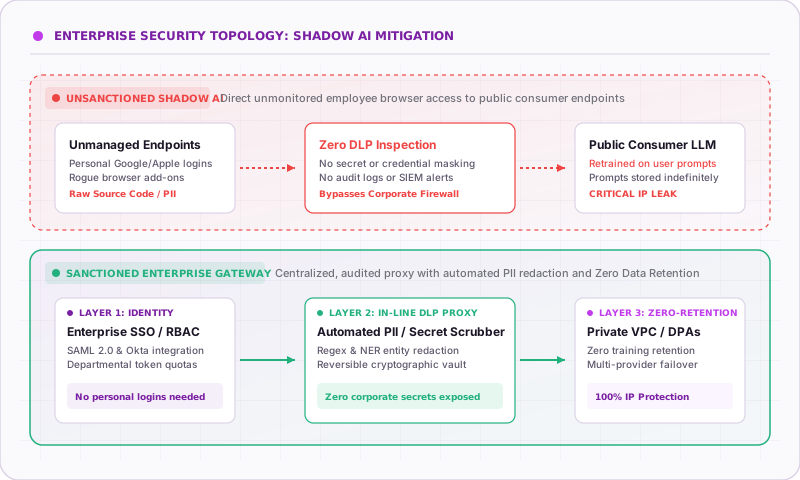
The Shadow AI Reality: Why Prohibition Fails in Enterprise Environments
Enterprises cannot eliminate shadow AI through threats or firewall domain blocks. According to Gartner research on enterprise governance, 69% of organizations suspect or confirm that staff actively use prohibited public Generative AI tools. Furthermore, Gartner forecasts that at least 40% of enterprises will experience a direct security incident caused by unsanctioned artificial intelligence.
When security teams issue blanket bans without alternatives, employees under delivery pressure do not stop. They simply migrate workflows to personal phones and unmanaged laptops. Telemetry from Cyberhaven Labs reveals that 83.8% of enterprise data routed to AI applications enters tools classified as high or critical security risk. Moreover, over 58% of Claude and 61% of Perplexity interactions in businesses occur via personal logins rather than enterprise contracts. Organizations failing to tackle shadow AI enterprise risk leave their core intellectual property unprotected.
Banning AI blinds monitoring while driving proprietary data underground. Resolving this issue requires a pragmatic strategy for managing employee AI tools through structured access rather than futile bans.
Anatomy of Shadow AI Enterprise Risk: Leaks, Training, and Rogue Add-Ons
Enterprise data leaks bypass perimeter defenses through three primary vectors:
Consumer tools use submitted prompts to train future models. Pasting code or strategy documents triggers an irreversible shadow AI data leak extractable via prompt probing.
Unvetted browser add-ons promising automated meeting notes request broad OAuth scopes, reading internal dashboards and CRM records to exfiltrate trade secrets.
Unvetted tools processing web content or supplier files ingest malicious prompts that hijack downstream autonomous agent workflows and pollute databases.
Cyberhaven's forensic audits show that 34.8% of workplace AI prompts contain sensitive corporate data, including source code and customer records. Without cryptographic boundaries, preventing unvetted AI tools from siphoning company IP is impossible.
Mathematical Formulation of the Shadow AI Vulnerability Index
To help leadership quantify exposure across operational units, Axontick formalizes organizational vulnerability through the Shadow AI Vulnerability Index:
In this formulation:
Viis monthly prompt volume sent to unvetted appi.Siis data sensitivity weight (0.1for public text to1.0for source code and PII).Tiis vendor training index (1.0for consumer tiers;0.0for zero-retention pipes).Ggatewayis the governance factor (0.0for unmonitored networks to1.0for a verified sanctioned enterprise AI gateway).
When Ggateway reaches 1.0, corporate exposure drops to zero regardless of volume.
Architectural Comparison: Unsanctioned Endpoints vs. Sanctioned AI Infrastructure
The technical contrast between unmanaged consumer apps and governed infrastructure separates security liabilities from operational advantage:
| Security Dimension | Unsanctioned Consumer AI | Sanctioned Enterprise AI Gateway |
|---|---|---|
| Data Retention & Training | Prompts train vendor models | Zero Data Retention (ZDR) via DPAs |
| In-Line Data Scrubbing | None; full PII exposed | Automated regex & NER scrubbing |
| Authentication & RBAC | Personal logins and cards | SSO, SAML 2.0, token vault limits |
| Telemetry & Auditing | Invisible to SIEM | Tamper-evident logs & live alerts |
Replacing Prohibition with Governed Enterprise Architecture
Transitioning from risk exposure to verified governance requires executing four infrastructure steps:
1. Deploying an Internal Proxy Gateway: All employee AI requests route through an internal proxy managing API keys centrally, eliminating personal accounts.
2. Automating Real-Time PII Redaction: In-line inspection filters outbound text for secrets and customer data, replacing them with reversible tokens prior to model submission.
3. Enforcing Zero-Data Retention DPAs: Contracts guarantee model vendors never persist or train on organization prompts, meeting strict privacy policy commitments.
4. Publishing an Actionable Governance Policy: Replace legal manuals with a clear corporate AI security policy that outlines data classifications and provides an expedited framework for managing employee AI tools.
By providing responsive internal tools, organizations eliminate employee incentives to bypass security, effectively solving the challenge of preventing unvetted AI tools.
FAQ: Eliminating Shadow AI in the Enterprise
What is the primary cause of shadow AI across enterprises?
The primary driver is delivery pressure combined with slow software procurement. When teams discover that AI tools save hours each week, they adopt consumer apps immediately if the enterprise fails to provide comparable alternatives.
Does a corporate AI security policy actually stop unvetted AI usage?
A written policy is ineffective without automated technical controls. Rules without internal alternatives merely push employees onto unmonitored personal devices, creating an unobservable shadow AI data leak.
How does structured governance preserve team velocity?
A dedicated proxy operates with sub-50ms latency, offering single-sign-on access to frontier models while automating compliance checks silently in the background.
Neutralize Shadow AI Enterprise Risk with Axontick
Treating generative artificial intelligence as contraband creates severe blind spots. High-performing organizations do not restrict compute—they establish secure, governed environments that accelerate productivity while safeguarding core intellectual property.
At Axontick, we build production-grade enterprise gateways, in-line DLP scrubbing pipelines, and private multi-agent architectures that satisfy rigorous compliance standards. Discover our implementation sprints via our interactive pricing calculator, or consult our engineering team to audit your AI architecture today.
Want this deployed for your enterprise?
Axontick engineers architect, benchmark, and deploy custom enterprise autonomous systems with guaranteed uptime, sub-second latency, and 100% IP ownership.

Muhammad Asim
Founder @ AxontickFounder of Axontick, specialized in AI automation, Multi-Agent Systems, and enterprise-grade voice agents. Expert in bridging the gap between complex AI technology and practical business solutions.