
Testing a basic chatbot is simple: you ask a question and check if the reply sounds helpful. But when deploying autonomous agents to schedule appointments, reconcile invoices, or update customer records, surface text checks break down. Learning how to evaluate AI agents requires shifting attention from isolated sentences to complete workflows. An agent might deliver the right answer, but if it ran six redundant queries, burned budget, and risked editing the wrong record, that agent is a business liability.
Autonomous agents do far more than generate text. They plan action steps, select tools, handle system errors, and execute workflows. Mastering how to evaluate AI agents means measuring both the final outcome and the step-by-step path the software took to get there.
Beyond the Chatbox: Why You Must Grade the Journey, Not Just the Destination
Traditional software features succeed or fail predictably. In contrast, AI agents operate probabilistically. Benchmark research by Anthropic and DeepEval reveals that over 65% of agent failures occur during intermediate reasoning steps—such as picking the wrong tool or passing bad parameters—rather than in final text formatting.
This reality makes trajectory evaluation AI essential. An agent's trajectory is the complete chronological sequence of its thoughts, tool choices, database calls, and observations. Understanding trajectory evaluation AI helps engineering teams catch flawed logic early.
Consider an everyday business example where a customer asks an agent to update a delivery address:
Verifies identity, calls the address-update API once with valid data, confirms database update, and alerts the customer.
Queries customer records three times, attempts writing to an archived row, catches an API error, retries, and finishes after 12 wasted calls.
Both agents produced the same final confirmation. However, Agent B is slow, expensive, and fragile. Rigorous AI agent benchmarking uncovers these hidden faults before deployment. Continuous AI agent benchmarking ensures reliable performance under load.
The 4-Layer Testing Matrix: 12 AI Agent Evaluation Metrics
To evaluate autonomous systems thoroughly, modern engineering teams track twelve core AI agent evaluation metrics across four operational layers. Adopting standardized AI agent evaluation metrics establishes clear quality baselines.
| Tier | Metric Name | What It Actually Means | Target |
|---|---|---|---|
| 1. Outcome | Task Success Rate (Pass@1) | Share of jobs completed correctly on first attempt without human takeover. | ≥ 92% |
| Constraint Adherence | Whether outcomes strictly respected user rules (e.g. price caps, dates). | 100% | |
| Containment Rate | Requests resolved completely by AI without escalating to human staff. | 75%–88% | |
| 2. Trajectory | Tool Selection Accuracy | Calling the right API while avoiding superfluous or incorrect tools. | ≥ 96% |
| Argument Validity | Supplying valid parameters to tools rather than hallucinated values. | ≥ 98% | |
| Step Efficiency | Ratio of ideal steps to executed actions; penalizes circular logic. | ≥ 85% | |
| Error Recovery Rate | Diagnosing API failures, adjusting inputs, and retrying safely. | ≥ 80% | |
| 3. Operational | Time to First Action (TTFA) | Elapsed seconds before initial response or tool trigger. | < 1.5s |
| End-to-End Latency | Total duration needed to conclude the full autonomous workflow. | < 8.0s | |
| Cost Per Resolved Task | Summed token and API compute expense per completed ticket. | < $0.08 | |
| 4. Safety | Faithfulness & Grounding | Assertions backed 100% by true records rather than speculation. | 100% |
| Guardrail Adherence | Resistance to prompt injections and unauthorized data leakage. | 100% |
(3 / 6) × 100 = 50%.
Using LLM-as-a-Judge: Rubrics, Pairwise Grading, and Taming Bias
Manual review cannot scale to thousands of daily interactions. Modern teams rely on LLM as a judge for agents, using a powerful model to grade reasoning steps and outputs. Effective LLM as a judge for agents setups score multi-turn traces automatically.
In benchmark research from UC Berkeley and LMSYS (Zheng et al., NeurIPS 2023), frontier models acting as judges achieved an 85% agreement rate with human expert reviewers when given structured rubrics. Crucially, human reviewers only agreed with one another 81%–82% of the time, proving automated judges perform at human consistency levels.
However, automated judges display three systematic biases that must be managed:
Judges favor the first answer. Fix: Run pairwise tests twice with flipped positions (A vs. B and B vs. A), dropping inconsistent verdicts.
Judges prefer longer answers even when padded. Fix: Explicitly penalize unnecessary text in the rubric and reward brevity.
Models favor outputs from their own family. Fix: Use independent judge models or strip model names from prompts.
Building a Production Eval Suite: From Golden Sets to Automated CI/CD
To deploy agents with confidence, enterprise teams implement an automated AI eval test suite inside continuous integration pipelines. A robust AI eval test suite prevents regressions whenever prompts or tools change.
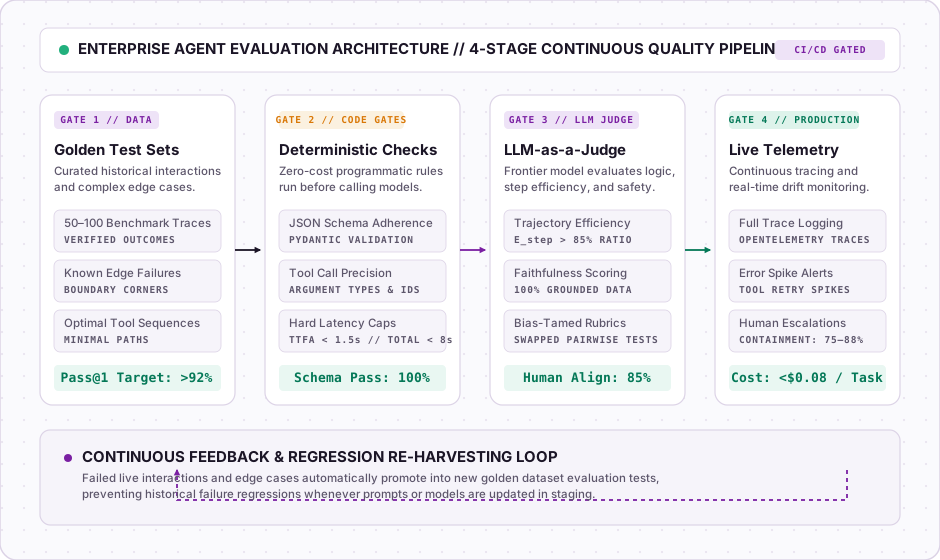
A production-ready evaluation pipeline runs across four practical gates:
Deploying Tested, Reliable AI Agents with Axontick
Understanding how to evaluate AI agents is not a one-time launch task; it is an ongoing engineering discipline. Monitoring trajectory accuracy, step efficiency, and containment rates ensures your systems stay fast, economical, and trustworthy as operations scale.
At Axontick, we build custom autonomous agent swarms equipped with automated evaluation pipelines, complete trajectory tracing, and strict safety guardrails. Explore our proven agent deployment process, model your efficiency gains with our interactive pricing calculator, or review our enterprise multi-agent systems solutions to see how verified automation drives bottom-line growth.
Want this deployed for your enterprise?
Axontick engineers architect, benchmark, and deploy custom enterprise autonomous systems with guaranteed uptime, sub-second latency, and 100% IP ownership.

Muhammad Asim
Founder @ AxontickFounder of Axontick, specialized in AI automation, Multi-Agent Systems, and enterprise-grade voice agents. Expert in bridging the gap between complex AI technology and practical business solutions.