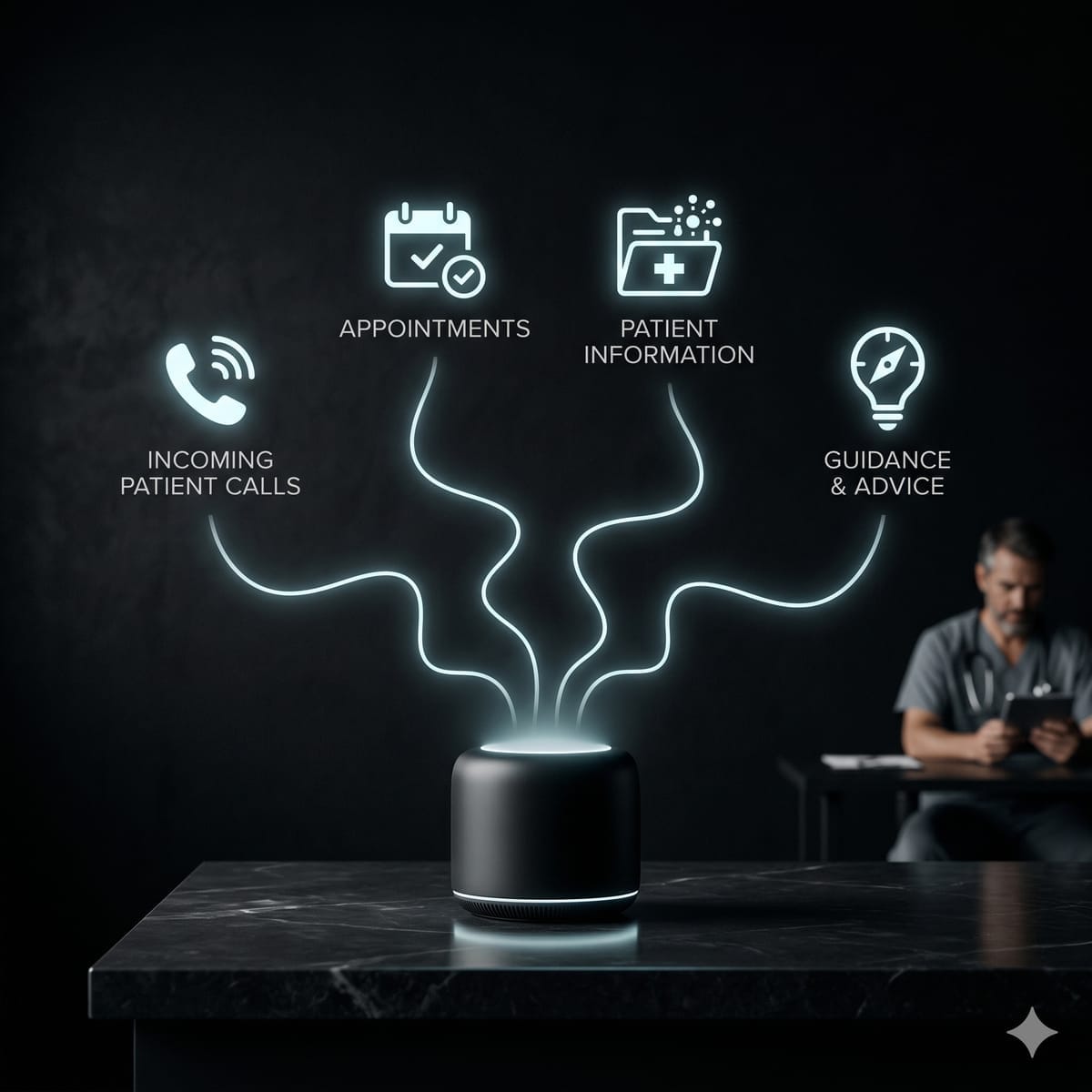
A plain-English guide to making your AI agents safe, legal, and ready for security audits—using clear activity logs, strict access limits, and zero-memory AI agreements.
Most companies build an AI agent first and worry about legal rules later. That mistake can freeze a launch overnight or trigger heavy fines.
Normal software follows fixed steps. AI agents read emails, look up files, make decisions, and trigger actions in your business tools. Because they act on their own, security auditors and privacy regulators watch them closely.
Getting AI regulatory compliance enterprise standards right does not require a law degree. It comes down to four habits: never letting public AI models train on private data, giving each agent only the access it needs, saving a clear record of every action, and signing privacy contracts with your AI providers.
Navigating the EU AI Act, SOC 2 Type II, and US Privacy Frameworks
SOC 2, GDPR, HIPAA, and the EU AI Act all ask the same basic question: Can you prove your AI handles private data safely and behaves predictably?
The stakes are high. Under the EU AI Act (Regulation 2024/1689), fines reach €35 million or 7% of global annual revenue for banned AI uses, and €15 million or 3% of revenue for breaking high-risk AI transparency and oversight rules. Meanwhile, the IBM Cost of a Data Breach Report (2025) found that 97% of organizations suffering an AI security breach lacked basic access controls on their AI systems.
Here is how a practical AI regulatory compliance enterprise strategy handles each rule:
| Framework | Who It Applies To | Main Rule in Plain English | What Your AI Must Do |
|---|---|---|---|
| SOC 2 Type II | B2B software & service teams | Prove systems are locked down and monitored | Limit agent permissions and log every action |
| GDPR | Businesses serving Europe | People own their data and can ask to erase it | Never train AI on user data; delete files on request |
| HIPAA | US clinics, hospitals & health tech | Keep patient medical records private | Sign a BAA contract and turn off AI data storage |
| EU AI Act | Companies using AI in Europe | Disclose AI use and keep humans in control | Label AI chats clearly and add human approval gates |
When building SOC 2 compliant AI systems, the biggest mistake is giving an AI agent a "master key" to your whole database. An AI helper should only see the files that the employee using it is allowed to see. Strong GDPR AI governance also means that if a customer asks to delete their account (where GDPR fines hit €20 million or 4% of global turnover), you can erase their records from both your database and AI search memory with one click.
Audit Trails: Logging Every Prompt, Context Document, Tool Call, and Output
Imagine an auditor asks: "Why did your AI agent issue a $4,000 refund last Tuesday?" If your only answer is "The AI decided to," you will fail the audit.
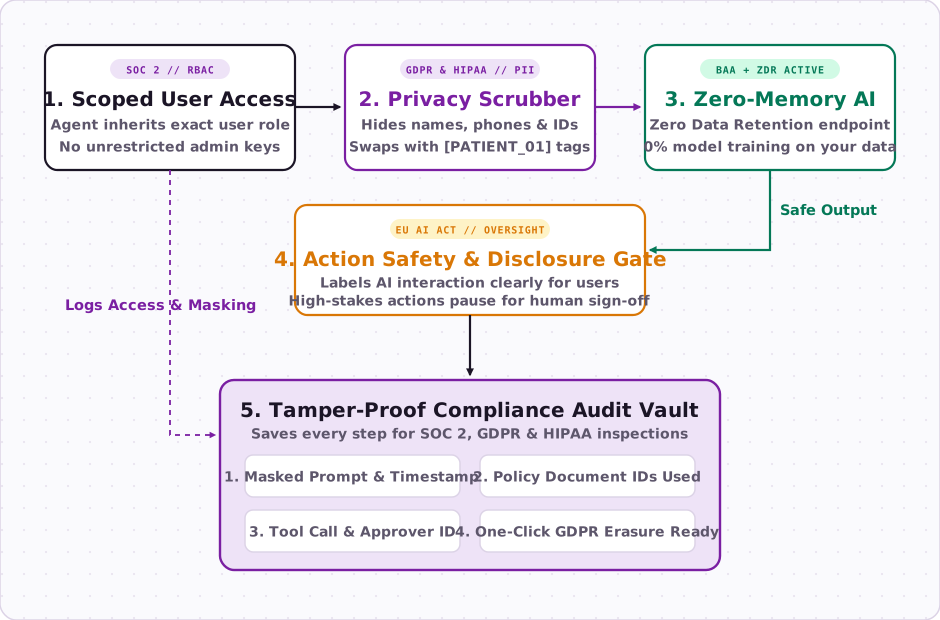
Your AI needs a "flight recorder." Every time an agent runs, your system should save a tamper-proof receipt showing four details—while hiding credit card or ID numbers:
Logs who asked, when they asked, and the prompt with names or card numbers hidden.
Saves the file IDs and policy paragraphs the AI read before deciding.
Records which tool the AI triggered, what values it sent, and who approved it.
Stores the final reply alongside the exact AI model version used.
Patient Data Security: Implementing BAA-Backed LLMs for Healthcare Clinics
Healthcare has the highest breach costs of any industry, averaging $7.42 million globally in IBM's 2025 report (after $9.77 million in 2024). Pasting patient notes into a consumer ChatGPT or Claude account violates HIPAA immediately.
Deploying HIPAA compliant AI agents requires three clear safeguards:
- Signed Business Associate Agreements (BAA): Sign a legal BAA contract with your provider—such as AWS Bedrock, Azure OpenAI, Google Vertex AI, or enterprise tiers of OpenAI and Anthropic—before processing patient data.
- Zero Data Retention (ZDR): Standard AI APIs often keep prompts for 30 days. Healthcare teams must use a zero data retention LLM connection so patient details are erased the instant the answer returns.
- Automatic Privacy Masking: Before text leaves your server, a filter swaps patient names and phone numbers with safe tags like
[PATIENT_01], as shown in our enterprise data privacy guide.
The Compliance Checklist Before Moving an Agent from Staging to Production
Never push an AI agent live until every safety switch is verified. In our launch gate formula, all four switches must equal 1 (complete)—if any item is 0, the score drops to zero:
Pair this checklist with our AI safety guardrails before launch:
Building Audit-Ready AI Systems with Axontick
Meeting AI regulatory compliance enterprise standards lets you automate high-value work without worrying about data leaks or failed audits. Whether you need SOC 2 compliant AI systems, clean GDPR AI governance, or HIPAA compliant AI agents, building these protections in from day one saves months of rework.
Explore our AI audit checklist prompts, review our privacy standards, or estimate your project with our AI Pricing Calculator.
Want this deployed for your enterprise?
Axontick engineers architect, benchmark, and deploy custom enterprise autonomous systems with guaranteed uptime, sub-second latency, and 100% IP ownership.

Muhammad Asim
Founder @ AxontickFounder of Axontick, specialized in AI automation, Multi-Agent Systems, and enterprise-grade voice agents. Expert in bridging the gap between complex AI technology and practical business solutions.