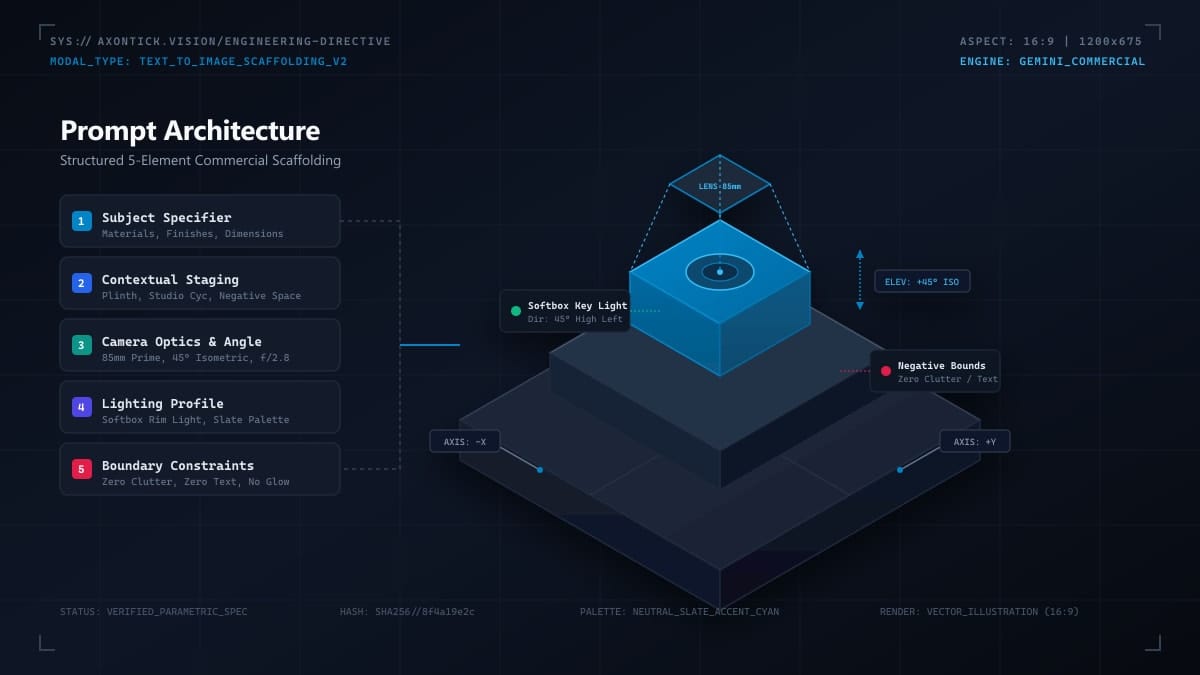
An architectural blueprint for detecting semantic decay, neutralizing upstream API updates, and maintaining production AI agents.
Managing AI model drift in production requires continuous behavioral monitoring, automated regression testing, and prompt recalibration. Unlike deterministic compiled software, foundation models decay over time from silent upstream updates and evolving user inputs. Without active observability, agents degrade in accuracy, violate schemas, and trigger downstream pipeline failures.
The Myth of "Set It and Forget It" Artificial Intelligence
Traditional software assumes deterministic stability: fixed code yields identical execution. Autonomous agents shatter this assumption. Even with frozen prompts, models exhibit pronounced LLM degradation over time.
Providers continuously deploy silent alignment passes and optimization weights behind fixed API endpoints. In landmark research from Stanford and UC Berkeley, researchers tracked commercial endpoints across three months: prime number identification in GPT-4 dropped from 84% in March to 51% in June, alongside severe formatting anomalies.
Unmonitored agent deployments invite silent failure, eroding user trust and operational gains.
Semantic Drift vs. Upstream Provider Updates
Production decay stems from two distinct operational vectors requiring separate diagnostic controls:
Providers deploy RLHF updates, altering instruction following without incrementing version identifiers.
User phrasing shifts over time, causing prompt drift as production queries diverge from baseline inputs.
Downstream APIs modify payloads or schemas, causing agents to generate invalid function arguments.
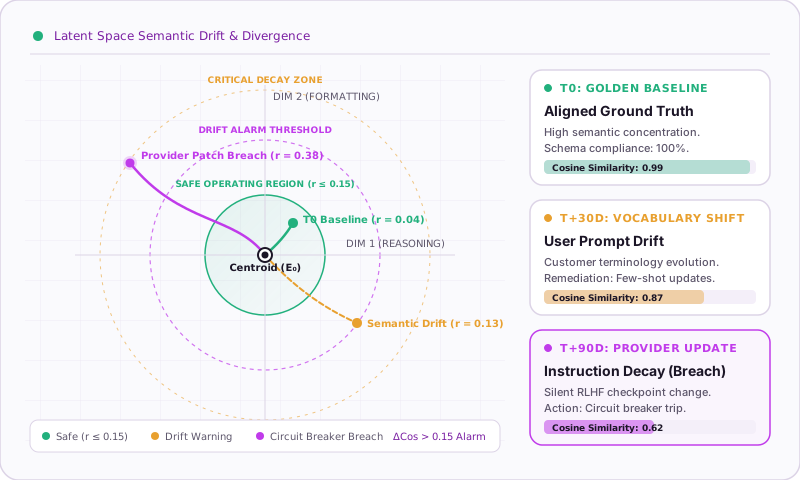
Differentiating these vectors dictates remediation. When prompt drift stems from customer phrasing, few-shot recalibration restores accuracy. When upstream provider updates degrade reasoning, prompt chains must be structurally re-architected.
Mathematical Formulation of Composite LLM Drift
Quantifying model decay requires moving beyond intuition to deterministic mathematical scoring. Production architectures compute composite drift across task accuracy, schema adherence, and semantic cosine distance.
Where ΔAcc measures accuracy decay against golden benchmarks, ΔFmt reflects schema violation changes, and Dsem represents embedding cosine distance: 1 − (Ebase ⋅ Ecurr) / (|Ebase| × |Ecurr|). Normalized weights sum to 1.0.
Consider an enterprise support agent evaluated against a 500-query golden test suite following an upstream model patch:
- Task Accuracy: Drops from 95% to 77% (
ΔAcc = 0.18, weighted atwacc = 0.50). - Schema Violations: JSON output errors rise from 0.1% to 6.1% (
ΔFmt = 0.06, weighted atwfmt = 0.30). - Semantic Distance: Latent vector cosine distance shifts by
0.25(weighted atwsem = 0.20).
Because 0.158 breaches the 0.150 tolerance threshold, the gateway automatically trips a circuit breaker, routing traffic to a frozen backup model in under 200ms. Embedding continuous AI evaluation into routing layers ensures degraded models fail over before users notice disruptions.
How Silent Output Format Changes Break Downstream Pipelines
The most dangerous drift is not an explicit crash, but subtle formatting corruption. When foundation models update, instruction-following fidelity deteriorates first.
Autonomous agents return structured JSON to microservices, ERP connectors, and payment gateways. Unannounced updates cause models to wrap JSON in backticks, omit required keys, or coerce integers to strings.
Per Gartner Research on Generative AI, multi-agent loops consume 5x to 30x more tokens than single queries, compounding syntax failures across nodes. When one worker emits malformed output, cascading errors halt the pipeline and drop transactions.
Architectural Comparison: Reactive Break-Fix vs. Continuous Drift Observability
Engineering teams must choose between firefighting unpredictable outages and establishing proactive monitoring:
| Operational Dimension | Reactive Break-Fix Approach | Continuous Observability (SLA) |
|---|---|---|
| Drift Detection | Customer complaints & production crashes | Automated nightly canary evals |
| Evaluation Baseline | Ad-hoc manual prompt checks | Versioned golden test benchmark suite |
| Mean Time to Recovery | 3 to 10 days of manual triage | < 4 hours via automated fallbacks |
| Schema Validation | Unvalidated regex & post-hoc logs | Deterministic schema guards & retries |
| Portfolio Strategy | Single-provider dependency | Multi-provider routing & redundancy |
As documented in IDC Perspectives on AI Infrastructure, managing model portfolios requires treating evaluation as an ongoing enterprise capability rather than a one-time deployment task.
The Anatomy of a Monthly SLA Retainer: Continuous Automated Benchmark Testing
Successfully maintaining production AI agents requires disciplined operational maintenance. A production SLA retainer enforces four core engineering controls:
1. Golden Test Auditing: Run nightly regression suites against 150+ standardized enterprise queries to catch degradation instantly.
2. LLM-as-a-Judge Evals: Score outputs on factuality, tone, and safety policy compliance via automated evaluator models.
3. Adversarial Stress Testing: Execute edge-case queries to test agent resilience against injections and context overflows.
4. Versioned Prompt Recalibration: Track prompts in Git with canary rollouts, enabling instant rollback when model behaviors shift.
By pairing automated testing with monthly prompt recalibration, engineering teams prevent silent LLM degradation over time and protect core production metrics.
FAQ: Managing AI Model Drift in Production
Why do deployed models degrade over time?
Model drift stems from unannounced provider updates, alignment tuning, and natural shifts in customer phrasing and input schemas.
How do automated golden datasets prevent LLM drift?
Golden datasets benchmark standard queries against ground truth, catching accuracy drops and format errors before users notice them.
Does setting temperature to zero prevent model drift?
No. Temperature zero enforces greedy token decoding, but cannot prevent behavioral shifts caused by underlying model weight modifications.
Safeguarding Production AI Reliability with Axontick
Autonomous agents deliver immense value, but unmonitored systems degrade. Architecting defenses against AI model drift in production ensures enterprise automations remain accurate and compliant.
Axontick builds resilient production systems. Through our multi-agent systems architecture and 4-step implementation methodology, we build automated canary evals, schema guards, and continuous AI evaluation into every deployment.
Stop silent drift before it impacts revenue. Plan your system with our AI Pricing Calculator, or contact our team to ensure long-term model reliability.
Want this deployed for your enterprise?
Axontick engineers architect, benchmark, and deploy custom enterprise autonomous systems with guaranteed uptime, sub-second latency, and 100% IP ownership.

Muhammad Asim
Founder @ AxontickFounder of Axontick, specialized in AI automation, Multi-Agent Systems, and enterprise-grade voice agents. Expert in bridging the gap between complex AI technology and practical business solutions.