
An architectural blueprint for decoupling model inference from raw corporate records, preventing public LLM training on proprietary IP, and enforcing Zero-Data-Retention (ZDR).
Establishing bulletproof enterprise AI data privacy requires isolating foundation model intelligence from internal databases. Pasting confidential customer records, financial ledgers, or source code into unvetted public portals creates catastrophic regulatory exposure. Securing autonomous systems demands defense-in-depth: client-side pre-ingestion tokenization, Zero-Data-Retention agreements, private cloud enclaves, and tamper-proof audit trails.
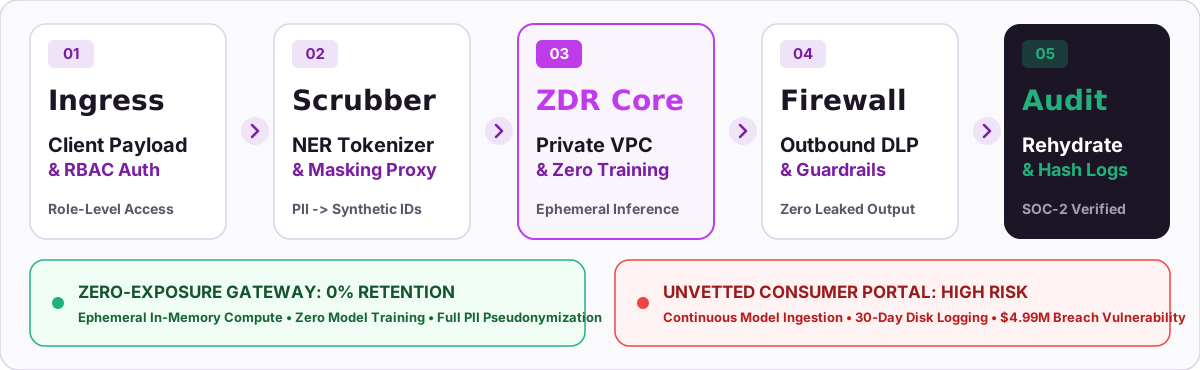
The Hidden Trap: Why Consumer AI Endpoints Threaten Enterprise IP
Consumer-grade chat interfaces harvest user prompts for continuous foundation model training. When employees enter data into standard public web portals, those inputs can be absorbed into model weights and exposed during subsequent external completions.
According to the IBM Cost of a Data Breach Report, the average data breach reached $4.99 million, with 97% of AI-related breaches occurring in enterprises lacking dedicated access controls. Furthermore, unmonitored "Shadow AI" adds $200,000 to $670,000 to breach remediation costs.
The Cisco Data Privacy Benchmark Study notes that 90% of organizations expanded privacy budgets for generative AI. Yet 23% still lack a dedicated AI governance committee. Protection requires automated perimeter gates rather than passive guidelines.
Pre-Ingestion Data Masking: The Inbound Tokenization Pipeline
Enterprises cannot rely on LLM prompts to self-censor. Protecting sensitive assets requires an intelligent AI data masking pipeline operating as an intermediary proxy between corporate systems and upstream model providers.
When prompts enter the gateway, Named Entity Recognition (NER) models scan payloads for Personally Identifiable Information (PII), medical data, and financial identifiers, applying reversible pseudonymization:
NER models detect names, tax IDs, and accounts, substituting synthetic tokens before egress.
The model reasons over tokenized structural semantics without ever observing underlying customer identities.
The gateway maps synthetic tokens back to original values inside the corporate firewall prior to delivery.
This reversible transformation is essential for preventing PII leaks LLMs would otherwise absorb, ensuring models process context without retaining proprietary records.
Mathematical Model of AI Data Exposure Risk
Enterprise exposure is governed by PII density, vendor storage persistence, and model training vulnerability:
Where:
- PPII is the density of unmasked sensitive entities in input payloads.
- Eretention is the persistence coefficient of vendor storage (1.0 for 30-day logging down to 0.0 for ephemeral sessions).
- Vtraining is the training exposure variable (1.0 if the vendor fine-tunes on inputs; 0.0 under zero-training DPAs).
Deploying an AI data masking pipeline collapses PPII toward zero, while an enterprise zero data retention LLM contract forces Eretention and Vtraining to zero, eliminating cumulative organizational exposure.
Zero-Data-Retention (ZDR) & Private AI Deployment Architectures
Securing production agents requires choosing an infrastructure topology that balances engineering velocity, operational costs, and data sovereignty.
Under a verified zero data retention LLM agreement, providers process inferences in transient memory, purging context upon response delivery.
For organizations with strict governance mandates, private AI deployment models provide isolated tenancy:
| Architecture Tier | Data Residency & Boundaries | Training Protection | Operational Overhead |
|---|---|---|---|
| Enterprise ZDR API | Multi-tenant cloud with proxy tokenization. | Zero disk retention and zero model training. | Low; pay-per-token with zero cluster maintenance. |
| Dedicated Cloud VPC | Isolated tenant (AWS Bedrock, Azure, GCP Vertex). | Network isolation with private endpoints. | Moderate; cloud VPC and IAM management. |
| Self-Hosted Weights | On-premise hardware or air-gapped bare metal. | Absolute physical sovereignty; zero egress. | High; dedicated GPU clusters and MLOps staff. |
Selecting the right private infrastructure model depends on whether workloads process standard customer service tickets or highly confidential financial portfolios.
Regulatory Governance: Architecting HIPAA GDPR Compliant AI
Deploying autonomous systems across healthcare, finance, or legal workflows requires active compliance with international privacy mandates. Establishing HIPAA GDPR compliant AI operations demands three core security controls:
1. Role-Based Retrieval Access (RBAC): RAG search pipelines must verify user authorization tiers prior to vector retrieval, preventing privilege escalation.
2. Tamper-Proof Audit Logging: Systems must capture cryptographic hashes of prompts, model versions, and response metadata in immutable ledgers without storing raw PII.
3. Outbound Content Filtering: Response guardrails inspect completions before user display, blocking unintentional data leakage.
Enforcing these perimeter controls ensures that preventing PII leaks LLMs might exhibit becomes an automated architectural standard rather than a compliance liability.
FAQ: Enterprise AI Security & Compliance
What is Zero Data Retention in enterprise LLM APIs?
Zero Data Retention (ZDR) guarantees that the API vendor deletes prompt text, embeddings, and completions from memory immediately after inference, storing nothing on disk and exempting inputs from model training.
How does an AI data masking proxy protect customer PII?
A masking proxy intercepts payloads before egress. Using Named Entity Recognition, it replaces sensitive values (names, SSNs, credit cards) with pseudonymous tokens, sends tokenized text to the model, and restores real values internally upon completion.
Can enterprises achieve HIPAA and GDPR compliance using public cloud AI?
Yes. Compliance is achieved by pairing signed Business Associate Agreements (BAAs) or Data Protection Agreements (DPAs) with Zero Data Retention endpoints, dedicated VPC private endpoints, and automated pre-ingestion PII tokenization.
Securing Enterprise AI Data Privacy with Axontick
Building autonomous agents must never compromise corporate trade secrets. When scaling generative workflows, maintaining rigorous enterprise AI data privacy is the definitive prerequisite for boardroom approval and production deployment.
At Axontick, we build hardened, audit-proof AI architectures. Through our workflow automation engineering and proven 4-step implementation methodology, we integrate sovereign PII masking gateways, private VPC endpoints, and tamper-proof compliance logging into every system we deploy.
Model your deployment parameters with our interactive AI Pricing Calculator, review our organizational Privacy Policy, or contact our security engineering team to book an architectural audit today.
Want this deployed for your enterprise?
Axontick engineers architect, benchmark, and deploy custom enterprise autonomous systems with guaranteed uptime, sub-second latency, and 100% IP ownership.

Muhammad Asim
Founder @ AxontickFounder of Axontick, specialized in AI automation, Multi-Agent Systems, and enterprise-grade voice agents. Expert in bridging the gap between complex AI technology and practical business solutions.