A strategic evaluation framework for CTOs, CIOs, and engineering leaders to navigate the make-or-buy dilemma, avoid hidden operational taxes, and deploy high-leverage hybrid systems.
The decision to build vs buy AI software is not a binary procurement choice; it is an architectural allocation of long-term operational responsibility. Enterprises should buy commodity intelligence layers where workflows are standardized and commercial SaaS delivers immediate utility. Organizations should build exclusively when proprietary data, custom algorithmic logic, or core business differentiation creates an unreplicable competitive moat. For complex, mission-critical systems requiring rapid time-to-market, enterprises should partner with specialized engineering teams to co-develop bespoke solutions while avoiding permanent internal headcount inflation and multi-year project stalls.
+----------------------------------------------------------------------------------------------------+
|                             THE STRATEGIC ENTERPRISE AI SPECTRUM                                   |
+----------------------------------------------------------------------------------------------------+
|                                                                                                    |
|  [ COMMODITY LAYER ]                 [ DIFFERENTIATION LAYER ]              [ CORE MOAT LAYER ]    |
|  Horizontal Utility                  Domain-Specific Workflows              Proprietary IP         |
|                                                                                                    |
|  - General Chat / Transcripts        - Multi-Source Claims Triage           - Algorithmic Trading  |
|  - Meeting Summaries                 - Underwriting Copilots                - Autonomous Diagnosis |
|  - Standard IT Ticket Routing        - Document Ingestion Pipelines         - Custom Robotics Code |
|                                                                                                    |
|  STRATEGY: BUY                       STRATEGY: PARTNER / CO-BUILD           STRATEGY: BUILD        |
|  * Rapid deployment                  * Accelerated delivery (3-6 mo)        * Maximum IP control   |
|  * Fixed SaaS subscription           * Production-grade guardrails          * In-house MLOps team  |
|  * Zero infrastructure overhead      * Dedicated client IP ownership        * Multi-year runway    |
|                                                                                                    |
+----------------------------------------------------------------------------------------------------+
The Broken Binary: Why the Old IT Playbook Fails for Build vs Buy Enterprise AI
For decades, enterprise software procurement followed a reliable heuristic: if a software capability supports back-office operations (such as payroll, ERP, or general customer relationship management), you buy off-the-shelf software. If the capability powers your primary customer-facing revenue engine, you build it in-house.
The rise of generative AI, foundation model APIs, and autonomous coding assistants has fundamentally broken this historical model. When evaluating build vs buy enterprise AI, engineering leaders face an entirely new set of software economics. Coding agents and modern developer tools have dramatically compressed the initial cost and calendar duration required to write first-generation code. According to McKinsey's enterprise technology research, approximately 33% of organizations have bypassed purchasing commercial software solutions because internal developers were able to quickly spin up custom prototypes using foundational LLM APIs.
However, writing prototype code is fundamentally different from owning production software. In traditional software engineering, code is deterministic; a properly compiled function behaves identically today, next month, and next year. Generative artificial intelligence, by contrast, is probabilistic. When a company chooses to build an internal agentic workflow, it does not merely commit to writing an initial feature set. The engineering organization assumes indefinite operational stewardship over prompt degradation, vendor API deprecation, vector indexing drift, and non-deterministic hallucination risks.
Applying traditional enterprise AI make or buy assumptions without accounting for probabilistic degradation leads to severe budgetary failure. Gartner's enterprise software studies reveal that 15% to 19% of in-house enterprise AI initiatives fail to reach positive financial returns, with projects frequently stalling in perpetual proof-of-concept stages due to ballooning operational and integration overhead. Establishing an auditable build vs buy enterprise AI evaluation process prevents internal departments from launching uncoordinated shadow AI experiments.
The 4-Pillar AI Build vs Buy Decision Matrix
To escape subjective debates between product managers advocating for custom builds and finance teams demanding rigid off-the-shelf software, leadership teams need an objective, scorable framework. Every proposed enterprise initiative must be evaluated against the AI build vs buy decision matrix, assessing four distinct organizational vectors before code is written or contracts are signed.
+----------------------------------------------------------------------------------------------------+
|                                 THE 4-PILLAR EVALUATION RUBRIC                                     |
+----------------------------------------------------------------------------------------------------+
|                                                                                                    |
|     1. COMPETITIVE MOAT                2. DATA SOVEREIGNTY                                         |
|     Does this pipeline define          Does this workload process strictly                         |
|     how we win against competitors?    regulated or confidential assets?                           |
|     [Score: 1 (Generic) - 5 (Moat)]    [Score: 1 (Public) - 5 (Air-Gapped)]                        |
|                                                                                                    |
|     3. TOTAL COST OF OWNERSHIP         4. TIME-TO-MARKET URGENCY                                   |
|     Can we absorb continuous MLOps     Is immediate deployment vital to                            |
|     maintenance and evaluation costs?  preserve operational market share?                          |
|     [Score: 1 (Low) - 5 (Extreme)]     [Score: 1 (12+ Mo) - 5 (Sub-90 Days)]                       |
|                                                                                                    |
+----------------------------------------------------------------------------------------------------+
Pillar 1: Competitive Advantage & Core IP
The primary consideration is whether the capability constitutes a defensible business differentiator. If the AI system automates a standard corporate function—such as summarizing customer call logs, parsing basic receipts, or drafting internal email announcements—the capability is table stakes. Purchasing commercial SaaS or standardized APIs allows the enterprise to benefit from continuous platform updates without allocating scarce technical capital.
Conversely, if the system processes unique institutional knowledge, proprietary pricing formulas, or high-dimensional operational telemetry that competitors cannot acquire, building custom IP creates a sustainable competitive barrier.
Pillar 2: Data Sovereignty and Security Governance
Enterprises operating in heavily regulated sectors—including healthcare, aerospace, defense, and investment banking—face strict regulatory constraints regarding third-party data processing. When evaluating whether to build vs buy AI software, security teams must audit third-party vendor data-retention guarantees, SOC 2 Type II compliance reports, and whether vendor models train on customer inputs.
If regulatory compliance or client confidentiality agreements prohibit transmitting raw documents or telemetry through commercial cloud endpoints, an enterprise must deploy self-hosted open-weights models inside private VPC environments or enforce zero-data-retention (ZDR) infrastructure.
Pillar 3: Realistic Total Cost of Ownership (TCO)
Many internal build proposals look deceptively inexpensive because teams calculate costs using only cloud compute charges and the current salaries of existing engineers. In reality, the lifetime cost of maintaining an enterprise AI pipeline is dominated by model evaluation, continuous prompt updates, and infrastructure scaling. When auditing build vs buy AI software business cases, executives must contrast three-year SaaS seat licenses against the operational overhead of custom pipelines. If the long-term running expense exceeds projected operational efficiency gains, an in-house build will erode enterprise operating margins.
Pillar 4: Time-to-Market and Opportunity Window
The pace of technological progress creates acute opportunity costs. Ground-up in-house builds across Fortune 500 enterprises require an average of 12 to 24 months from architectural scoping to hardened production rollout. If delaying deployment by eighteen months allows competitors to capture critical market share or lock in customer workflows, the theoretical long-term savings of an in-house build become irrelevant. Navigating build vs buy AI software trade-offs requires distinguishing between commodity software and proprietary core competencies.
The Buy vs Build AI Total Cost of Ownership Iceberg
The single most common mistake in corporate AI development is comparing a commercial vendor's annual licensing quote against raw internal developer salaries on an initial project spreadsheet. This surface-level calculation ignores the massive hidden expense structure beneath the waterline when calculating buy vs build AI total cost of ownership. A comprehensive evaluation must model long-term model maintenance and regression testing.
+----------------------------------------------------------------------------------------------------+
|                         THE ENTERPRISE AI TOTAL COST OF OWNERSHIP (TCO) ICEBERG                    |
+----------------------------------------------------------------------------------------------------+
|                                                                                                    |
|  VISIBLE COSTS (Surface Projections):                                                              |
|  ├── Base Foundation Model API Calls ($0.002 - $0.015 / 1k Tokens)                                 |
|  └── Initial Prototype Sprint (2-4 Senior Engineers for 8 Weeks)                                   |
|  ~~~~~~~~~~~~~~~~~~~~~~~~~~~~~~~~~~~~~~~~~~~~~~~~~~~~~~~~~~~~~~~~~~~~~~~~~~~~~~~~~ (Waterline)     |
|  HIDDEN ONGOING OPERATIONAL TAXES (Beneath the Surface):                                           |
|  ├── 1. Model Drift & Prompt Decay (LLM updates altering reasoning paths)                         |
|  ├── 2. Continuous Evaluation Harnesses (Synthetic regression testing & LLM-as-a-judge)            |
|  ├── 3. Production Infrastructure & Telemetry (Redis semantic cache, vector index rebalancing)    |
|  └── 4. Key-Person Risk & Talent Churn ($220k - $340k fully loaded ML engineer replacement)       |
|                                                                                                    |
+----------------------------------------------------------------------------------------------------+
1. The Prompt Maintenance and Model Drift Tax
Unlike compiled code libraries that remain static, foundation models undergo continuous fine-tuning, safety re-alignments, and weight adjustments by their upstream providers. An enterprise prompt that executed deterministic JSON extraction with a 99.4% success rate in January can subtly degrade to an 86% success rate in April following an unannounced provider update.
When an organization builds in-house, internal software teams bear the continuous operational burden of debugging prompt regressions, adapting to deprecated API parameters, and rewriting agent execution graphs.
2. Dedicated Evaluation Infrastructure and Guardrails
Deploying an internal agent to production requires far more than chaining an LLM call to an internal database. Reliable production deployments require:
- Multi-dimensional evaluation suites (such as LLM-as-a-judge pipelines) running automated synthetic regression tests against thousands of historical edge cases.
- Deterministic schema validation engines (such as Pydantic) to halt and retry malformed payloads before corrupted data enters downstream enterprise systems of record.
- Semantic guardrail layers to intercept prompt injections, sensitive data exfiltration, and adversarial jailbreaks.
Building and maintaining this auxiliary evaluation harness typically consumes twice as many engineering hours as developing the core feature logic itself.
3. Key-Person Dependency and Specialized Talent Attrition
Enterprise AI engineering requires specialized domain competence spanning vector retrieval mathematics, chunking heuristics, context window caching, and asynchronous state machines. When the one or two lead architects responsible for a custom internal system depart the company, internal teams frequently struggle to debug complex agentic orchestration loops. According to tech recruitment data, replacing senior AI infrastructure talent costs between $220,000 and $340,000 in fully loaded compensation and requires 3 to 6 months of search time, stalling active software roadmaps. Rigorous buy vs build AI total cost of ownership analyses factor this talent risk directly into initial viability models.
Buy, Build, or Partner: Comparing the Three Enterprise Trajectories
To make an informed decision, executive steering committees must evaluate all three available paths: building completely in-house, purchasing off-the-shelf commercial software, or partnering with an established AI engineering firm. Conducting an objective enterprise AI make or buy review clarifies which workflows warrant custom engineering investment.
| Operational Dimension | Path 1: BUY (Commercial SaaS / Platform) | Path 2: BUILD (Ground-Up In-House) | Path 3: PARTNER (Specialized Co-Development) |
|---|---|---|---|
| Primary Advantage | Immediate deployment and zero ongoing MLOps maintenance overhead | Complete, absolute ownership of code, model weights, and proprietary IP | Custom domain architecture deployed in months with pre-built production guardrails |
| Typical Time to Value | 2 to 6 Weeks | 12 to 24 Months | 3 to 6 Months |
| Upfront Capital Cost | Low (Setup fees + seat licensing) | Extreme ($250,000 - $800,000+ in dedicated engineering salaries) | Moderate ($30,000 - $120,000 fixed-scope sprint milestone) |
| Ongoing Operating Cost | High per-seat pricing that scales exponentially with headcount | Dedicated MLOps team salaries + internal cloud hosting & compute | Flat or tiered maintenance SLA + direct token pass-through costs |
| Customization Depth | Rigid (Limited to vendor UI toggles and standard webhooks) | Unlimited (Tailored to exact proprietary enterprise workflows) | Deeply Tailored (Engineered directly around internal ERP/CRM schemas) |
| Primary Strategic Risk | Vendor lock-in, forced roadmap changes, and workflow compromises | High failure rate (15-19%), model drift, and unbudgeted maintenance drag | Vendor coordination overhead and dependency on external partner reliability |
When evaluating these paths, partnering with AI development agency specialists allows mid-market and enterprise organizations to capture the primary benefits of custom software—tailored business logic, complete IP ownership, and zero seat-licensing taxes—without bearing the crippling timelines and hiring risks of building from scratch. For organizations with limited internal machine learning bandwidth, partnering with AI development agency specialists accelerates deployment while transferring critical institutional knowledge.
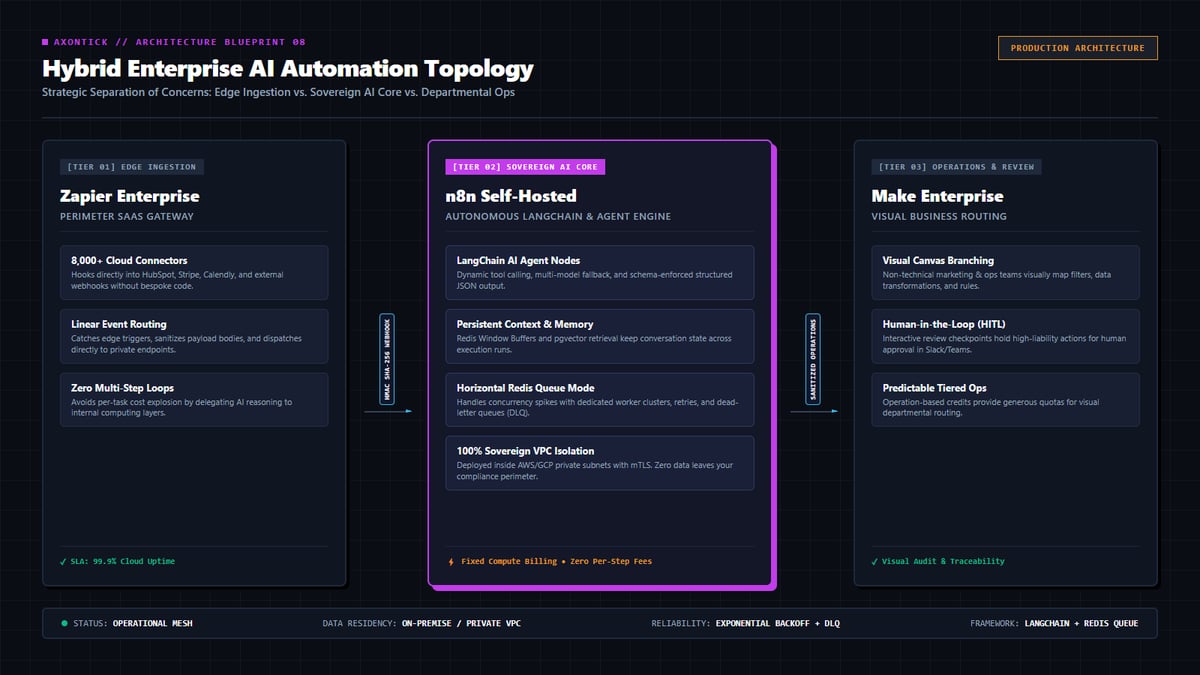
The Modern Hybrid AI Architecture: Buying Foundations and Building the Glue
The most successful enterprise technology organizations no longer view development through an antiquated binary lens. Instead of choosing between building everything or buying everything, industry-leading engineering teams adopt a hybrid AI architecture build and buy strategy, mapped directly to Gartner's Pace-Layered Application Strategy. Engineering leaders evaluating build vs buy AI software options frequently find that hybrid architectures offer the optimal balance of speed and control.
+----------------------------------------------------------------------------------------------------+
|                         THE 3-TIER PACE-LAYERED HYBRID AI BLUEPRINT                                |
+----------------------------------------------------------------------------------------------------+
|                                                                                                    |
|  TIER 1: SYSTEMS OF INNOVATION (Custom Proprietary Edge - BUILD / CO-DEVELOP)                     |
|  ├── Bespoke Multi-Agent Decision Swarms (LangGraph, Temporal stateful orchestration)              |
|  ├── Proprietary Data Ingestion Pipelines (Domain-specific RAG chunking & embedding models)       |
|  └── Custom Role-Based Dashboards & Specialized Operator Copilots                                 |
|                                     │                                                              |
|                                     ▼ [Direct Secure APIs & Webhooks]                              |
|  TIER 2: SYSTEMS OF DIFFERENTIATION (Commercial Foundation Platforms - BUY / LICENSE)              |
|  ├── Enterprise Foundation Models (Anthropic Claude 3.5, OpenAI GPT-4o, Google Gemini 1.5)         |
|  ├── Managed Vector Databases (Pinecone, Qdrant Cloud, pgvector on AWS RDS)                        |
|  └── Zero-Data Retention Commercial Ingress (Dedicated enterprise compliance endpoints)           |
|                                     │                                                              |
|                                     ▼ [Deterministic Integration Gateways]                        |
|  TIER 3: SYSTEMS OF RECORD (Enterprise Core Infrastructure - BUY / MAINTAIN)                      |
|  ├── Legacy ERP & Financial Ledgers (SAP, NetSuite, Workday)                                       |
|  ├── Enterprise CRM Databases (Salesforce, HubSpot)                                                |
|  └── Compliance, Audit Logs & Access Control (Okta SSO, SOC 2 monitoring, AWS CloudTrail)          |
|                                                                                                    |
+----------------------------------------------------------------------------------------------------+
In this modern architecture:
- You BUY the Commodity Foundation: Never build your own base LLM or manage raw Kubernetes GPU clusters for standard inference unless your core product is foundational AI research. License top-tier foundation models via secure commercial APIs that guarantee zero data retention.
- You BUY the Systems of Record: Do not attempt to rebuild core ERP, CRM, or identity platforms. Existing enterprise applications already solve decades of legal, tax, and regulatory compliance requirements.
- You BUILD the Differentiating Glue: You custom-engineer the agentic orchestration layer, domain-specific retrieval-augmented generation (RAG) pipelines, and structured business logic that connects your enterprise data to the foundational intelligence models.
Deploying a hybrid AI architecture build and buy strategy protects organizations from vendor lock-in while preserving rapid development velocity. This hybrid approach ensures that the enterprise maintains 100% intellectual property ownership over its business processes while relying on external vendors to absorb the multi-billion-dollar R&D cost of foundational models and database scaling.
Production-Ready Decision Engine: Auditing Your Next AI Initiative
To assist enterprise leadership teams in evaluating whether a proposed AI initiative should be bought, built, or co-developed with a partner, the Python script below provides an auditable, production-grade decision engine. By embedding the AI build vs buy decision matrix directly into project intake workflows, engineering teams ensure consistent architectural governance. It scores initiatives across the four foundational decision vectors, applies weighted strategic constraints, and outputs a concrete architectural recommendation.
"""
Enterprise AI Build vs. Buy vs. Partner Evaluation Engine.
Evaluates software initiatives across Competitive Moat, Data Sovereignty,
Total Cost of Ownership, and Time-to-Market Urgency to output an auditable
procurement and architectural recommendation.
"""

from dataclasses import dataclass
from typing import Dict, Any


@dataclass(frozen=True)
class InitiativeCriteria:
    initiative_name: str
    competitive_moat_score: int       # 1 (Commodity utility) to 5 (Core proprietary IP)
    data_sovereignty_score: int       # 1 (Public / non-sensitive) to 5 (Strictly regulated / air-gapped)
    tco_absorbability_score: int      # 1 (No dedicated MLOps team) to 5 (Mature internal AI engineering)
    time_to_market_urgency: int       # 1 (18+ month runway acceptable) to 5 (Critical deployment < 90 days)


@dataclass(frozen=True)
class EvaluationRecommendation:
    initiative: str
    recommended_path: str
    overall_confidence: float
    rationale: str
    architectural_directives: list[str]


class EnterpriseDecisionMatrix:
    """
    Executes algorithmic scoring on enterprise AI initiatives.
    """

    @staticmethod
    def evaluate(criteria: InitiativeCriteria) -> EvaluationRecommendation:
        # Validate input boundaries
        for score, name in [
            (criteria.competitive_moat_score, "Competitive Moat"),
            (criteria.data_sovereignty_score, "Data Sovereignty"),
            (criteria.tco_absorbability_score, "TCO Absorbability"),
            (criteria.time_to_market_urgency, "Time to Market"),
        ]:
            if not 1 <= score <= 5:
                raise ValueError(f"Score for {name} must be an integer between 1 and 5.")

        # Logic Branch 1: Pure Commodity Workflows
        if criteria.competitive_moat_score <= 2 and criteria.data_sovereignty_score <= 3:
            return EvaluationRecommendation(
                initiative=criteria.initiative_name,
                recommended_path="BUY (Commercial SaaS / Managed Platform)",
                overall_confidence=0.92,
                rationale="Capability represents horizontal commodity software. Building in-house creates unnecessary technical debt without establishing a defensible market advantage.",
                architectural_directives=[
                    "Procure enterprise SaaS with native LLM integrations.",
                    "Verify SOC 2 Type II compliance and zero-data-retention (ZDR) clauses.",
                    "Avoid committing internal engineering sprints to commodity features.",
                ],
            )

        # Logic Branch 2: High Urgency + Core Differentiator (The Partnering Sweet Spot)
        if criteria.competitive_moat_score >= 3 and criteria.time_to_market_urgency >= 3:
            if criteria.tco_absorbability_score <= 3:
                return EvaluationRecommendation(
                    initiative=criteria.initiative_name,
                    recommended_path="PARTNER (Specialized Agency Co-Development)",
                    overall_confidence=0.89,
                    rationale="High strategic value combined with tight time-to-market constraints and limited internal MLOps bandwidth. Partnering delivers custom enterprise IP within 90-120 days.",
                    architectural_directives=[
                        "Retain a boutique AI systems firm to co-build the orchestration layer.",
                        "Enforce enterprise ownership of all custom agent code and integration schemas.",
                        "Structure the contract around fixed-scope delivery milestones with internal knowledge transfer.",
                    ],
                )

        # Logic Branch 3: Deep Proprietary Core Moat + Established Internal Scale
        if criteria.competitive_moat_score >= 4 and criteria.tco_absorbability_score >= 4:
            return EvaluationRecommendation(
                initiative=criteria.initiative_name,
                recommended_path="BUILD (In-House Dedicated Engineering)",
                overall_confidence=0.86,
                rationale="Core intellectual property requiring proprietary algorithmic training and long-term internal iteration. The organization possesses the MLOps maturity to sustain the maintenance tail.",
                architectural_directives=[
                    "Staff a dedicated full-time engineering pod spanning data pipelines and evaluation.",
                    "Deploy an automated regression harness (LLM-as-a-judge) prior to production rollout.",
                    "Isolate proprietary business logic inside private cloud microservices.",
                ],
            )

        # Default Fallback: The Hybrid Staggered Model
        return EvaluationRecommendation(
            initiative=criteria.initiative_name,
            recommended_path="HYBRID (Buy Foundation + Build Custom Connectors)",
            overall_confidence=0.84,
            rationale="Balanced requirements. License foundation model APIs and commercial databases while writing custom orchestration glue in-house.",
            architectural_directives=[
                "Deploy commercial LLM endpoints behind an internal API gateway.",
                "Build domain-specific RAG retrieval pipelines in-house.",
                "Review project economics quarterly to decide whether to bring additional components in-house.",
            ],
        )


if __name__ == "__main__":
    test_initiatives = [
        InitiativeCriteria(
            initiative_name="Customer Service Call Summarization",
            competitive_moat_score=1,
            data_sovereignty_score=2,
            tco_absorbability_score=2,
            time_to_market_urgency=4,
        ),
        InitiativeCriteria(
            initiative_name="Automated Commercial Underwriting Pipeline",
            competitive_moat_score=4,
            data_sovereignty_score=4,
            tco_absorbability_score=2,
            time_to_market_urgency=4,
        ),
        InitiativeCriteria(
            initiative_name="Proprietary High-Frequency Trading Engine",
            competitive_moat_score=5,
            data_sovereignty_score=5,
            tco_absorbability_score=5,
            time_to_market_urgency=2,
        ),
    ]

    print("================================================================================")
    print("                 ENTERPRISE AI MAKE-OR-BUY DECISION AUDIT                       ")
    print("================================================================================")
    for initiative in test_initiatives:
        decision = EnterpriseDecisionMatrix.evaluate(initiative)
        print(f"\n[INITIATIVE: {decision.initiative}]")
        print(f"  - Decision Path:    {decision.recommended_path}")
        print(f"  - Confidence:       {int(decision.overall_confidence * 100)}%")
        print(f"  - Strategic Rationale: {decision.rationale}")
        print("  - Directives:")
        for directive in decision.architectural_directives:
            print(f"      * {directive}")
Executing this decision engine across internal IT project requests prevents teams from wasting hundreds of thousands of dollars developing commodity features that could be purchased off-the-shelf, while ensuring that core proprietary workflows receive the custom engineering rigor they require.
Frequently Asked Questions
When should an enterprise build custom AI software?
An enterprise should build custom AI software when the workflow directly encodes proprietary business logic, leverages non-public intellectual property, and serves as a defensible commercial moat. If the process is a core product differentiator that competitors cannot replicate by licensing commercial software, building in-house is fully justified.
What are the hidden costs of building AI in-house?
The hidden costs include ongoing prompt regression remediation, model drift monitoring, the construction of automated evaluation harnesses (LLM-as-a-judge), and key-person talent churn. Maintaining probabilistic software typically requires 2x to 3x the continuous engineering overhead of traditional deterministic software codebases.
What is the hybrid build and buy AI model?
The hybrid model is a pace-layered architecture where organizations license foundational commodity layers (foundation models, cloud databases, and core ERP systems) while building custom proprietary orchestration pipelines, business logic schemas, and specialized agent workflows that integrate directly with enterprise data. Organizations that implement a hybrid AI architecture build and buy approach typically achieve operational break-even within 3 to 6 months.
Why do so many enterprise internal AI builds fail?
Over 70% of internal AI initiatives stall because organizations treat generative AI as a one-time development project rather than a continuous operational commitment. When models drift, APIs change, or unstructured inputs break deterministic systems, internal teams without dedicated MLOps support struggle to maintain reliability.
When does partnering with an AI agency make more sense than building in-house?
Partnering with an experienced AI agency is optimal when an organization needs customized, production-grade intelligence deployed in 3 to 6 months without adding permanent engineering overhead. A specialized partner provides pre-built architectural blueprints, hardened evaluation guardrails, and rapid execution while the client maintains complete IP ownership. When evaluating external support, partnering with AI development agency teams provides immediate access to production-hardened evaluation harnesses.
Strategic Roadmap: From Decision to Production Deployment
Navigating the choice to build vs buy AI software requires technical honesty and disciplined operational accounting. Defaulting to an in-house build out of engineering pride creates sprawling technical debt, while buying rigid commercial SaaS tools for core business differentiators leaves your enterprise vulnerable to commoditization.
By applying an objective evaluation matrix, calculating true lifetime total cost of ownership, and adopting a modern pace-layered hybrid architecture, executive leaders preserve corporate capital while deploying scalable, high-velocity intelligence systems.
Ready to determine the optimal deployment trajectory for your enterprise?
- Explore our step-by-step engineering roadmap on our Process Page.
- Model your anticipated development investment using our Interactive AI Pricing Calculator.
- Discover how deterministic integration streamlines complex business logic in our Workflow Automation Guide.
- Learn how specialized swarms coordinate multi-system tasks in our Multi-Agent Systems Blueprint.
Want this deployed for your enterprise?
Axontick engineers architect, benchmark, and deploy custom enterprise autonomous systems with guaranteed uptime, sub-second latency, and 100% IP ownership.

Muhammad Asim
Founder @ AxontickFounder of Axontick, specialized in AI automation, Multi-Agent Systems, and enterprise-grade voice agents. Expert in bridging the gap between complex AI technology and practical business solutions.