
The future of enterprise AI agents is not about typing prompts into a chat window. It is about autonomous software programs that plan, use business tools, and complete complex work across your company with minimal human intervention. Today, fewer than 3% of companies run mature autonomous operations. Over the next five years, businesses will move from simple chat assistants to self-improving networks of specialized agents. Organizations that build clean data systems, clear permissions, and strong safety controls today will lead their industries through 2030.
Here is the strategic roadmap for how autonomous systems will evolve, how to keep operational costs low, and what forward-thinking leaders must build right now.
The 3 Waves of Enterprise AI: From Copilots to Autonomous Networks
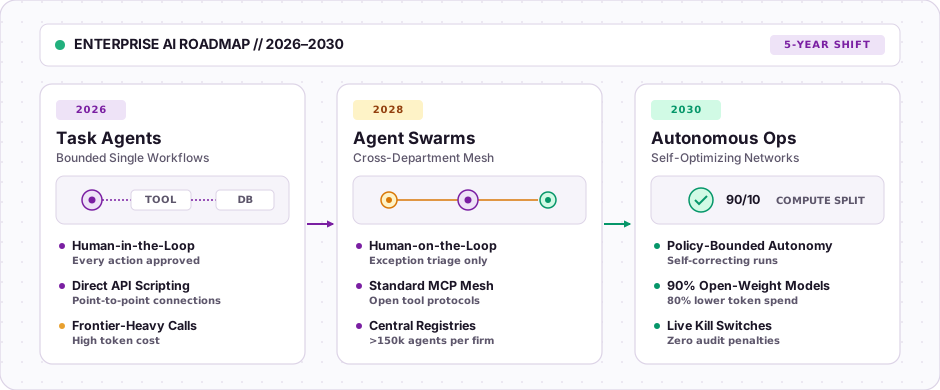
To understand where technology is heading, executives must follow the transition across enterprise software. The journey toward a complete autonomous enterprise roadmap unfolds in three distinct waves:
Assistants & Copilots
Reactive chatbots that summarize documents, answer employee questions, and draft emails with human review on every output.
Task-Specific Agents
Independent agents connected to business tools. They resolve IT tickets, triage inbound calls, and automate workflows across databases.
Autonomous Networks
Dynamic agent swarms collaborating across departments to manage supply chains, route incidents, and self-correct using live feedback.
According to enterprise research from Gartner, the move to Wave 3 will be rapid. By 2028, Gartner projects that the average Global Fortune 500 company will run over 150,000 active software agents. Furthermore, up to 33% of enterprise software interactions will move directly into agent interactions.
Tracking these AI agent trends 2026 2030 allows leadership teams to invest in flexible architecture rather than temporary tools that quickly become obsolete. Building an autonomous enterprise roadmap guarantees your team deploys agents that integrate smoothly with existing enterprise infrastructure.
The 90/10 Compute Rule: Taming Operational Token Costs
Using frontier reasoning models for every automated step is an expensive mistake. While top-tier models excel at complex reasoning, using them for routine data entry or status checks quickly drains budgets.
Gartner projects that uncapped token pricing causes companies to exceed initial cost estimates by more than 50%. By 2030, however, Gartner forecasts that approximately 90% of enterprise operational agent workflow steps will run on smaller, domain-specific open-weight models, with frontier models handling only the remaining 10% of high-stakes decisions.
The 90/10 Compute Allocation Formula
Data extraction, classification, basic database updates, JSON validation, and routine API calls. Fast and pennies per million tokens.
Conflict resolution, compliance exception reviews, strategic planning, and unmapped anomaly investigations.
By adopting a tiered multi-agent orchestration architecture, enterprises keep response times low and slash recurring compute bills by 60% to 80% compared to single-model setups. Understanding broader AI agent trends 2026 2030 ensures your computing footprint scales sustainably as operational volume expands. Analyzing key AI agent trends 2026 2030 keeps your infrastructure cost-effective over time.
Decision Governance: Managing Agent Sprawl and Risk
When hundreds of autonomous agents execute actions across company systems, monitoring uptime is no longer enough. You must monitor decisions. Effective AI decision governance guarantees that every autonomous action is logged, verifiable, and instantly reversible.
A major finding in recent Gartner analysis is the end of vendor lock-in. Gartner predicts that by 2028, 70% of enterprises will abandon agent systems built through vendor-dependent custom engineering because those proprietary systems are too rigid and costly to maintain. Companies want direct control over their own source code, prompts, and tool integrations.
At the same time, strong safety controls are becoming non-negotiable. IDC reports that enterprises lacking automated cut-off switches and detailed activity logs on production agents will face 25% higher insurance premiums and twice as many audit penalties by 2028. Incorporating strict AI decision governance into your multi-agent orchestration architecture gives executive leadership complete confidence in daily operations.
The 2026 Leadership Blueprint: 4 Foundations to Build Today
Preparing for the future of enterprise AI agents does not mean waiting for future models. It requires building reliable foundations today. Analyzing the future of enterprise AI agents reveals four critical capabilities:
- Build a Clean Data Semantic Layer: AI agents are only as reliable as the data they query. Unify customer records, inventory counts, and support history into clean, standardized APIs so agents never make decisions based on outdated records.
- Standardize Tool Protocols: Connect your internal systems using open standards like the Model Context Protocol (MCP). Standard protocols allow you to swap models or add new tools without rewriting custom connectors.
- Establish an Enterprise Agent Registry: Catalog every agent running inside your organization, documenting its assigned permissions, daily budget limit, and human supervisor. If an agent behaves unexpectedly, your team must be able to disable it in a single click.
- Transition from Human-in-the-Loop to Human-on-the-Loop: Early pilots require a person to approve every step. As agents prove reliable in production, move team members into a supervisory role where they review unusual edge cases while agents handle routine work automatically.
A successful long term AI strategy balances ambitious automation goals with measured, practical execution steps. Executing this long term AI strategy step by step ensures your organization turns technological shifts into measurable business advantages.
Building Your Autonomous Enterprise with Axontick
The companies that lead the next decade will not be those running endless experiments. They will be businesses embedding governed agents into daily operations. Embracing an autonomous enterprise roadmap prepares leaders for the future of enterprise AI agents.
At Axontick, we help companies design, build, and deploy production-grade multi-agent systems with complete code ownership, transparent pricing, and enterprise-grade security. Explore our full suite of Enterprise AI Services, estimate implementation timelines with our AI Pricing Calculator, or discover our proven deployment methodology on our Process Overview page.
Ready to build your roadmap? Schedule a consultation with our engineering team to design an autonomous operations plan.
Want this deployed for your enterprise?
Axontick engineers architect, benchmark, and deploy custom enterprise autonomous systems with guaranteed uptime, sub-second latency, and 100% IP ownership.

Muhammad Asim
Founder @ AxontickFounder of Axontick, specialized in AI automation, Multi-Agent Systems, and enterprise-grade voice agents. Expert in bridging the gap between complex AI technology and practical business solutions.