Deploying multi-agent systems allows enterprises to decompose complex business logic into specialized, autonomous execution graphs that eliminate the context degradation, tool hallucinations, and single-point failures of monolithic prompts.
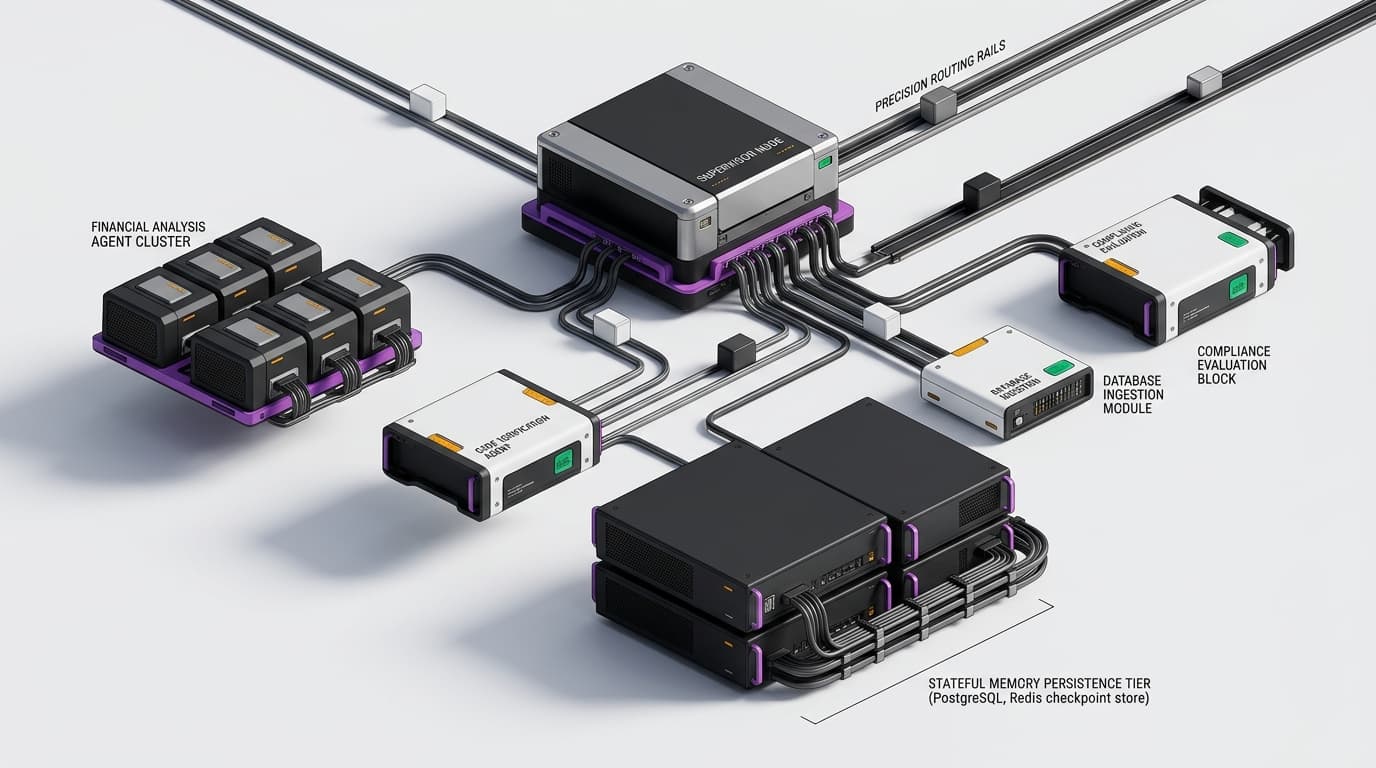
Deploying multi-agent systems for enterprise operations enables organizations to solve complex, multi-stage workflows that inevitably break single-prompt LLM architectures. By orchestrating specialized, autonomous agents—each constrained to a defined operational role, tool set, and context boundary—enterprises transform non-deterministic chatbots into resilient, deterministic execution graphs. Rather than relying on a single monolithic model to research, synthesize, validate, and execute mission-critical tasks, distributed swarms coordinate through stateful graphs, persistent memory checkpoints, and formal consensus protocols to deliver auditable, production-grade automation.
Building on our analyses of What Are AI Agents? and our 5-Point Feasibility Matrix, this architectural blueprint examines the engineering principles, coordination topologies, and infrastructure required to deploy robust multi-agent systems for enterprise environments.
┌────────────────────────────────────────────────────────────────────────┐
│             MONOLITHIC PROMPT VS. ENTERPRISE MULTI-AGENT SWARM        │
├───────────────────────────────────┬────────────────────────────────────┤
│     SINGLE MONOLITHIC PROMPT      │   SPECIALIZED MULTI-AGENT SWARM    │
├───────────────────────────────────┼────────────────────────────────────┤
│ • 1 Model, 35 Tools, 8,000 Tokens │ • Discrete agents with 1–3 tools   │
│ • Context drift & hallucination   │ • Strict role & scope isolation    │
│ • Single point of failure         │ • Modular node retries & recovery  │
│ • Opaque "black box" execution    │ • Transparent state graph traces   │
│ • Runaway token consumption       │ • Deterministic routing & budgets  │
│ • Zero persistent checkpointing   │ • Full state serialization in DB   │
└───────────────────────────────────┴────────────────────────────────────┘
The Collapse of the Monolithic Agent: Context Rot and Cognitive Overload
In early enterprise AI initiatives, the default instinct was to construct a single "super-agent." Engineers equipped a state-of-the-art model (such as GPT-4 or Claude 3.5 Sonnet) with a sprawling system prompt and dozens of tools: database connectors, web scrapers, CRM APIs, code interpreters, and notification webhooks.
In practice, monolithic agents suffer from well-documented systemic breakdown:
- Context Window Saturation (Context Rot): As conversation history, intermediate tool responses, and schema definitions accumulate, the model's attention mechanism degrades. Research shows that retrieval accuracy and instruction adherence drop precipitously when complex reasoning is attempted over dense contexts exceeding 30,000 tokens.
- Tool Selection Hallucination: When an agent is exposed to more than 15 tool definitions simultaneously, the probability of selecting the incorrect function or formatting malformed JSON arguments increases by over 40%.
- Cascading Failure Without Rollback: If a single monolithic agent encounters a timeout or rate-limit error at step 7 of an 8-step pipeline, the entire context crashes. The system lacks the ability to isolate the failed node, rollback state, or execute an alternative sub-route.
Engineering scalable multi-agent systems for enterprise applications requires abandoning the fantasy of the all-knowing single agent. True scalability mirrors human organizational design: complex tasks are divided among specialized domain experts who communicate over structured channels with clear handoffs.
┌────────────────────────────────────────────────────────────────────────┐
│                   THE ARCHITECTURAL SHIFT TO SWARMS                    │
└───────────────────────────────────┬────────────────────────────────────┘
                                    │ User Goal: "Audit Q3 Revenue Discrepancies"
                                    ▼
┌────────────────────────────────────────────────────────────────────────┐
│ 1. SUPERVISOR / ROUTER AGENT                                           │
│    • Deconstructs objective into discrete dependency graph              │
│    • Assigns state keys & operational budgets                          │
└───────────────┬───────────────────┬───────────────────┬────────────────┘
                │                   │                   │
                ▼                   ▼                   ▼
    ┌──────────────────────┐ ┌───────────────┐ ┌───────────────────┐
    │ INGESTION AGENT      │ │ LEDGER AUDIT  │ │ COMPLIANCE AGENT  │
    │ • Queries Stripe API │ │ • Queries SQL │ │ • Checks SOC-2 &  │
    │ • Normalizes payloads│ │ • Reconciles  │ │   tax schedules   │
    └───────────┬──────────┘ └───────┬───────┘ └─────────┬─────────┘
                │                   │                   │
                └───────────────────┼───────────────────┘
                                    ▼
┌────────────────────────────────────────────────────────────────────────┐
│ 2. EVALUATION & CONSENSUS GATEWAY                                      │
│    • Cross-validates findings against deterministic schema             │
│    • Re-routes mismatches or triggers Human-in-the-Loop review         │
└───────────────────────────────────┬────────────────────────────────────┘
                                    │
                                    ▼ Final Validated Output
Architectural Topologies: Supervisor, Hierarchical, and Peer-to-Peer
The core differentiator of any multi-agent deployment is its communication topology. Selecting the wrong topology creates communication bottlenecks or runaway token loops. Production architectures generally fall into three structural patterns:
1. The Centralized Supervisor Pattern
In the supervisor pattern, a single coordinator agent sits at the center of the architecture. It receives the initial user objective, decomposes the problem, routes subtasks to worker agents sequentially or in parallel, and synthesizes the final result.
- Strengths: Simple to implement, deterministic execution order, centralized cost tracking, straightforward audit logging.
- Weaknesses: The supervisor becomes a single point of failure and a cognitive bottleneck. If the supervisor misclassifies an intent, all downstream workers execute faulty instructions.
2. Hierarchical Multi-Agent Architecture
For large enterprises managing multi-departmental workflows, a single supervisor is insufficient. A hierarchical multi-agent architecture introduces multi-tiered management structures that mirror corporate departments.
In a hierarchical multi-agent architecture, a top-level Executive Agent communicates solely with Domain Leads (e.g., Finance Lead, Engineering Lead, Legal Lead). Each Domain Lead orchestrates its own localized cluster of specialized worker agents.
- Strengths: Maximum modularity, domain-specific prompt tuning, isolated context windows, highly resilient delegation chains.
- Weaknesses: Increased inter-agent network latency, higher upfront engineering investment.
┌────────────────────────────────────────────────────────────────────────┐
│                 HIERARCHICAL MULTI-AGENT ARCHITECTURE                  │
└───────────────────────────────────┬────────────────────────────────────┘
                                    │
                         EXECUTIVE SUPERVISOR
                                    │
         ┌──────────────────────────┴──────────────────────────┐
         ▼                                                     ▼
┌────────────────────────────────┐            ┌────────────────────────────────┐
│ FINANCE CLUSTER LEAD           │            │ LEGAL & COMPLIANCE LEAD        │
└────────┬──────────────┬────────┘            └────────┬──────────────┬────────┘
         │              │                              │              │
         ▼              ▼                              ▼              ▼
┌──────────────┐ ┌──────────────┐             ┌──────────────┐ ┌──────────────┐
│ Invoicing    │ │ Bank Triage  │             │ Contract OCR │ │ Regulatory   │
│ Worker       │ │ Worker       │             │ Worker       │ │ Auditor      │
└──────────────┘ └──────────────┘             └──────────────┘ └──────────────┘
3. Peer-to-Peer Collaborative Swarms
In decentralized peer swarms, agents interact without a rigid central supervisor. Work progresses through an event bus or pub/sub message broker where agents subscribe to specific state changes and emit output events for other agents to consume.
- Strengths: Dynamic adaptability, natural parallelism, resilient against single-node crashes.
- Weaknesses: Difficult to trace, prone to emergent non-deterministic conversational loops, challenging to enforce strict completion bounds.
For production enterprise systems, a hierarchical multi-agent architecture built on top of a stateful graph engine represents the gold standard for balancing control, auditability, and speed.
Framework Breakdown: LangGraph vs. CrewAI vs. AutoGen
Choosing the foundational orchestration framework dictates your development velocity, failure modes, and deployment complexity:
| Architectural Dimension | LangGraph (LangChain) | CrewAI | AutoGen (Microsoft) |
|---|---|---|---|
| Core Paradigm | Stateful Finite State Machine (DAG) | Role-Based Crew Collaboration | Event-Driven Multi-Party Dialogue |
| State Persistence | Native DB Checkpointing (Postgres/Redis) | In-Memory (Requires Custom Wrappers) | In-Memory Conversational History |
| Control & Determinism | Strictly Explicit & Deterministic | Managed Role Delegation | Emergent Conversational Dynamics |
| Error Recovery | Time-travel rollback to failed node | Re-run full chain or retry task | Retry conversational loop |
| Human-in-the-Loop | Native Interrupts & State Mutation | Supported via basic CLI prompts | Conversational Human Input mode |
| Learning Curve | Moderate / High (10–14 days) | Low / Intuitive (2–3 days) | Moderate (5–7 days) |
| Enterprise Readiness | Mission-Critical Production | Rapid Prototyping & MVPs | Academic & Exploratory Research |
Why LangGraph Dominates Production Enterprise Deployments
While CrewAI provides an accessible abstraction for rapid prototyping, production multi-agent systems for enterprise applications overwhelmingly converge on LangGraph. The reason is structural: enterprise systems require state machines, not freeform chat rooms.
In LangGraph, execution is modeled as a cyclic graph where:
- Nodes represent agent reasoning steps or deterministic Python functions.
- Edges define explicit routing logic based on state conditions.
- State is a strongly-typed schema (using Pydantic or TypedDict) updated through immutable reducer functions.
- Checkpointers automatically serialize and save the state graph after every node execution.
Engineering Stateful Workflows: Checkpointing, Memory, and Error Recovery
A fundamental requirement of enterprise software is fault tolerance. If an automated underwriting pipeline crashes on step 5 due to an API timeout, the enterprise cannot afford to discard all previous computations and restart from scratch.
Implementing stateful multi-agent workflows guarantees that every computational step is durable, auditable, and recoverable.
┌────────────────────────────────────────────────────────────────────────┐
│            STATEFUL CHECKPOINTING & RECOVERY LIFECYCLE                 │
└───────────────────────────────────┬────────────────────────────────────┘
                                    │
                                Node 01: Ingest Data
                                    │
                                    ▼
                         [CHECKPOINT 01 SAVED TO DB]
                                    │
                                Node 02: Extract Metrics
                                    │
                                    ▼
                         [CHECKPOINT 02 SAVED TO DB]
                                    │
                                Node 03: Third-Party API Call (TIMES OUT ✖)
                                    │
                       State Machine Catches Error
                                    │
                                    ▼
┌────────────────────────────────────────────────────────────────────────┐
│ RESILIENCE ENGINE: TIME-TRAVEL STATE RECOVERY                          │
│ 1. Read last valid checkpoint (Checkpoint 02)                          │
│ 2. Apply exponential backoff & switch to fallback API provider        │
│ 3. Resume graph execution from Node 03 WITHOUT re-running Node 01 & 02 │
└───────────────────────────────────┬────────────────────────────────────┘
                                    │
                                    ▼
                         [CHECKPOINT 03 SAVED TO DB]
                                    │
                                Node 04: Complete Workflow
Production LangGraph Implementation: Stateful Agent Node with Pydantic
Below is an enterprise-grade pattern implementing stateful multi-agent workflows with strongly-typed state, checkpointing, and conditional routing:
from typing import Annotated, List, Dict, Any, Literal
from typing_extensions import TypedDict
from pydantic import BaseModel, Field
from langgraph.graph import StateGraph, START, END
from langgraph.checkpoint.postgres import PostgresSaver

# 1. Define Strict Pydantic State Schema
class SwarmState(TypedDict):
    task_id: str
    input_payload: Dict[str, Any]
    ingested_data: List[Dict[str, Any]]
    analysis_findings: Dict[str, Any]
    compliance_passed: bool
    audit_notes: List[str]
    current_retry_count: int
    error_message: str | None

# 2. Define Node Execution Functions
def ingestion_agent_node(state: SwarmState) -> Dict[str, Any]:
    """Ingests and normalizes external corporate records."""
    raw_input = state["input_payload"]
    normalized_records = [{"record_id": 101, "amount": 45000.0, "status": "pending"}]
    return {
        "ingested_data": normalized_records,
        "audit_notes": state["audit_notes"] + ["Ingestion completed: 1 record processed."]
    }

def analysis_agent_node(state: SwarmState) -> Dict[str, Any]:
    """Analyzes financial records and checks balance reconciliation."""
    records = state["ingested_data"]
    findings = {"discrepancy_detected": False, "confidence_score": 0.98}
    return {
        "analysis_findings": findings,
        "audit_notes": state["audit_notes"] + ["Analysis completed with 98% confidence."]
    }

def compliance_evaluator_node(state: SwarmState) -> Dict[str, Any]:
    """Audits findings against enterprise regulatory policy."""
    findings = state["analysis_findings"]
    is_compliant = findings.get("confidence_score", 0) >= 0.95
    return {
        "compliance_passed": is_compliant,
        "audit_notes": state["audit_notes"] + [f"Compliance check result: {is_compliant}"]
    }

# 3. Conditional Routing Logic
def route_after_compliance(state: SwarmState) -> Literal["approved", "remediate", "human_review"]:
    if state["compliance_passed"]:
        return "approved"
    elif state["current_retry_count"] < 3:
        return "remediate"
    return "human_review"

# 4. Construct the Stateful Execution Graph
builder = StateGraph(SwarmState)

builder.add_node("ingest", ingestion_agent_node)
builder.add_node("analyze", analysis_agent_node)
builder.add_node("compliance", compliance_evaluator_node)

builder.add_edge(START, "ingest")
builder.add_edge("ingest", "analyze")
builder.add_edge("analyze", "compliance")

builder.add_conditional_edges(
    "compliance",
    route_after_compliance,
    {
        "approved": END,
        "remediate": "analyze",
        "human_review": END
    }
)

# Attach persistent PostgresSaver for production checkpointing
# checkpointer = PostgresSaver.from_conn_string("postgresql://user:pass@localhost:5432/agents")
# app = builder.compile(checkpointer=checkpointer)
Through disciplined autonomous agent orchestration, every state transition is committed to the database, ensuring zero data loss and enabling instantaneous rollbacks if an external service fails.
Consensus Protocols and Multi-Agent Verification
In single-agent setups, hallucinations often slip into production unnoticed. In multi-agent systems for enterprise applications, data integrity is enforced through structured multi-agent consensus protocols.
Rather than trusting the primary agent's initial extraction, the system routes the findings to an adversarial Critic or Verification Agent. Only when multiple agents reach formal consensus does the graph transition to execution.
┌────────────────────────────────────────────────────────────────────────┐
│                   MULTI-AGENT CONSENSUS PROTOCOL                       │
└───────────────────────────────────┬────────────────────────────────────┘
                                    │ Input Document
                                    ▼
                    ┌──────────────────────────────┐
                    │ Extraction Agent (Node A)    │
                    │ Extracts contractual terms   │
                    └───────────────┬──────────────┘
                                    │ Structured Payload
                                    ▼
┌────────────────────────────────────────────────────────────────────────┐
│ CROSS-EXAMINATION & ADVERSARIAL CONSENSUS                              │
├───────────────────────────────────┬────────────────────────────────────┤
│ • Verification Agent (Node B)     │ • Regulatory Agent (Node C)        │
│   Re-reads document independently │   Audits against compliance policy │
│   Flags missing clauses           │   Validates liability caps         │
└───────────────────────────────────┴────────────────────────────────────┘
                                    │
                                    ▼
┌────────────────────────────────────────────────────────────────────────┐
│ CONSENSUS RESOLUTION GATEWAY                                           │
│ • Case 1: All agents agree (Consensus >= 95%) ──► Commit to ERP / CRM  │
│ • Case 2: Discrepancy detected               ──► Trigger debate pass   │
│ • Case 3: Irreconcilable conflict            ──► Escalate to Human     │
└────────────────────────────────────────────────────────────────────────┘
Implementing 3-Tier Multi-Agent Consensus
- Majority Voting (Ensemble): Multiple specialized models independently generate extractions. If 2 out of 3 produce identical structured fields, the consensus threshold is met.
- Adversarial Debating: Agent A generates a proposed business action; Agent B is given the persona of a skeptical risk officer whose goal is to find edge-case vulnerabilities. The debate iterates until Agent B approves or flags specific line items.
- Deterministic Rule Gating: LLM outputs are piped into hard-coded Python validation engines (e.g., Pydantic validators, mathematical ledger calculations). If the AI's calculated balance differs from raw ledger mathematics by even $0.01, the consensus gate immediately triggers remediation.
Applying rigorous multi-agent consensus protocols completely eliminates catastrophic hallucinations in mission-critical applications like tax preparation, loan approvals, and healthcare billing.
Human-in-the-Loop (HITL): Safe Enterprise Control Planes
Complete autonomy without oversight is reckless in regulated industries. The most successful enterprise AI swarm deployment projects are built as Human-in-the-Loop (HITL) control planes.
In modern graph architectures, HITL is implemented not as a crude pause command, but as a native state interrupt:
Swarm running autonomously...
    │
    ▼
Node: "Generate Final $250,000 Vendor Wire Transfer"
    │
    ▼
[GRAPH EXECUTION INTERRUPT TRIGGERED]
    │
    ├── State automatically persisted to PostgreSQL Checkpoint
    ├── Slack / Teams notification dispatched to Finance VP:
    │   "Swarm #4481 prepared $250k wire. Click [Inspect & Approve] to proceed."
    │
    ▼
Human Operator reviews exact state payload in web console:
    ├── OPTION A: Approve ──► Graph resumes from checkpoint instantly
    ├── OPTION B: Edit State ──► Human modifies amount, graph resumes with new value
    └── OPTION C: Abort ──► Swarm rolls back state and alerts security desk
By decoupling agent computation from human authorization, organizations achieve the speed benefits of 90% autonomous execution while preserving 100% human accountability on high-liability decisions.
Production Deployment & Operationalizing Swarms
Transitioning from a local developer prototype to an enterprise-grade enterprise AI swarm deployment requires rigorous infrastructure engineering:
┌────────────────────────────────────────────────────────────────────────┐
│              ENTERPRISE AI SWARM PRODUCTION ARCHITECTURE               │
├────────────────────────────────────────────────────────────────────────┤
│ 1. API GATEWAY & RATE LIMITER                                          │
│    • Kong / Cloudflare Ingress                                         │
│    • Token bucket rate limiting & tenant budget quotas                 │
├────────────────────────────────────────────────────────────────────────┤
│ 2. SWARM ORCHESTRATION CLUSTER (Docker / Kubernetes / AWS ECS)         │
│    • LangGraph Server / Custom FastAPI Runners                         │
│    • Horizontal Pod Autoscaling based on pending task queue depth      │
├────────────────────────────────────────────────────────────────────────┤
│ 3. PERSISTENT STORAGE & CACHING LAYER                                  │
│    • PostgreSQL Checkpointing (pgvector for semantic memory)           │
│    • Redis for ephemeral inter-agent message pub/sub & locks           │
├────────────────────────────────────────────────────────────────────────┤
│ 4. OBSERVABILITY & CONTROL PLANE                                       │
│    • OpenTelemetry & LangSmith distributed tracing                     │
│    • Per-agent token cost tracking & anomaly detection                 │
│    • Automated kill-switches for runaway execution loops               │
└────────────────────────────────────────────────────────────────────────┘
Essential Operational Controls for Multi-Agent Systems
- Deterministic Max-Step Budgets: Every swarm execution must have an immutable recursion limit (e.g.,
recursion_limit=25). If agents fail to reach consensus within the step budget, the system gracefully halts and alerts human supervision rather than consuming infinite tokens. - Per-Agent Model Selection (Cost Optimization): Not every agent requires a frontier $15/M-token model. The Supervisor might run on Claude 3.5 Sonnet or GPT-4o for deep reasoning, while the Extraction and Formatting Agents run on Claude 3.5 Haiku or Llama-3.3-70B via Groq at 1/10th the cost.
- Full Distributed Tracing: Every message, tool invocation, token count, and latency interval must be tagged with a unique
trace_id. When a swarm makes a decision, engineers must be able to visually trace the exact path through the graph in LangSmith or Phoenix.
Frequently Asked Questions About Multi-Agent Systems
What is the primary difference between single-agent and multi-agent systems?
A single-agent system relies on one model attempting to balance multiple prompt instructions, tool definitions, and long conversation histories, leading to context saturation and frequent errors. A multi-agent system decomposes the problem into specialized, role-constrained agents that collaborate through stateful graphs, maintaining isolated contexts and cross-verifying each other's outputs.
Which framework is best for building production enterprise AI swarms?
For mission-critical enterprise production, LangGraph is the recognized leader due to its state machine architecture, native database checkpointing (PostgreSQL/Redis), and robust Human-in-the-Loop interrupt capabilities. CrewAI is well-suited for rapid prototyping of role-based teams, while AutoGen is primarily favored for exploratory research and conversational dynamics.
How do multi-agent systems prevent infinite loops and runaway token costs?
Production systems implement strict execution guardrails, including deterministic recursion limits (max-step budgets), token consumption ceilings per task, and timeout thresholds on all inter-agent communications. If an agent cluster fails to reach consensus within its allocated budget, the graph halts and routes the state to a human supervisor.
How does state persistence work in multi-agent workflows?
State persistence is achieved by saving an immutable snapshot (checkpoint) of the graph's shared state to an external database (such as PostgreSQL or Redis) after every node execution. If a network failure or external API timeout occurs, the system recovers state from the last valid checkpoint and resumes execution without re-running completed steps.
Can multi-agent systems integrate with our existing enterprise software?
Yes. Specialized agents within a swarm integrate with enterprise CRMs (HubSpot, Salesforce), ERPs (SAP, NetSuite), SQL databases, and internal APIs using secure REST webhooks, GraphQL, or the Model Context Protocol (MCP). Tool calls are validated against strict Pydantic schemas to ensure data integrity.
Conclusion: Engineering Your Sovereign Multi-Agent Swarm
The future of enterprise software is not a smarter chatbot—it is an autonomous, distributed workforce of specialized AI agents working deterministically inside your operational infrastructure.
By moving from brittle, monolithic prompts to a hierarchical multi-agent architecture equipped with stateful checkpoints, cross-agent consensus verification, and safe human control planes, forward-thinking enterprises unlock unprecedented operational velocity while eliminating error risk.
At Axontick, we architect, benchmark, and deploy bespoke multi-agent swarms engineered specifically for your business processes—delivering 100% intellectual property ownership and zero vendor lock-in.
Ready to architect autonomous agent swarms in your enterprise?
- Model your custom operational parameters and compute savings in our interactive AI Pricing Calculator.
- Explore our production architecture capabilities on the Multi-Agent Systems Service Page.
- Learn more about our delivery methodology in Our 6-Step Engineering Delivery Process and book an architectural discovery session with our founding engineering team today.
Want this deployed for your enterprise?
Axontick engineers architect, benchmark, and deploy custom enterprise autonomous systems with guaranteed uptime, sub-second latency, and 100% IP ownership.

Muhammad Asim
Founder @ AxontickFounder of Axontick, specialized in AI automation, Multi-Agent Systems, and enterprise-grade voice agents. Expert in bridging the gap between complex AI technology and practical business solutions.