


When an HVAC engineer pulls up to a customer's property, the first five minutes dictate whether that call makes or loses money.
Yet in hundreds of UK heating businesses, technicians sit idling in driveways, scrolling through messy text threads or calling dispatch: "What’s the gate code?", "Where is the boiler?", or "What did the customer actually say?"
The root cause is broken HVAC job cards. When dispatchers send engineers into the field with incomplete notes, every call starts with 15 to 20 minutes of friction. Standardizing your HVAC job cards into a 30-second mobile format eliminates driveway phone tag, saves over 1.5 billable hours daily per engineer, and protects your margins.
The Driveway Standoff: The Cost of Incomplete Notes
Imagine your lead engineer arriving at a client's home for a heating repair.
He knocks on the door and asks, "What seems to be the problem today?"
The homeowner sighs: "I already spent twenty minutes explaining this to your office this morning. Did nobody tell you?"
Before your technician unzips his tool bag, two problems occur: 1. Customer trust drops immediately. Over 74% of clients cite repeating their issue as their top service frustration, per industry benchmarks. 2. Paid time burns without progress. The technician spends 15 minutes playing detective—calling dispatch, tracking parking permits, or searching for key safe codes.
This breakdown in your HVAC work order handoff is an expensive operational leak.
Building Engineering Services Association (BESA) studies show technicians in unstandardized shops lose 15 to 20 minutes per call resolving missing details. Across five engineers running four daily calls, that equals six lost hours—or £720 in unbilled labor daily (£168,000 annually).
Example (5 Engineers): 5 engineers × 4 calls × 18 wasted mins = 6.0 lost hours = £720 / day
Why Dispatchers Write Paragraphs (And Techs Still Miss Details)
When owners spot this issue, their first reaction is telling dispatch: "Take more detailed notes."
The dispatcher tries their best. When the phone rings, they type an unbroken wall of text:
"Customer called said heat pump is humming and not heating upstairs. Husband touched valve Thursday. Two dogs in yard. Parking tight need porch permit. Gate code 4921. Unit in rear garden behind shed."
What happens when your engineer opens this in the rain?
He glances at the screen for two seconds, spots "heat pump humming," and closes the app. He walks into the garden, gets surprised by two barking dogs, and finds the gate locked because the code was buried in line four.
Long, unstructured HVAC technician dispatch notes fail because field engineers scan information; they do not read essays.
To bridge office intake and field execution, dispatch tickets must follow a four-point structure.
The 4 Essential Sections of an HVAC Job Card
A high-performing field service job card does not require complex software. It requires strict consistency across four core areas:
| Core Section | The Broken Practice (High Friction) | The Standardized Practice (Clean Execution) |
|---|---|---|
| 1. Access & Parking | Buried in long text notes or forgotten | Dedicated fields for gate code, key safe, and parking |
| 2. Equipment Snapshot | "Boiler broken" with zero make or model | Unit type, brand, exact location (loft, cellar), and age |
| 3. Customer Symptoms | Vague assumptions ("Needs new pump") | Exact customer quote and symptom timeline |
| 4. Safety & Hazards | Unchecked until the engineer arrives | Clear flags: pets on site, steep ladder, or asbestos |
When you enforce this structure, intake staff ask the right questions, and engineers arrive prepared.
The 30-Second Job Card Blueprint
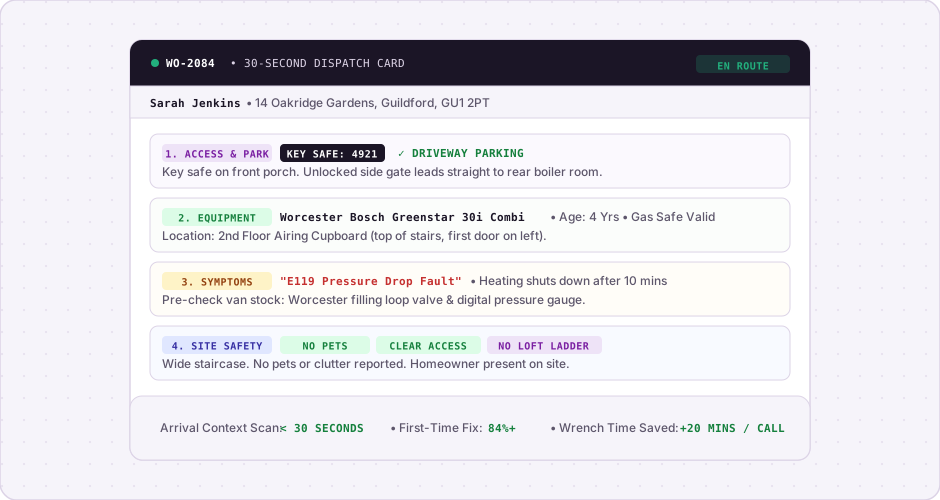
Below is the standardized layout used by high-margin contractors. An engineer reviews this entire field service job card in thirty seconds while pulling up to the curb.
The 4 Mandatory Rules for Every Ticket
- Equipment Snapshot: List make, model, and physical location (e.g., Worcester Bosch Greenstar 30i – Airing Cupboard).
- Exact Quote: Log the homeowner’s exact description (e.g., "E119 pressure fault code blinking"). The engineer grabs the right tools immediately.
- Hazard Check: Flagging pets or tight ladder access takes seconds during booking, preventing injuries and delays.
- Zero Assumptions: If unit age or location is unknown, explicitly log "Unknown – confirm on arrival" so the engineer knows no prior record exists.
How Standardized Handoffs Protect Your First-Time Fix Rate
Eliminating arrival friction directly drives your HVAC first-time fix rate.
Under BESA and SFG20 standards, uncoordinated teams achieve a 65% to 72% first-time fix rate. Nearly one in three jobs requires a return trip because the engineer lacked equipment context.
With clean HVAC technician dispatch notes and a structured HVAC work order handoff, first-time fix rates climb to 84% or higher.
When your engineer sees the exact boiler model and fault history before leaving the shop, they can verify parts in truck stock. They arrive confident, confirm symptoms without frustrating the homeowner, and start fixing immediately.
Clear Notes Unlock Calm Growth
Running a profitable heating business is about eliminating administrative friction points that drain your team's energy.
By upgrading dispatch with standardized HVAC job cards, you eliminate morning phone tag, give engineers clear context, and increase your HVAC first-time fix rate. Most importantly, you reclaim hundreds of lost billable hours that flow straight to your bottom line.
Once your job cards run with precision, the next bottleneck appears: How do you keep vans from wasting half the day crisscrossing across town?
Next in Day 3 of our 15-Day HVAC Systems Series:
The Cross-Town Ping-Pong — How cluster calendar scheduling cuts windshield driving time in half and reclaims one to two billable hours per van every single day.
Want this deployed for your enterprise?
Axontick engineers architect, benchmark, and deploy custom enterprise autonomous systems with guaranteed uptime, sub-second latency, and 100% IP ownership.

Muhammad Asim
Founder @ AxontickFounder of Axontick, specialized in AI automation, Multi-Agent Systems, and enterprise-grade voice agents. Expert in bridging the gap between complex AI technology and practical business solutions.