


Look at your GPS tracking map at 11:00 AM on Tuesday. You will spot an expensive pattern.
Engineer A drives forty minutes north for a boiler service. Engineer B drives thirty-five minutes south for a heat pump check. They cross paths mid-journey, waving as fuel burns and unbilled hours tick away.
This is the cross-town ping-pong.
It happens when dispatchers book appointments first-come, first-served rather than by geographic density. The solution is disciplined HVAC route scheduling. Implementing the Cluster Calendar eliminates unbillable HVAC windshield time, cuts driving by 35%, and reclaims one to two billable hours per van daily.
The Highway Standoff: Anatomy of the Ping-Pong
Most HVAC businesses suffer from a routing leak, not a technician shortage.
When office staff take calls, their reflex is accommodation: "Tuesday at 10:00 AM? Booked." Minutes later, another caller books 11:30 AM across town.
FleetMotion studies show UK engineers spend 20% to 35% of their working day traveling between jobs—paying skilled staff for two driving hours before turning a valve. This haphazard dispatch violates basic field service route optimization, inflating fuel bills and exhausting technicians.
The True Cost of Windshield Time in UK HVAC
Excessive travel is silent margin erosion.
Example (5 Vans): 5 vans × 1.5 unbillable drive hours × £120/hr rate × 240 days = £216,000 in lost annual capacity
Under BESA guidelines, heating engineers command a billable rate of £120 per hour.
Losing 90 minutes daily to zig-zag routes forfeits £180 in billable labor per van daily—over £216,000 annually across five vans.
Add RAC motoring averages of £4,500 to £5,200 per van in yearly diesel, and unmanaged HVAC windshield time becomes your largest operational leak.
The Cluster Calendar: 3-Step Geographic Zoning
You do not need complicated software to solve cross-town driving; you need a disciplined booking framework.
High-margin contractors eliminate route chaos using HVAC zone scheduling, structured through The Cluster Calendar.
| Framework Pillar | The Old Chaos (First-Come, First-Served) | The Cluster Calendar (Geographic Dispatch) |
|---|---|---|
| 1. Service Sectors | Vans roam anywhere across the county daily | Territory split into 3 to 4 distinct postcode sectors |
| 2. Booking Logic | Customers pick arbitrary times on any day | Office steers non-urgent calls into dedicated zone days |
| 3. Travel Threshold | 35 to 55 minutes between consecutive jobs | Maximum 10 to 15 minutes between clustered stops |
Step 1: Divide Territory Into Postcode Sectors
Do not draw circular radiuses around your shop. Circles look tidy on paper, but they ignore the daily reality of UK transit—such as toll bridges, railway bottlenecks, and congested bypasses.
Instead, map your operating territory into three or four distinct postal clusters along primary road arteries (e.g., Sector A along the M1, Sector B along the A10, and Sector C for the urban core).
Assign specific engineers as "Sector Leads" for each zone. Working the same sector lets technicians learn local housing stock (Victorian conversions vs modern unvented systems), navigate parking restrictions, and build relationships with nearby merchant branches.
Step 2: Establish Dedicated Sector Days
Assign fixed weekdays to each zone for non-emergency boiler servicing and maintenance checks.
When a customer calls for routine servicing, dispatch uses the Dedicated Specialist Script:
"Our dedicated heating specialists are scheduled in your postcode sector every Tuesday and Thursday. Would you prefer our 09:00 to 11:00 morning arrival or our 13:00 to 15:00 afternoon window?"
Customers are not told you cannot come today; they are offered a reserved slot with their dedicated local specialist. Nine out of ten accept without hesitation.
Step 3: Implement Cluster Scheduling HVAC Rules
When an engineer is dispatched to a major repair or boiler replacement survey, that job becomes the day's Geographic Anchor.
Dispatch then applies strict cluster scheduling HVAC rules to fill adjacent morning and afternoon slots within a three-mile radius. Rather than a 40-minute drive across town after lunch, their second call is seven minutes away in the neighboring street.
This geographic density preserves technician energy, protects first-time fix rates, and eliminates afternoon schedule collapse.
Route Comparison: Highway Driving vs. Clustered Neighborhoods
The contrast between haphazard dispatch and clustered routing is immediate.
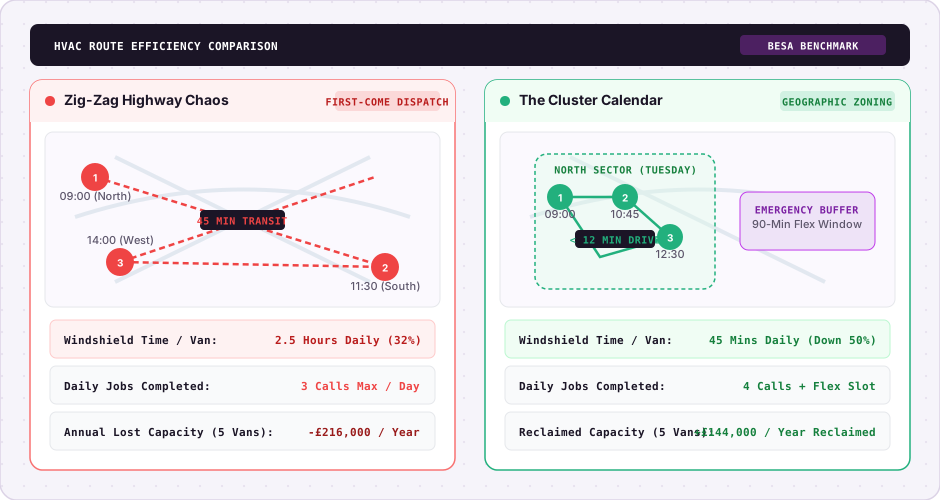
When following clustered routes: Windshield time drops 35% to 50%, saving one to two hours per engineer daily. Engineers complete one extra billable job daily, turning wasted diesel into profit. * Fuel spend drops £1,200+ per vehicle annually, reducing wear and emissions.
The Emergency Buffer Rule: Handling Same-Day Breakdowns
Contractors ask: "What about emergency breakdowns?"
Emergency repairs cannot wait for Thursday's assigned zone. To protect responsiveness while preserving route sanity, high-performing shops use the Emergency Buffer Rule.
Each van reserves a 90-minute afternoon flex window. If an emergency strikes within that active zone, dispatch routes the technician directly without disturbing other commitments. If no emergency occurs by 1:00 PM, the window converts into maintenance or quote follow-ups.
Pairing emergency buffers with field service route optimization delivers rapid response without forcing vans to crisscross the city in panic.
Calm Routes Build High-Margin Businesses
Rushing across town makes an HVAC company chaotic, not productive.
Proactive HVAC route scheduling eliminates gridlock, cuts fuel waste, and reclaims wrench time. Structured HVAC zone scheduling turns unbilled transit into billable profit and gives engineers a predictable workday.
Once technicians arrive promptly in their designated zones, another operational challenge surfaces: What happens when an engineer diagnoses a faulty fan motor, walks back to the van, and discovers the shelf is empty?
Next in Day 4 of our 15-Day HVAC Systems Series:
The Van Inventory Guessing Game — How a 1-tap mobile truck restock loop prevents costly mid-day supply house runs and protects your first-time fix rate.
Want this deployed for your enterprise?
Axontick engineers architect, benchmark, and deploy custom enterprise autonomous systems with guaranteed uptime, sub-second latency, and 100% IP ownership.

Muhammad Asim
Founder @ AxontickFounder of Axontick, specialized in AI automation, Multi-Agent Systems, and enterprise-grade voice agents. Expert in bridging the gap between complex AI technology and practical business solutions.