
Every peak season, HVAC owners get trapped in a frustrating cycle. Phones ring constantly, vans burn fuel across town, and technicians work long days. Yet the monthly profit-and-loss statement shows razor-thin margins.
You are working harder than ever, but your business feels like a leaky bucket.
The root cause is rarely lack of demand or technician skill. The real culprit is the absence of simple HVAC business systems. When a shop operates without clear internal workflows, billable hours vanish into invisible administrative cracks—driving your team into the classic "busy but broke" trap.
To build durable profits, you must stabilize your internal operations before spending another dollar on advertising. The foundation begins with a straightforward concept: The Single Truth Board.
The Wrench Time Reality: Where Did the Hours Go?
Most contractors assume an eight-hour shift produces at least six billable hours. Industry benchmarks show a tougher reality.
According to operational studies from the Building Engineering Services Association (BESA), the average field technician spends only 30% to 50% of their paid shift performing direct, revenue-generating repairs on equipment. This benchmark—known as HVAC technician wrench time—means that out of an eight-hour paid shift, your company bills only 2.5 to 4 hours per technician.
Where does the rest of the day go?
- Windshield Time (12% to 18%): Technicians crisscrossing territory on unorganized routes in traffic.
- Parts Hunting (5% to 8%): Unplanned detours to trade counters for parts missing from van stock.
- Administrative Drag (15% to 20%): Deciphering messy notes, calling for access codes, and searching text threads for equipment details.
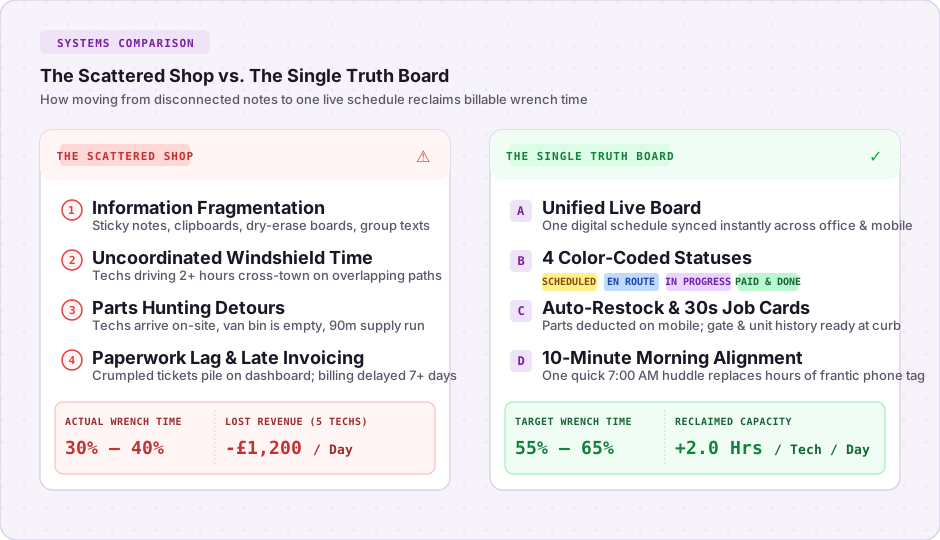
Across five technicians, losing two billable hours per tech daily at a £120 shop rate equals £1,200 in lost revenue daily—or over £280,000 every year.
Example (5 Techs): 5 techs × 2 lost hours × £120/hr = £1,200 / day
Why Adding More Leads Makes the Problem Worse
When margins look thin, many owners assume the cure is more volume: "We need more phone calls." "Let’s increase our budget on Google Local Services Ads." "We need to hire two more technicians."*
Pouring more leads into an unorganized shop floor does not produce healthy HVAC contractor profit margins. It simply accelerates the breakdown. Without standardized HVAC business systems, adding jobs only adds chaos.
If dispatchers are drowning in sticky notes, adding calls leads to missed appointments and angry homeowners. If technicians already waste three hours a day on the road, extra stops cause rushed diagnostics and costly callbacks.
Before turning on the marketing faucet, you must seal internal shop leaks. You need practical workflows that unlock true HVAC operational efficiency.
The Solution: The Single Truth Board
The first system to put in place is The Single Truth Board.
In struggling HVAC companies, vital information is scattered across five disconnected places: 1. The dispatcher's desktop calendar or paper desk pad 2. A group text thread between installers and the service manager 3. Notes scribbled on paper work orders on van dashboards 4. Voice memos on personal cell phones 5. The owner's memory
When facts are scattered, your team wastes the morning asking: "Who has the Smith call?", "Did the 3-ton coil arrive?", or "Did Mrs. Davis pay?"
The Single Truth Board replaces scattered chatter with one live screen that your entire company views and updates in real time.
| Operational Area | The Scattered Shop (High Friction) | The Single Truth Board (Calm Systems) |
|---|---|---|
| Daily Scheduling | Paper sheets, text messages, whiteboard dry-erase markers | Centralized live board updated instantly across phone and desktop |
| Technician Status | Dispatcher calls tech: "Where are you right now?" | 1-tap mobile status: En Route, Working, Complete |
| Customer Notes | Sifting through paper folders or memory | Instant digital job card with equipment history and gate notes |
| Parts Tracking | Tech arrives on-site only to find parts were never ordered | Real-time tag: In Stock, On Van, or Ordered |
| Evening Wrap-Up | 45-minute debrief deciphering handwritten paper slips | Zero debrief needed; jobs and signatures close at the curb |
How to Implement the Board This Week
Whether using specialized software or a clean digital board, clear HVAC dispatch scheduling rules keep crews moving smoothly: 1. The Single Source Rule: If a job is not on the board, it does not exist. No service call is dispatched via side texts or hallway conversations. 2. Four Color-Coded Stages: Keep status scanning instant. Use Yellow (Scheduled), Blue (En Route), Purple (In Progress), and Green (Completed & Paid). A dispatcher should read the entire board in three seconds. 3. The 10-Minute Morning Alignment: Review the board once at 7:00 AM. Confirm parts, verify technician zones, and roll trucks out with zero guesswork.
Stabilize the Inside, Then Scale the Outside
Sustainable business growth does not require eighty-hour workweeks. It requires removing friction so technicians can do what they do best: diagnose systems and keep customers comfortable.
By organizing your shop around proven HVAC business systems like a Single Truth Board, you eliminate the morning scramble, reclaim lost HVAC technician wrench time, and protect your crew from burnout. Most importantly, you establish the foundation required for modern HVAC dispatch scheduling, higher HVAC contractor profit margins, and long-term HVAC operational efficiency.
Once your shop shares a single board, the next bottleneck quickly appears: What happens when your technician pulls into the customer's driveway?
Tomorrow in Day 2 of our 15-Day HVAC Systems Series:
The "Where Are the Notes?" Disaster — How a standardized, 30-second digital job card saves 20 minutes on every service call and stops customer frustration before your technician knocks on the door.
Want this deployed for your enterprise?
Axontick engineers architect, benchmark, and deploy custom enterprise autonomous systems with guaranteed uptime, sub-second latency, and 100% IP ownership.

Muhammad Asim
Founder @ AxontickFounder of Axontick, specialized in AI automation, Multi-Agent Systems, and enterprise-grade voice agents. Expert in bridging the gap between complex AI technology and practical business solutions.