

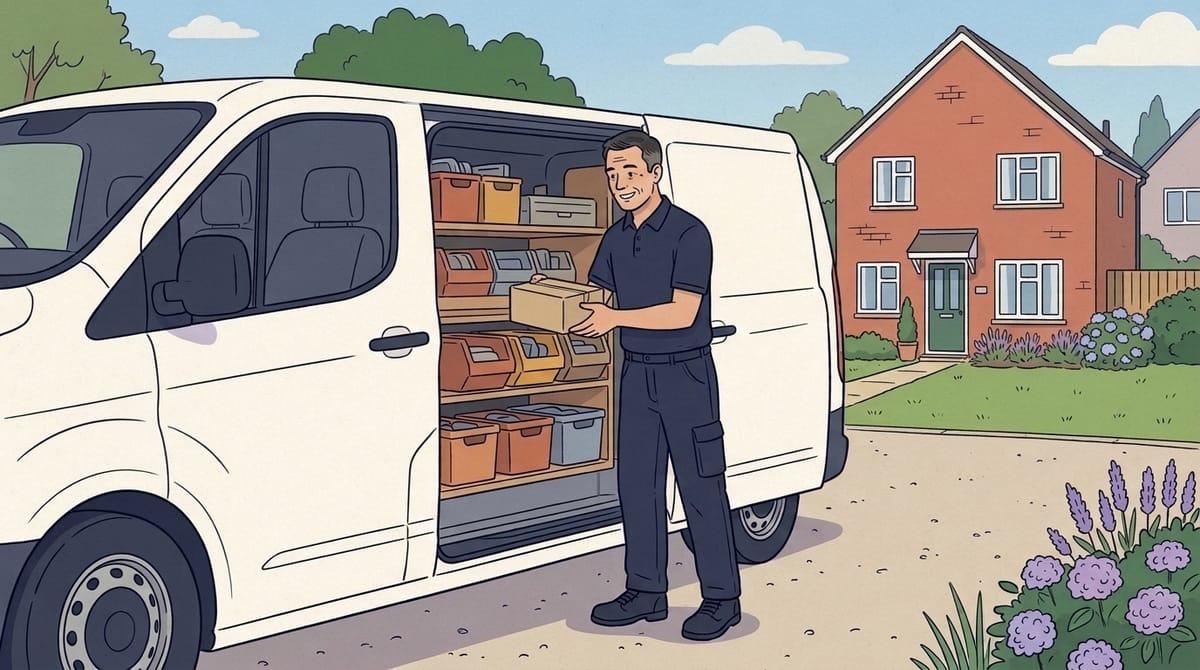
An experienced heating engineer arrives at a cold home, diagnoses a failed igniter in ten minutes, walks back to the van, and discovers an empty box. The component was fitted on Tuesday, never logged, and never replenished.
To finish the job, the engineer must drive 35 minutes to a trade merchant like Wolseley or BSS, queue at the counter, and drive back. A routine 45-minute repair just swallowed three unbilled hours.
Optimizing your HVAC truck inventory is the fastest way to eliminate these costly delays. When engineers carry the exact parts they need, your HVAC first-time fix rate climbs from 70% to over 90%, eliminating callbacks and protecting your daily margins.
The £150 Trip for a £15 Capacitor: The True Cost of Supply House Runs
Mid-day merchant runs are often viewed as an unavoidable trade nuisance. In practice, unexpected supply house runs HVAC teams make quietly drain tens of thousands of pounds each year.
The true economics of an unbilled merchant detour:
- Lost Billable Time: An unplanned supply run takes 60 to 90 minutes round-trip. At a standard shop rate of £120 per hour, that trip consumes £120 to £180 in lost billable labor.
- Fuel and Wear: Driving an extra 15 to 25 miles through traffic adds £8 in fuel and van wear per detour.
- Disrupted Schedules: When a morning call stretches from one hour into three, afternoon appointments must be rescheduled, frustrating waiting homeowners.
Cost of 1 Supply Run = 1.25 Hours Transit (£150 Billable Value) + £8 Fuel = £158 Lost
If five vans average one missing part detour weekly, the business wastes over £38,000 annually. Eliminating unexpected supply house runs HVAC crews make restores immediate cash flow.
Why Traditional Van Stock Management Breaks Down
Most heating and plumbing businesses manage van stock using three broken methods:
- The Morning Free-for-All: Technicians grab parts from central stores at 7:00 AM based on visual guesswork. Engineers over-stock popular parts and forget essentials.
- The Paper Stocktaking Clipboard: The office asks engineers for weekly paper checklists. Tired technicians write hurried estimates, leaving inventory data inaccurate.
- The Unmonitored Merchant Account: Technicians are told to "just stop by the merchant when you run out." Without oversight, unbilled parts slip through and vans accumulate dead stock.
Traditional HVAC van stock management fails because it depends on manual memory after an exhausting workday. When restocking creates extra paperwork, consistency collapses.
The 80/20 Van Stock Blueprint: Standardized Min/Max Par Levels
Service vans should not be mobile warehouses. High-performing contractors treat each vehicle as a standardized micro-store built on the 80/20 rule.
Roughly 80% of breakdown repairs are solved by 25 standardized components. Setting strict Minimum and Maximum (Min/Max) thresholds keeps every vehicle stocked identically:
| Category | High-Turnover Components | Min Par | Max Par |
|---|---|---|---|
| Electrical Controls | Dual-run capacitors, contactors, potential relays, transformers | 2 units | 4 units |
| Ignition & Safety | Universal igniters, flame sensors, limit switches | 2 units | 4 units |
| Airflow & Drainage | Float switches, condensate pumps, drain lines, blower relays | 1 unit | 2 units |
| Heating & Valves | 2-port & 3-port valve actuators, air vents, thermistors | 2 units | 3 units |
| Consumables | Fuses, terminal clips, wire connectors, PTFE tape, fittings | 1 kit | 2 kits |
Standardizing your HVAC truck inventory ensures any engineer can step into any company van and locate critical parts within thirty seconds.
The 1-Tap Restock Loop: Connecting Job Cards to Replenishment
How do you keep shelves full without forcing engineers to count every fitting? You implement an automated closed loop: The 1-Tap Restock Loop.
Replenishment occurs naturally through daily digital work orders:
- Deduct at the Curb: When the engineer installs a part, they tap the item on their mobile job card. The component is billed and deducted from van inventory.
- Automated Replenishment Flag: When stock drops below Minimum threshold, the system flags the part on tomorrow morning's warehouse replenishment queue.
- The Morning Restock Bin: The warehouse coordinator pulls flagged items and places them into a labeled crate matching the van number.
- The 2-Minute Morning Swap: Before their first call, the engineer collects their pre-packed bin, slides parts into their bins, and rolls out.
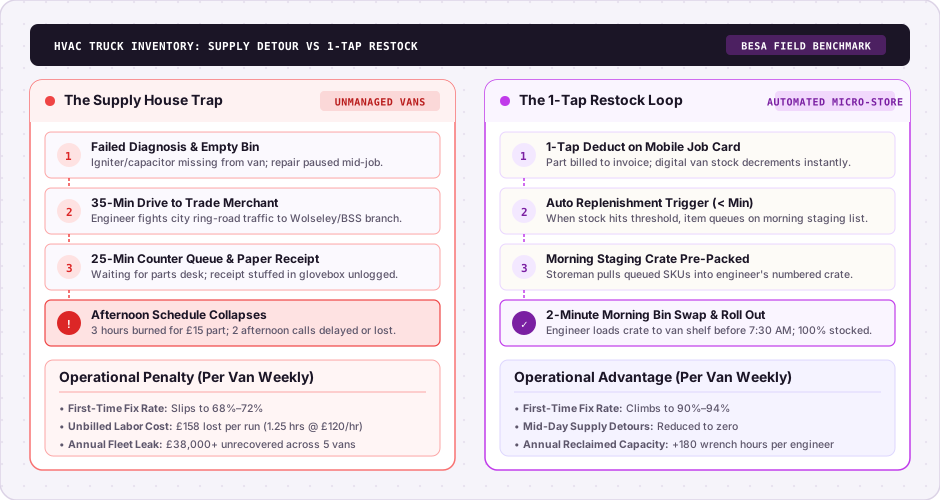
This automated HVAC truck restock loop eliminates paper order forms, prevents forgotten reorders, and ensures vans roll out fully equipped every morning.
Protecting Your First-Time Fix Rate: The 90% Benchmark
First-time fix rate is the ultimate scorecard for service profitability.
When missing parts force return visits, the customer remains without heat, a second truck roll is dispatched for free under callback terms, and double travel time is incurred.
Structured HVAC van stock management reverses this cycle: First-Time Fix Rate exceeds 90%, surpassing the 72% industry baseline. Customer reviews improve, because heating is restored on the initial visit. * Technician frustration drops, as engineers spend their days completing repairs rather than sitting in merchant traffic.
Protecting your HVAC first-time fix rate builds a superior local reputation while reclaiming valuable wrench capacity.
Reliable Van Stock Builds High-Margin Operations
Disorganized vans drain technician morale and company profit.
Discipline and simple automation convert field inventory into a reliable profit driver. Setting standardized par levels and running an automated HVAC truck restock loop stops merchant runs, protects billable hours, and delivers consistent service.
With disciplined HVAC truck inventory in place, the final step in field operations arrives: How do you collect payment, capture customer sign-offs, and close tickets without a mountain of weekend paper invoices?
Next in Day 5 of our 15-Day HVAC Systems Series:
The Friday Paperwork Graveyard — How the Curb-Close Protocol keeps job records complete, sends accurate invoices, and records payment according to agreed terms.
Want this deployed for your enterprise?
Axontick engineers architect, benchmark, and deploy custom enterprise autonomous systems with guaranteed uptime, sub-second latency, and 100% IP ownership.

Muhammad Asim
Founder @ AxontickFounder of Axontick, specialized in AI automation, Multi-Agent Systems, and enterprise-grade voice agents. Expert in bridging the gap between complex AI technology and practical business solutions.