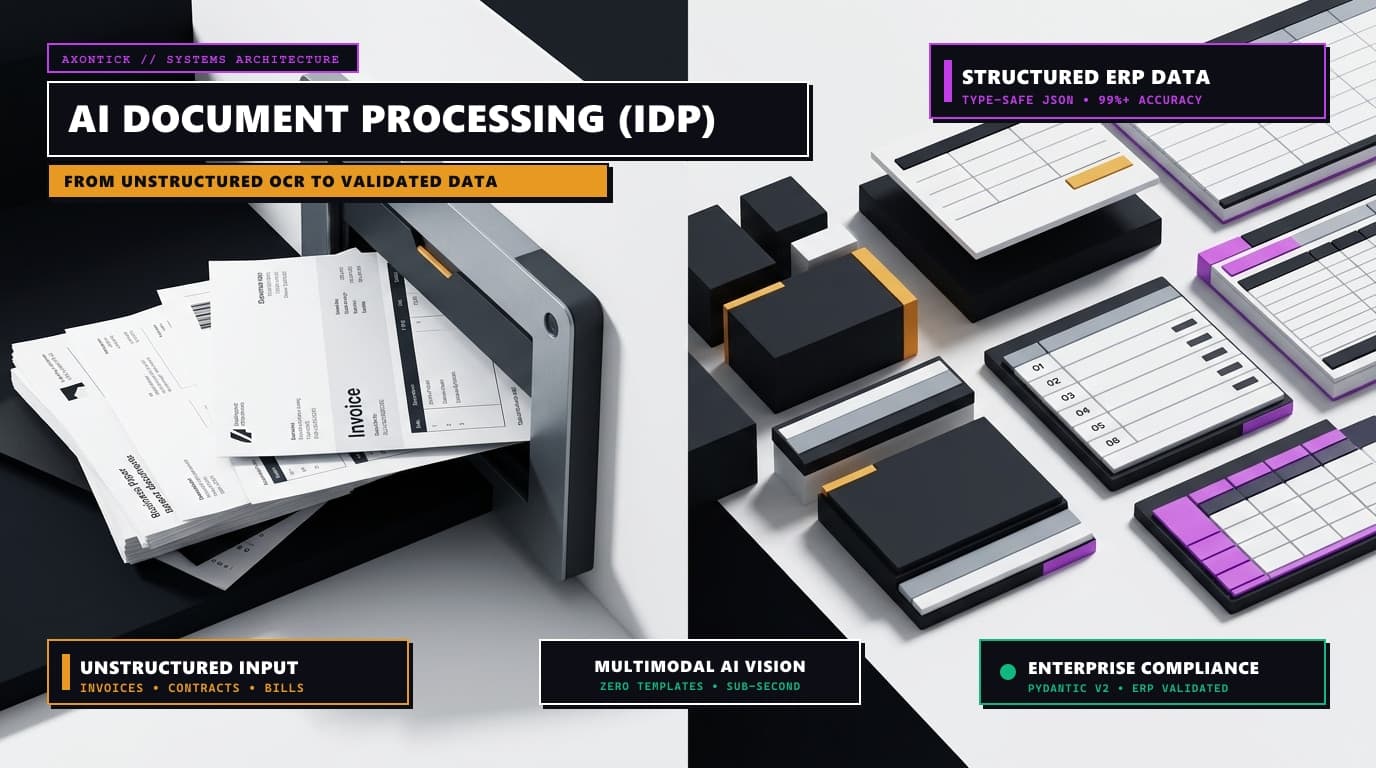
Why rigid coordinate templates collapse on real-world document chaos, and how multimodal vision pipelines deliver 99%+ schema-validated accuracy for enterprise operations.
Optical Character Recognition (OCR) transcribes visual pixels into unformatted character strings without understanding context, while Intelligent Document Processing (IDP) combines multimodal vision models, layout comprehension, and deterministic schema enforcement to convert unstructured documents directly into type-safe, ERP-ready JSON. Where legacy OCR engines break when an invoice column shifts by two millimeters, modern AI document processing OCR pipelines understand document semantics, extract nested line items, parse cursive handwriting, and reconcile mathematical totals autonomously. This technological leap establishes a new benchmark for end-to-end automated document processing across enterprise back-offices, separating brittle manual data entry from resilient operational workflows.
+---------------------------------------------------------------------------------------------------+
|                                  THE PARADIGM SHIFT IN DOCUMENT AI                                |
+---------------------------------------------------------------------------------------------------+
|  LEGACY OCR PIPELINE:                                                                             |
|  [Scanned PDF] ---> [Tesseract / Pixel Scan] ---> [Raw String Dump] ---> [Regex/Templates] --->   |
|                                                                          (Fails on layout shift)  |
|                                                                                                   |
|  MODERN MULTIMODAL IDP PIPELINE:                                                                  |
|  [Scanned PDF] ---> [Hybrid Layout Parser]   ---> [Vision LLM (VLM)] ---> [Pydantic Validation]   |
|                     (Text + Spatial Tiles)        (Semantic Reasoning)    |-- Valid -> [ERP Sync] |
|                                                                           +-- Invalid -> [HITL]   |
+---------------------------------------------------------------------------------------------------+
Why Regex and Template OCR Break on Real Invoices
Traditional optical character recognition was designed for uniform, single-column documents such as scanned books, legal deposition transcripts, and fixed government forms. In these idealized environments, character bounding boxes follow predictable coordinate grids. A developer can write a zonal script instructing the parser to extract whatever text appears between coordinates (x: 140, y: 320) and (x: 480, y: 380) and assign that value as the invoice total.
In real-world enterprise operations, however, documents are rarely uniform. An accounts payable department receives thousands of bills each month from hundreds of distinct suppliers. Each vendor uses a unique document geometry, custom font hierarchy, dynamic header spacing, and unpredictable table boundaries. When a supplier updates their invoicing software or adds a discount banner at the top of the page, physical bounding coordinates shift downward. Legacy zonal templates immediately break, capturing garbage strings or failing to detect totals altogether.
BRITTLE TEMPLATE-BASED EXTRACTION (ZONAL OCR):
+-------------------------------------------------------+
| VENDOR INC.                                           |
|                                                       |
| [New Promotional Banner Added]   <-- Shifts text down |
|                                                       |
| INVOICE TOTAL: $4,850.00                              |
|   ^                                                   |
|   |--- Expected box at (Y:320): Captures blank space!  |
+-------------------------------------------------------+

SEMANTIC INTELLIGENT PARSING (MULTIMODAL IDP):
+-------------------------------------------------------+
| VENDOR INC.                                           |
|                                                       |
| [New Promotional Banner]                              |
|                                                       |
| INVOICE TOTAL: $4,850.00                              |
|   ^                                                   |
|   |--- Vision LLM identifies semantic label 'TOTAL'   |
|        and extracts currency value '$4,850.00'        |
|        regardless of physical page position.          |
+-------------------------------------------------------+
Engineers historically attempted to rescue brittle zonal systems by wrapping raw OCR outputs in complex regular expressions (regex). But regex patterns are notoriously fragile when confronted with OCR typos, optical noise, and multi-line formatting. A simple speck of dust on a flatbed scanner turns $1,050.00 into S1,O50.OO, completely defeating numeric regex matching. Furthermore, regex cannot infer semantic relationships; it cannot determine whether an extracted date represents the invoice issue date, payment due date, shipping date, or period-of-performance window.
This technical fragility creates a massive operational bottleneck known as the "OCR triage tax." Benchmark evaluations across high-volume document pipelines reveal that legacy template tools achieve only 60% to 80% extraction accuracy on complex, unstructured, or degraded multi-page layouts. Consequently, human operators must manually review and re-key four out of every ten documents, defeating the economic premise of automation. Modern intelligent document parsing replaces fragile spatial coordinates with semantic scene understanding, treating documents as structured visual entities rather than flat bags of text. When evaluating alternatives to brittle regex scripts, AI document processing OCR architectures allow systems to interpret changing document topologies dynamically. By transitioning to intelligent document processing IDP, engineering teams eliminate template maintenance entirely while maintaining deterministic accuracy across thousands of disparate document formats.
Multimodal LLM Vision vs. Legacy OCR Engines
The fundamental limitation of legacy OCR engines like Tesseract, Abbyy FineReader, or basic cloud vision APIs is their visual isolation. These engines operate as two-dimensional raster scanning algorithms: they detect edges, group pixels into character contours, match contours against known glyph dictionaries, and spit out raw strings. They possess zero comprehension of layout hierarchy, spatial adjacency, or domain context.
In contrast, modern Vision-Language Models (VLMs) process images and typography concurrently within a shared embedding space. Rather than flattening visual data, multimodal AI extraction models process images and typography concurrently to preserve complex relational hierarchies. A VLM does not merely read the letters T-O-T-A-L; it visually analyzes the geometry of the page. It perceives that the word sits at the bottom right corner of an enclosed border, rendered in bold font, vertically aligned with an itemized column of prices, and directly opposite the phrase "Net 30 Days." This spatial and linguistic awareness enables zero-shot document classification and extraction without requiring pre-configured layout templates.
+---------------------------------------------------------------------------------------------------------+
|                                 OCR ENGINE VS. MULTIMODAL VLM COMPARISON                                |
+---------------------------------------------------------------------------------------------------------+
| DIMENSION                 | LEGACY OCR ENGINES                  | MULTIMODAL AI AGENTS (IDP)            |
+---------------------------+-------------------------------------+---------------------------------------+
| Core Mechanism            | Raster glyph pattern matching       | Joint visual-linguistic transformers  |
| Layout Handling           | Fixed coordinates & zonal masks     | Dynamic spatial scene comprehension   |
| Baseline Accuracy         | 60%–80% on complex layouts          | 99%+ on standardized benchmarks       |
| Table Extraction          | Breaks on borderless/merged cells   | Preserves row/col tree relationships  |
| Handwriting Recognition   | Near-zero accuracy on cursive text  | Robust multi-script comprehension     |
| Schema Enforcement        | External post-processing required   | Native JSON schema / Pydantic output  |
| Processing Cost (Page)    | $0.0015                             | $0.015 – $0.035 (Optimized hybrid)    |
| Error Recovery            | Silent failure / garbled text       | Confidence scoring & triage routing   |
+---------------------------------------------------------------------------------------------------------+
Empirical data substantiates this architectural leap. In standardized document understanding benchmarks such as DocVQA, modern agentic parsing pipelines evaluate visual documents directly to answer complex operational questions. Recent benchmark testing by LandingAI demonstrates that specialized multimodal IDP pipelines achieve up to 99.16% accuracy on DocVQA validation splits, proving that downstream models can interpret complex business documents without manual human transcription. By incorporating intelligent document parsing into ingestion pipelines, organizations extract tabular entities with complete contextual fidelity.
However, pure multimodal vision inference is not a silver bullet. Naively feeding full 300-DPI high-resolution document scans into multi-billion-parameter frontier models introduces latency penalties (frequently exceeding 4,000ms per page) and drives up inference token costs. Production systems resolve this through a hybrid architecture:
- Native Text Layer Extraction: If an incoming PDF contains digital text, the system uses high-speed geometric parsers (such as
pdfminerorPyMuPDF) to extract digital characters and bounding boxes directly in sub-50 milliseconds. - Selective Visual Routing: Raster image conversion and VLM inference are reserved exclusively for scanned imagery, complex visual tables, handwritten signatures, and layout disambiguation.
Research on legal document intelligence using the Contract Understanding Atticus Dataset (CUAD) confirms the power of this hybrid approach. Incorporating a dedicated OCR and layout parsing stage alongside MLLM routing produces an approximate 10% accuracy lift compared to relying purely on raw vision inference. Furthermore, benchmark evaluations on enterprise RAG pipelines (such as EnterpriseDocBench) show that hybrid retrieval approaches combining dense embeddings with layout-aware sparse retrieval achieve an nDCG@5 score of 0.92, compared to just 0.83 for pure dense vector retrieval. Combining precision character extraction with transformer-based visual reasoning allows modern AI document processing OCR architectures to achieve enterprise-grade reliability at manageable operational costs.
The 2025–2026 AI Model Landscape for Enterprise Document Intelligence
The frontier of multimodal document AI is no longer a monolithic race between generic chatbots. Today's enterprise architectures orchestrate specialized model families tailored to reasoning depth, bulk throughput, context length, and private sovereignty:
| Model Architecture | Provider / Ecosystem | Primary Document Superpower | Context Window | Test-Time Reasoning | Native Spatial Grounding | Enterprise Deployment Mode | Effective Cost / 1K Pages |
|---|---|---|---|---|---|---|---|
| Claude Sonnet 5 | Anthropic | Multi-page contract audits, mathematical ledger verification, cursive handwriting | 200K tokens | Dynamic Extended Thinking | High (Visual semantic attention) | Managed Cloud API | $25.00 – $45.00 |
| Gemini 3.8 Flash | Google Cloud | Ultra-low-latency bulk ingestion, sub-second receipt and bill of lading parsing | 1.05M tokens | Fast single-pass (or Flash Thinking) | Native spatial patch tokens | Managed Cloud API / Vertex AI | $2.50 – $6.00 |
| Gemini 3.1 Pro | Google Cloud | 300+ page loan dossiers, SEC 10-K filings, global cross-document RAG | 2.09M tokens | Optional extended thinking | Native multi-page document scanning | Managed Cloud API / Vertex AI | $15.00 – $30.00 |
| OpenAI GPT-5.6 / GPT-5.6 mini | OpenAI | Guaranteed JSON Schema adherence via constrained decoding, ERP ingestion | 128K tokens | Single-pass omni (o1/o3 for reasoning) | Visual grid tile patches | Managed Cloud API / Azure OpenAI | $3.00 – $20.00 |
| Qwen 3.8-VL (72B / 7B) | Alibaba / Open-Weights | Sovereign on-premise execution, air-gapped HIPAA/defense compliance, native OCR | 128K tokens | Available via reasoning fine-tunes | Native coordinates [ymin, xmin, ymax, xmax] | Private VPC / On-Prem (vLLM / SGLang) | Amortized GPU compute (~$3.50) |
| ColPali (PaliGemma-based) | Open Source / Hugging Face | End-to-end visual RAG, chart and blueprint retrieval without OCR text chunking | Page-level patches | N/A (Late-interaction visual vectors) | Patch-level visual indexing | Self-Hosted / Vector DB (Qdrant / Milvus) | Amortized indexing compute |
1. Hybrid Reasoning VLMs: Claude Sonnet 5 and OpenAI o1
Standard single-pass VLMs frequently struggle with arithmetic checks and subtle contractual contradictions because they generate tokens sequentially without intermediate planning. When confronted with an invoice containing tiered volume discounts, shipping surcharges, and prorated sales tax, single-pass models often extract stated figures without verifying their internal mathematical validity.
Hybrid reasoning models like Claude Sonnet 5 and OpenAI o1 / o3-mini fundamentally alter this dynamic. By provisioning adaptive thinking tokens, engineers grant the model an internal scratchpad before any JSON output is emitted. During extended thinking, the model visually parses each table cell, cross-multiplies quantity against unit price, verifies that the subtotal equals the sum of line totals, and validates that tax rates match statutory jurisdictions. For enterprise compliance teams, this test-time verification eliminates the "silent hallucination" failure mode where numbers look cosmetically plausible but fail basic ledger reconciliation.
2. High-Throughput Workhorses: Google Gemini 3.8 Flash
In accounts payable and freight logistics, organizations process tens of thousands of bills of lading, customs declarations, and delivery slips daily. At this operational volume, running multi-dollar frontier reasoning models on every routine page is economically unviable.
Gemini 3.8 Flash solves the enterprise throughput dilemma. Combining sub-800ms end-to-end multimodal inference with aggressive pricing (~$0.10 per million input tokens), it allows engineering teams to deploy visual document extraction at costs competitive with legacy cloud OCR while achieving over 98% field accuracy on standard receipts and invoices. In high-velocity pipelines, Gemini 3.8 Flash serves as an agile Tier-2 triage engine, instantly passing high-confidence routine forms and escalating only mathematically suspect documents to heavier reasoning models.
3. Ultra-Long Context Ingestion: Gemini 3.1 Pro
Traditional document ingestion pipelines rely on aggressive chunking: dividing a 100-page contract into 4-page snippets, extracting entities from each snippet, and attempting to stitch them back together in a relational database. This fragmentation routinely destroys cross-page semantic context: a warranty disclaimer on page 84 that modifies an indemnity obligation on page 12 is severed by arbitrary chunk boundaries.
With context windows spanning up to 2.09 million tokens, models like Gemini 3.1 Pro process entire 300+ page commercial real estate loan packages, municipal bond prospectuses, and SEC 10-K filings in a single visual prompt. The model maintains global attention across the entire document corpus, resolving cross-page definitions and exhibits without losing context or requiring fragile heuristic stitching.
4. Deterministic Schema Enforcement: OpenAI GPT-5.6 Structured Outputs
One of the greatest operational hazards in automating document pipelines is JSON syntax drift: unexpected null values, missing keys, or hallucinated markdown wrappers that crash downstream ERP databases.
OpenAI GPT-5.6 addresses this through grammar-constrained decoding (Structured Outputs). Rather than treating schema compliance as a soft prompt instruction, the model's token-generation logits are constrained at the inference engine level to conform strictly to a supplied JSON Schema or Pydantic contract. This guarantees that every emitted payload is 100% syntactically valid, eliminating downstream deserialization exceptions in SAP, Oracle NetSuite, and Workday.
5. Sovereign On-Premise Execution: Qwen 3.8-VL for Regulated Sectors
For enterprises in healthcare, defense, and investment banking, sending patient records, classified schematics, or non-public financial disclosures to public cloud APIs violates HIPAA, ITAR, or GDPR compliance standards.
The release of Qwen 3.8-VL (72B and 7B) has transformed sovereign document AI. Benchmarking on par with proprietary commercial models across DocVQA, ChartQA, and InfoVQA, Qwen 3.8-VL can be hosted entirely within private virtual clouds (VPCs) or air-gapped on-premise GPU clusters using inference engines like vLLM and SGLang. Furthermore, Qwen 3.8-VL introduces native dynamic resolution support—processing documents at their native aspect ratios without distortion—and outputs explicit spatial coordinates [ymin, xmin, ymax, xmax], providing audit-ready bounding box overlays for every extracted field.
6. Visual Document Retrieval: ColPali and the End of Text-Only RAG
In traditional document search pipelines, PDFs are converted to text via OCR, split into sentences, and embedded into vector databases. This process completely destroys non-textual information: engineering schematics, organizational charts, flow diagrams, and complex financial tables are flattened into unreadable text soups.
The ColPali architecture (built on Vision-Language Models like PaliGemma) introduces multi-vector late-interaction retrieval for document images. Rather than extracting text, ColPali embeds page images directly as visual patch representations. When an engineer queries "hydraulic pump flow diagram with bypass valve," ColPali matches the visual topology of the schematic directly, outperforming traditional text-based chunking on visual document benchmarks like ViDoRe.
Extracting Complex Tables, Handwritten Notes, and Multi-Page Legal Clauses
Document processing pipelines in banking, insurance, logistics, and healthcare face three notorious failure modes: borderless nested tables, handwritten field annotations, and multi-page semantic dependencies.
+---------------------------------------------------------------------------------------------------+
|                            CHALLENGES IN UNSTRUCTURED DATA EXTRACTION                             |
+---------------------------------------------------------------------------------------------------+
| 1. BORDERLESS NESTED TABLES                                                                       |
|    Item Description             Quantity      Unit Price     Subtotal                             |
|    Enterprise Cloud License        12           $450.00      $5,400.00                            |
|      - Add-on: Dedicated VPC       12            $75.00        $900.00   <-- Nested child item    |
|    Support Retainer (Tier 1)        1         $1,200.00      $1,200.00                            |
|                                                                                                   |
| 2. HANDWRITTEN FIELD ANNOTATIONS                                                                  |
|    Payment Terms: [Net 30]  -->  Handwritten margin scribble: "Approved Net 60 - per CFO 10/12"   |
|                                                                                                   |
| 3. MULTI-PAGE CONTRACT DEPENDENCY                                                                 |
|    Page 2: "Governed by Master Terms under Section 14.2..."                                       |
|    Page 18, Section 14.2: "Total liability capped at 2x annual contract value ($500,000)..."      |
+---------------------------------------------------------------------------------------------------+
1. Reconstructing Borderless and Multi-Line Tables
In financial statements, bills of lading, and freight manifests, tables rarely follow strict HTML-style gridlines. Instead, they rely on subtle whitespace indentation, multi-line product descriptions, and wrapped column headers. When legacy OCR reads these tables, it flattens the page into horizontal lines of text, interweaving descriptions from column one into prices from column two.
Modern multimodal AI extraction systems evaluate tables through structural similarity metrics like Tree-Edit-Distance-based Similarity (TEDS), established by the OmniDocBench standard. Rather than extracting flat text, vision models such as Claude Sonnet 5 (leveraging adaptive thinking to cross-check cell alignments) and Qwen 3.8-VL reconstruct the document's hierarchical Document Object Model (DOM), explicitly encoding rowspan, colspan, and nested parent-child hierarchies. If an invoice item contains a parent SKU with three indented sub-component line items, the vision agent recognizes the visual indentation as an object hierarchy, emitting nested JSON arrays rather than fragmented lines.
2. Disambiguating Handwritten Annotations
Field operations in construction, logistics, and clinical trials frequently rely on paper forms stamped, signed, or modified with pen ink. An engineer might cross out an initial delivery date on a shipping manifest and scribble "Rerouted to Dock B, 14:00" in the margin.
Legacy OCR engines treat handwritten ink as scanning artifacts or unreadable noise, either dropping the text or outputting gibberish characters. Modern multimodal models like Claude Sonnet 5 and Qwen 3.8-VL analyze the stroke dynamics, font variance, and spatial proximity of the annotation to the printed field. The pipeline extracts both the original printed text and the handwritten amendment, flagging the document with a metadata tag: handwritten_override_detected: true. This allows downstream workflows to trigger targeted managerial reviews before updating core enterprise databases.
3. Resolving Multi-Page Dependencies in Legal Contracts
In enterprise contract analysis, a single covenant cannot be interpreted in isolation. A limitation-of-liability clause on page 4 of a Master Services Agreement (MSA) may reference definitions established on page 2 and an indemnification schedule detailed in Exhibit B on page 48.
When traditional tools extract text page-by-page, cross-page semantic context collapses. Next-generation contract auditing AI solves this through stateful document chunking and cross-page entity resolution, powered by 2M-token context windows in models like Gemini 3.1 Pro and deep reasoning loops in Claude Sonnet 5:
+----------------------------------------------------------------------------------------------------+
|                               STATEFUL CONTRACT AUDITING ARCHITECTURE                              |
+----------------------------------------------------------------------------------------------------+
|  [Multi-Page PDF]                                                                                  |
|        |                                                                                           |
|        v                                                                                           |
|  [Document Graph Extractor] ---> Builds cross-page entity tree (Definitions -> Clauses -> Exhibits) |
|        |                                                                                           |
|        v                                                                                           |
|  [Focused Clause Agent]     ---> Ingests targeted clause + cross-referenced definitions            |
|        |                                                                                           |
|        v                                                                                           |
|  [Pydantic Audit Schema]    ---> Emits structured audit risk assessment:                           |
|                                  - Clause Type: "Limitation of Liability"                          |
|                                  - Cap Amount: "$1,000,000 USD"                                    |
|                                  - Mutual vs One-Way: "Mutual"                                     |
|                                  - Super-Cap Exceptions: ["IP Infringement", "Gross Negligence"]   |
+----------------------------------------------------------------------------------------------------+
By decoupling raw character extraction from relational document graphs and pairing 2M-token context windows with targeted clause reasoning agents, enterprise audit systems verify compliance across 100-page loan packages and MSAs in minutes, eliminating weeks of manual legal review.
Automated Schema Validation: Guaranteeing Valid JSON Output
The most severe architectural vulnerability in LLM-based document automation is non-deterministic output formatting. A generative model prompted to "extract invoice data into JSON" will inevitably hallucinate Markdown code fences (```json ... ``), emit trailing commas, change key names between requests (e.g., oscillating between invoice_number, inv_no, and id`), or omit required nested arrays.
Feeding unvalidated generative text directly into enterprise resource planning (ERP) platforms like SAP, Oracle NetSuite, or QuickBooks is an operational disaster. A single malformed date string or unexpected null value crashes automated ingestion jobs, corrupting financial ledgers and halting accounts payable cycles. Reliable schema enforcement is the missing link required to achieve touchless automated document processing in financial and legal systems.
Deploying deterministic schema validation transforms experimental scripts into enterprise-grade AI document processing OCR infrastructure. Combining Pydantic schemas with multimodal AI extraction ensures that extracted values conform to strict downstream database constraints. While modern APIs like OpenAI GPT-5.6 (via Structured Outputs), Anthropic Claude Sonnet 5 (via tool-use definitions), and Google Gemini 3.8 (via responseSchema) enforce strict syntactic JSON formatting during token generation, application-level Pydantic validators provide the necessary layer of semantic verification: ensuring that line items multiply accurately and reconcile against stated totals. The production Python implementation below demonstrates an enterprise-grade extraction pipeline. It defines a rigid data contract for invoice parsing, performs runtime type coercion, verifies mathematical consistency, and executes automated correction loops upon validation failure.
"""
Production-Ready Intelligent Document Processing (IDP) Pipeline.
Demonstrates structured multimodal extraction with Pydantic v2 validation,
mathematical reconciliation checks, and automated error recovery.
"""

from typing import List, Optional
from decimal import Decimal
import json
from pydantic import BaseModel, Field, field_validator, model_validator


class LineItem(BaseModel):
    sku: Optional[str] = Field(default=None, description="Product or service SKU code")
    description: str = Field(..., description="Itemized service or goods description")
    quantity: Decimal = Field(..., gt=0, description="Quantity delivered; must be strictly positive")
    unit_price: Decimal = Field(..., ge=0, description="Price per unit")
    line_total: Decimal = Field(..., description="Stated total for this line item")

    @model_validator(mode="after")
    def verify_line_math(self) -> "LineItem":
        expected_total = (self.quantity * self.unit_price).quantize(Decimal("0.01"))
        stated_total = self.line_total.quantize(Decimal("0.01"))
        if abs(expected_total - stated_total) > Decimal("0.05"):
            raise ValueError(
                f"Line math mismatch: {self.quantity} * {self.unit_price} = "
                f"${expected_total}, but document stated ${stated_total}"
            )
        return self


class InvoiceExtraction(BaseModel):
    vendor_name: str = Field(..., min_length=2, description="Legal entity name of issuing vendor")
    vendor_tax_id: Optional[str] = Field(default=None, description="EIN, VAT, or registered Tax ID")
    invoice_number: str = Field(..., min_length=1, description="Primary invoice identifier")
    invoice_date: str = Field(..., pattern=r"^\d{4}-\d{2}-\d{2}$", description="ISO 8601 date YYYY-MM-DD")
    currency: str = Field(default="USD", min_length=3, max_length=3, description="ISO 4217 currency code")
    line_items: List[LineItem] = Field(..., min_items=1, description="List of itemized invoice entries")
    subtotal: Decimal = Field(..., ge=0, description="Calculated subtotal before taxes and discounts")
    tax_amount: Decimal = Field(default=Decimal("0.00"), ge=0, description="Total sales or VAT tax applied")
    total_amount: Decimal = Field(..., gt=0, description="Final payable amount")

    @model_validator(mode="after")
    def verify_invoice_reconciliation(self) -> "InvoiceExtraction":
        # 1. Sum up all validated line items
        calculated_lines_sum = sum(item.line_total for item in self.line_items).quantize(Decimal("0.01"))
        stated_subtotal = self.subtotal.quantize(Decimal("0.01"))

        if abs(calculated_lines_sum - stated_subtotal) > Decimal("0.10"):
            raise ValueError(
                f"Invoice reconciliation failed: Line items sum to ${calculated_lines_sum}, "
                f"but stated subtotal is ${stated_subtotal}"
            )

        # 2. Check total payable against subtotal + tax
        expected_total = (self.subtotal + self.tax_amount).quantize(Decimal("0.01"))
        stated_total = self.total_amount.quantize(Decimal("0.01"))

        if abs(expected_total - stated_total) > Decimal("0.10"):
            raise ValueError(
                f"Grand total reconciliation failed: Subtotal (${self.subtotal}) + Tax (${self.tax_amount}) = "
                f"${expected_total}, but stated total is ${stated_total}"
            )
        return self


class DocumentExtractionEngine:
    """
    Simulated runtime harness demonstrating multimodal extraction
    with automated schema validation and self-healing retry logic.
    """

    def __init__(self, max_retries: int = 2):
        self.max_retries = max_retries

    def execute_extraction(self, raw_model_response: dict) -> InvoiceExtraction:
        """
        Validates raw dictionary output from a Vision LLM against our Pydantic schema.
        Raises descriptive validation errors if the extraction fails business rules.
        """
        try:
            validated_record = InvoiceExtraction(**raw_model_response)
            return validated_record
        except Exception as err:
            # In a production pipeline, this error string is fed back to the LLM
            # in an automated retry loop: "Your output failed schema validation: {err}. Please rectify."
            raise ValueError(f"Schema validation failure: {str(err)}")


# Production Unit Test Verification
if __name__ == "__main__":
    sample_payload = {
        "vendor_name": "Axontick Enterprise Systems LLC",
        "vendor_tax_id": "XX-XXXXXXX",
        "invoice_number": "INV-2026-8841",
        "invoice_date": "2026-10-13",
        "currency": "USD",
        "line_items": [
            {
                "sku": "AI-AGENT-DEPLOY",
                "description": "Multimodal IDP Architecture Sprint",
                "quantity": 2,
                "unit_price": 4500.00,
                "line_total": 9000.00
            },
            {
                "sku": "OBSERVABILITY-SETUP",
                "description": "Automated Confidence Triage Pipeline",
                "quantity": 1,
                "unit_price": 2500.00,
                "line_total": 2500.00
            }
        ],
        "subtotal": 11500.00,
        "tax_amount": 0.00,
        "total_amount": 11500.00
    }

    engine = DocumentExtractionEngine()
    result = engine.execute_extraction(sample_payload)
    print(f"Extraction 100% Validated: {result.vendor_name} | Total: ${result.total_amount}")
This pattern guarantees that no raw or mathematically corrupt string ever reaches an ERP database. If an extracted line item does not multiply correctly, or if the sum of line totals deviates from the stated subtotal, the validator rejects the payload immediately, generating a deterministic error trace that drives automated self-correction or routes the document to a human auditor.
Confidence Scoring and Human-in-the-Loop Exception Routing
Full autonomy in enterprise document processing is an anti-pattern. While state-of-the-art vision models achieve unprecedented accuracy, real-world document streams inevitably present black-swan anomalies: water-damaged paper, missing signature pages, truncated scan margins, or ambiguous payment contingencies. Attempting to force 100% autonomous processing on unvetted edge cases introduces financial and legal risk. Automated exception routing represents the operational backbone of scalable intelligent document parsing across enterprise back-offices.
In high-throughput environments, calibrating confidence thresholds ensures your AI document processing OCR system only escalates genuine ambiguities. A production-ready intelligent document processing IDP deployment maintains strict confidence scoring to catch low-quality or corrupt scans before ingestion. The industry gold standard is the 95/5 Human-in-the-Loop (HITL) operating architecture:
- The Autonomous 95%: Standard, clean, and high-confidence documents pass through multimodal extraction, validation, and ERP ingestion in sub-second automated pipelines.
- The Human 5%: Low-confidence edge cases, mathematical mismatches, or suspicious data points are automatically isolated and routed to human review queues.
+---------------------------------------------------------------------------------------------------+
|                         ENTERPRISE CONFIDENCE TRIAGE & ESCALATION FLOW                            |
+---------------------------------------------------------------------------------------------------+
|                                                                                                   |
|  [Document Ingested] ---> [Multimodal VLM Extraction] ---> [Mathematical & Schema Validation]     |
|                                                                      |                            |
|                               +--------------------------------------+                            |
|                               |                                      |                            |
|                       [Validation Passed]                   [Validation Failed]                   |
|                               |                                      |                            |
|                   Check Confidence Score:                            |                            |
|                   Confidence >= 0.95?                                |                            |
|                     /             \                                  |                            |
|                   YES              NO                                |                            |
|                    |                \                                /                            |
|                    v                 +------------------------------+                             |
|          [Instant ERP Ingestion]                     |                                            |
|          - SAP / NetSuite Sync                       v                                            |
|          - Status: Fully Reconciled         [HITL Exception Queue]                                |
|                                             - Interactive Review Dashboard                        |
|                                             - Highlighting Specific Failing Field                 |
|                                             - Human approves / edits in 15 seconds                |
|                                                      |                                            |
|                                                      v                                            |
|                                             [Feedback Loop to Evaluation Set]                     |
+---------------------------------------------------------------------------------------------------+
Deconstructing the EnterpriseDocBench Hallucination Curve
Recent empirical research published in the EnterpriseDocBench study sheds critical light on where and why document models fail in production. Analyzing hallucination rates across varying document lengths reveals a distinct non-linear curve:
HALLUCINATION RATE BY DOCUMENT LENGTH (EnterpriseDocBench):
+-------------------------------------------------------------------+
| Document Length     | Hallucination Rate | Primary Failure Mode   |
+---------------------+--------------------+------------------------+
| Short (< 3 pages)   | 28.1%              | Over-interpretation    |
| Medium (4–15 pages) | 9.2%               | Optimal context window |
| Long (> 16 pages)   | 23.8%              | Context loss / drift   |
+---------------------+--------------------+------------------------+- Short Documents (28.1% Hallucination): In brief, single-page memos or short receipts, models frequently over-interpret minimal context, "inventing" missing addresses, standard payment terms, or company designations not explicitly present in the source image.
- Long Documents (23.8% Hallucination): In lengthy 50+ page prospectuses or technical blueprints, models suffer from context dilution, losing track of nested definitions or missing isolated line items buried on page 37.
- Medium Documents (9.2% Hallucination): Documents spanning 4 to 15 pages land in the sweet spot of attention mechanics, exhibiting the highest fidelity and lowest hallucination rates.
Equally significant is the study's finding regarding answer completeness. While overall factual accuracy on extracted statements averaged 85.5%, the answer completeness metric hovered around 0.40. This indicates that when a model outputs a fact, it is usually correct, but it frequently omits peripheral, dense, or fine-print details unless explicitly steered by structured schemas.
Designing High-Velocity Triage Interfaces
A human reviewer should never be forced to re-read an entire document from scratch. Modern IDP architectures feature interactive triage UIs that display the original document scan side-by-side with the extracted JSON fields.
If the Pydantic validator flags a line-math mismatch on item #4, the triage UI automatically zooms the human operator's viewport directly to the bounding coordinates of that specific item on the original PDF, highlighting the disputed text in red. Instead of spending 5 minutes re-typing an invoice, the human auditor confirms or corrects the single field in 10 seconds. The corrected record is logged into an active evaluation dataset, providing ground-truth training pairs to continuously refine system prompts and validation rules.
Operational Economics: Latency, Token Costs, and ROI Benchmarks
When evaluating document automation strategies, executive leadership must weigh three competing variables: computational cost per page, end-to-end processing latency, and post-processing human labor expense. The economic calculus of intelligent document processing IDP becomes undeniable when analyzing total cost of ownership across high-volume document workflows.
+-------------------------------------------------------------------------------------------------------------+
|                                    TOTAL COST OF OWNERSHIP (PER 1,000 PAGES)                                |
+-------------------------------------------------------------------------------------------------------------+
| EXTRACTION METHOD            | COMPUTE COST  | HUMAN TRIAGE COST | EFFECTIVE ACCURACY | TOTAL COST / 1K PGS |
+------------------------------+---------------+-------------------+--------------------+---------------------+
| Manual Data Entry            | $0.00         | $2,500.00         | 92% – 95%          | $2,500.00           |
| Legacy Template OCR          | $1.50         | $1,050.00 (42% er)| 60% – 80%          | $1,051.50           |
| Raw Multimodal LLM (Pure VLM)| $38.00        | $225.00 (9% err)  | 91% – 94%          | $263.00             |
| Optimized Hybrid IDP (Agent) | $18.50        | $50.00 (2% err)   | 99.1%              | $68.50              |
+-------------------------------------------------------------------------------------------------------------+
1. The True Cost of Manual Data Entry
Organizations relying on human clerks spend between $1.50 and $3.50 per invoice when factoring in salaries, benefits, supervisory overhead, and physical workspace expenses. Beyond direct payroll, manual processing imposes severe latency delays: typical invoice turnaround times range from 3 to 7 business days, causing companies to forfeit early-payment vendor discounts (typically 2% Net 10) and exposing supply chains to late-payment penalties.
2. The Fallacy of "Cheap" Legacy OCR
On paper, legacy OCR appears virtually free at approximately $0.0015 per page. However, because traditional OCR achieves only 60% to 80% accuracy on non-standard layouts, organizations must maintain substantial human review teams to manually verify and correct data errors. When four out of every ten documents require manual human re-keying, the effective operational cost of legacy OCR surges past $1.00 per page.
3. The Optimized Hybrid IDP Architecture
By deploying a tiered hybrid system, enterprise operations achieve the ultimate balance of cost, speed, and precision:
- Tier 1 (Fast-Path Geometric Extraction): Native digital PDFs are parsed using open-source Python engines (
pdfminer,PyMuPDF), costing $0.0001 per page with a latency of under 50 milliseconds. - Tier 2 (High-Throughput Multimodal Inference): Routine visual invoices, receipts, and manifests are routed to ultra-fast models like Google Gemini 3.8 Flash or GPT-5.6 mini, costing between $0.0025 and $0.006 per page with latency under 1,000 milliseconds. Prompt caching amortizes repeated header tokens, driving down continuous operational costs.
- Tier 3 (High-Stakes Reasoning & Audit): Complex multi-page loan packages, messy handwriting, and contested contracts are escalated to hybrid reasoning models like Claude Sonnet 5 or OpenAI o1, costing $0.025 to $0.05 per page to execute test-time mathematical reconciliation and cross-clause verification.
- Sovereign Tier (On-Premise / Air-Gapped): Regulated healthcare and defense pipelines execute locally on private GPU clusters running Qwen 3.8-VL 72B via vLLM, eliminating external data egress while delivering amortized compute costs under $0.004 per page.
- Tier 4 (Deterministic Schema Validation): Local Pydantic rules validate calculations in under 2 milliseconds, passing 95%+ of documents directly to ERP sync without human touch. Continuous telemetry monitoring tracks extraction latency and schema validation pass-rates in real time, alerting engineers to unexpected document format drifts.
For an enterprise processing 50,000 invoices and compliance documents monthly, transitioning from legacy OCR to an optimized automated document processing mesh reduces annual operational expenditures from over $600,000 to under $42,000, delivering a comprehensive payback period of less than 60 days.
FAQ
What is the difference between OCR and Intelligent Document Processing (IDP)?
Optical Character Recognition (OCR) transcribes pixels into raw strings without semantic context or layout awareness. Intelligent Document Processing (IDP) combines OCR with multimodal AI, computer vision, and schema enforcement to comprehend document hierarchies, validate business logic, and output type-safe JSON directly into enterprise databases.
Which AI model is best for enterprise document processing in 2025/2026?
Selecting the right model depends on document complexity, throughput requirements, and regulatory constraints:
- High-Volume Invoices & Logistics: Google Gemini 3.8 Flash and OpenAI GPT-5.6 mini offer the best price-to-performance ratio, achieving sub-second extraction at under $0.005 per page.
- Complex Multi-Page Contracts & Financial Audits: Anthropic Claude Sonnet 5 (leveraging dynamic extended thinking) and OpenAI o1 lead the industry in mathematical reconciliation, cursive handwriting disambiguation, and cross-page covenant analysis.
- Mission-Critical ERP Ingestion: OpenAI GPT-5.6 with Structured Outputs guarantees 100% adherence to Pydantic JSON schemas via constrained grammar decoding.
- Air-Gapped & Regulated Environments (HIPAA, ITAR, GDPR): Alibaba Qwen 3.8-VL (72B and 7B) running on private vLLM or SGLang clusters delivers commercial-grade accuracy with zero data egress and native bounding box coordinate prediction.
Can multimodal AI models read handwritten notes on scanned documents?
Yes. Modern Vision-Language Models (VLMs) are trained on diverse multi-lingual handwriting datasets. Unlike legacy OCR engines that fail on cursive or faint ink, multimodal models evaluate stroke dynamics and surrounding context, successfully extracting handwritten margin notes, approvals, and signatures with high fidelity.
How do you prevent AI from hallucinating numbers or invoice totals?
Production pipelines implement programmatic schema enforcement using tools like Pydantic, combined with mathematical verification checks. The pipeline validates that itemized quantities and unit prices multiply out accurately and sum up to stated subtotals before database ingestion, automatically routing discrepancies to human review queues.
Is intelligent document processing compliant with SOC-2, HIPAA, and GDPR?
Yes. Enterprise IDP pipelines run on dedicated Virtual Private Clouds (VPCs) or leverage zero-data-retention (ZDR) enterprise API agreements where inputs are never used for model training. Automated pre-processing microservices scrub Personally Identifiable Information (PII) before documents reach inference endpoints.
Architecting Your Enterprise Document Pipeline
Transitioning from brittle legacy OCR templates to autonomous, multimodal document intelligence is not a speculative science experiment; it is an established operational imperative for scaling modern enterprises. By replacing manual data entry and fragile regex scripts with semantic vision models, strict Pydantic validation, and high-velocity human-in-the-loop triage, organizations eliminate operational backlogs, prevent financial discrepancies, and unlock 24/7 business velocity.
Whether you need to automate multi-page accounts payable matching, parse complex logistics manifests, or execute autonomous contract auditing AI across legacy agreements, Axontick designs, deploys, and maintains production-ready document systems tailored to your enterprise architecture. Deploying next-generation AI document processing OCR creates an agile, audit-proof foundation for autonomous operations.
Explore our interactive AI pricing calculator to project your automation ROI, browse our comprehensive engineering resource library, or read our technical guide on hybrid n8n and Make automation pipelines to start modernizing your document infrastructure today.
Want this deployed for your enterprise?
Axontick engineers architect, benchmark, and deploy custom enterprise autonomous systems with guaranteed uptime, sub-second latency, and 100% IP ownership.

Muhammad Asim
Founder @ AxontickFounder of Axontick, specialized in AI automation, Multi-Agent Systems, and enterprise-grade voice agents. Expert in bridging the gap between complex AI technology and practical business solutions.