The zero-missed-call operational blueprint: How mechanical contractors deploy sub-second autonomous voice intake, emergency dispatch triage, and bi-directional FSM sync under a predictable $500/month fractional engineering retainer.
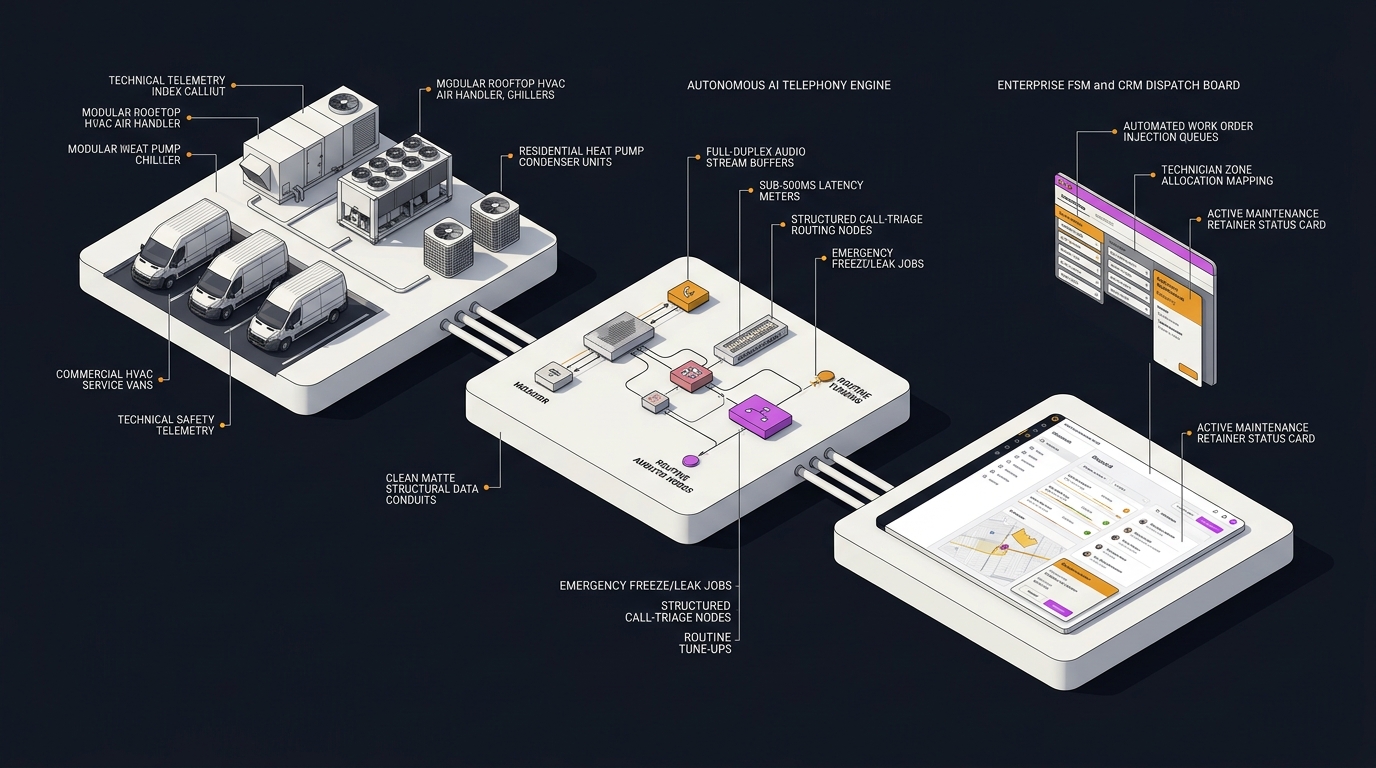
Managed AI for HVAC contractors is an ongoing operational service where dedicated systems engineers deploy, monitor, and continuously tune autonomous voice receptionists, emergency dispatch triage, and bi-directional CRM pipelines for a flat monthly fee—typically $500/month. Unlike brittle one-off setups that crash during freezing cold snaps, managed AI delivers 24/7 call capture with sub-500ms voice response, eliminates empty truck rolls, shields on-call technicians from 2 AM burnout, and automatically writes booked work orders directly into ServiceTitan, Housecall Pro, or Jobber dispatch boards.
In the mechanical trades, the phone is the front door of your shop. If a homeowner’s furnace dies at 9:00 PM during a sub-zero freeze and your line rings four times into voicemail, that customer is not waiting until 8:00 AM. They hang up, tap the next sponsored listing on Google, and hand an $8,500 system changeout to the competitor down the street.
The True Cost of Missed Calls: Leaking $80k–$250k in the Cracks
Every experienced HVAC and plumbing operator knows the foundational rule of service profitability: if you ain’t turning wrenches or rolling trucks, you’re burning cash.
Yet industry benchmarks from Invoca and ServiceTitan reveal a staggering operational leak: residential contractors miss between 27% and 74% of inbound calls. The vast majority of these dropped calls occur after 5:00 PM, on weekends, or during severe seasonal weather transitions when office customer service representatives (CSRs) are buried under ringing lines.
+-----------------------------------------------------------------------------------+
|                        THE SPEED-TO-LEAD DROP-OFF IN TRADES                       |
+-----------------------------------------------------------------------------------+
| 0 to 60 seconds (Live AI Voice Answer):   78% Booking Conversion Rate             |
| 1 to 5 minutes (Manual Call-Back):         34% Booking Conversion Rate             |
| 30+ minutes (Voicemail Call-Back):        11% Booking Conversion Rate             |
| Next-Morning Follow-Up:                    2% Booking Conversion Rate             |
+-----------------------------------------------------------------------------------+
When an emergency lead drops, the financial loss is not the $99 diagnostic fee—it is the lost lifetime value and the high-ticket replacement job. Consider the real numbers for a typical 5-to-15-truck residential heating and cooling shop:
- The Cost of Paid Acquisition: Contractors routinely bid $35 to $65 per click on Google Local Services Ads (LSA) and Pay-Per-Click campaigns. Paying top dollar to direct a high-intent homeowner with frozen pipes or a dead compressor into an unmonitored voicemail box is financial malpractice. This is precisely why forward-thinking mechanical operators are turning to managed AI for HVAC contractors to bridge the gap between expensive ad clicks and booked revenue.
- The High-Ticket System Changeout: The average residential HVAC system changeout ranges between $7,500 and $14,000. Missing just two replacement opportunities a month bleeds over $200,000 in top-line revenue annually.
- The Unnecessary Truck Roll: When non-emergency calls are dispatched haphazardly after hours, shop owners pay time-and-a-half or double-time overtime to on-call journeymen for simple issues like a blown 3-amp fuse or dead thermostat batteries. By deploying an autonomous AI receptionist for HVAC, shops answer 100% of calls within two rings and screen every inquiry before rolling a truck.
Hiring a full-time overnight CSR costs between $45,000 and $55,000 per year before payroll taxes, insurance, and benefits. Conversely, legacy call centers charge $1.50 to $2.50 per minute to read rigid, robotic scripts, mispronounce trade terminology, and drop unformatted text messages into a dispatcher's inbox.
The "Build-and-Run" Trap: Why One-Off AI Setups Always Break
Over the past two years, dozens of contractors have attempted DIY setups or hired freelance bot builders to assemble Zapier webhooks and conversational voice wrappers. Almost every one-off setup fails within 90 days. Without continuous engineering oversight, one-off bots decay, reinforcing the operational necessity of managed AI for HVAC contractors over temporary freelance builds.
                                  ONE-OFF BUILD
                                (The 90-Day Failure)
  +------------------+         +------------------+         +------------------+
  |  Freelance Bot   | ------> |  Seasonal Shift  | ------> |  Silent API Drift|
  |  Setup ($3k-$5k) |         |  (July -> Dec)   |         |  (Broken Bookings|
  +------------------+         +------------------+         +------------------+
                                        |                            |
                                        v                            v
                               Hallucinations at 2 AM         Missed $10k Changeouts
                                                              Tech Burnout & Churn
Why do static setups collapse in real-world contracting?
1. The Shock of Dynamic Trade Seasonality
A voice prompt programmed in July is engineered around refrigerant leaks, frozen evaporator coils, capacitor failures, and air conditioning tune-up promotions. When the first polar vortex arrives in November, customer intent flips overnight to no-heat emergencies, cracked heat exchangers, furnace lockouts, and frozen water lines. A static bot lacks seasonal awareness, attempting to book routine daytime visits for frantic homeowners whose indoor temperatures are plunging below 45 degrees.2. Silent API and FSM Schema Drift
Field service management software platforms update continuously. When ServiceTitan, Housecall Pro, or Jobber pushes an API release, updates custom field structures, or alters arrival window payloads, brittle Zapier automations fail silently. The contractor believes their automation is operating, while booked calls disappear into limbo and prospective customers vanish.3. Edge-Case Triage and Prompt Decay
Without continuous transcript auditing, AI agents accumulate conversational edge cases. A caller reporting a faint gas smell near their water heater might be treated as a routine inspection inquiry rather than an immediate life-safety evacuation hazard. Without ongoing human-in-the-loop review, slight prompt drifts alienate callers and trigger severe liabilities.The Solution: A Dedicated $500/Month HVAC Automation Maintenance Retainer
The solution to the build-and-run trap is treating automation not as a software product, but as an operational utility backed by an ongoing engineering partnership. A dedicated implementation of managed AI for HVAC contractors transforms brittle software into an appreciating operational asset.
An HVAC automation maintenance retainer provides mechanical contractors with a dedicated systems engineer who functions as a fractional automation mechanic for their digital front office. For a flat $500/month, the shop secures 24/7 operational reliability, continuous optimization, and proactive system defense.
                      AXONTICK MANAGED PARTNERSHIP
                    ($500/Month Engineering Retainer)
  +--------------------------------------------------------------------+
  |  1. Weekly Transcript Audits & Voice Activity Detection (VAD) Tuning|
  |  2. Proactive Seasonal Switchovers (Summer AC -> Winter Heating)   |
  |  3. FSM Schema & Webhook Drift Defense (ServiceTitan / Jobber)      |
  |  4. Zero-Downtime Model Upgrades (Claude Haiku / Cartesia / Groq)   |
  |  5. 24/7 Telephony Health Monitoring & Carrier SLA (A2P 10DLC)      |
  +--------------------------------------------------------------------+
What the $500/Month Retainer Delivers Every 30 Days:
Weekly Audio & Transcript Audits: Systems engineers review call recordings, inspect edge-case transcripts, tune interruption thresholds (Voice Activity Detection), and eliminate conversational collisions. Proactive Seasonal Switchovers: In May and October, Axontick engineers overhaul prompt instructions, updating emergency triage parameters, seasonal pricing tiers, diagnostic fee schedules, and marketing offers. FSM Schema & Webhook Defense: Continuous health checks on bi-directional API endpoints ensure work orders, customer profiles, priority tags, and audio recordings flow into the dispatch board without interruption. Continuous Model Upgrades: As lower-latency voice synthesis and more capable reasoning models enter production, Axontick swaps out telephony pipelines to reduce latency and infrastructure costs without charging billable hours. Telephony Carrier Compliance: Full management of Twilio SIP trunks, carrier brand registrations (A2P 10DLC compliance), local number reputation monitoring, and automated spam-flag remediation.
With a dedicated maintenance retainer in place, the contractor never touches code, configures webhooks, or worries about broken integrations during peak season rushes.
Core System 1: Sub-Second AI Receptionist for HVAC & 24/7 Call Intake
The primary pillar of managed AI for HVAC contractors is conversational voice telephony that operates with true human cadence. When a homeowner calls a heating and air company, robotic IVR phone trees ("Press 1 for service, Press 2 for dispatch") cause 67% of callers to disconnect.
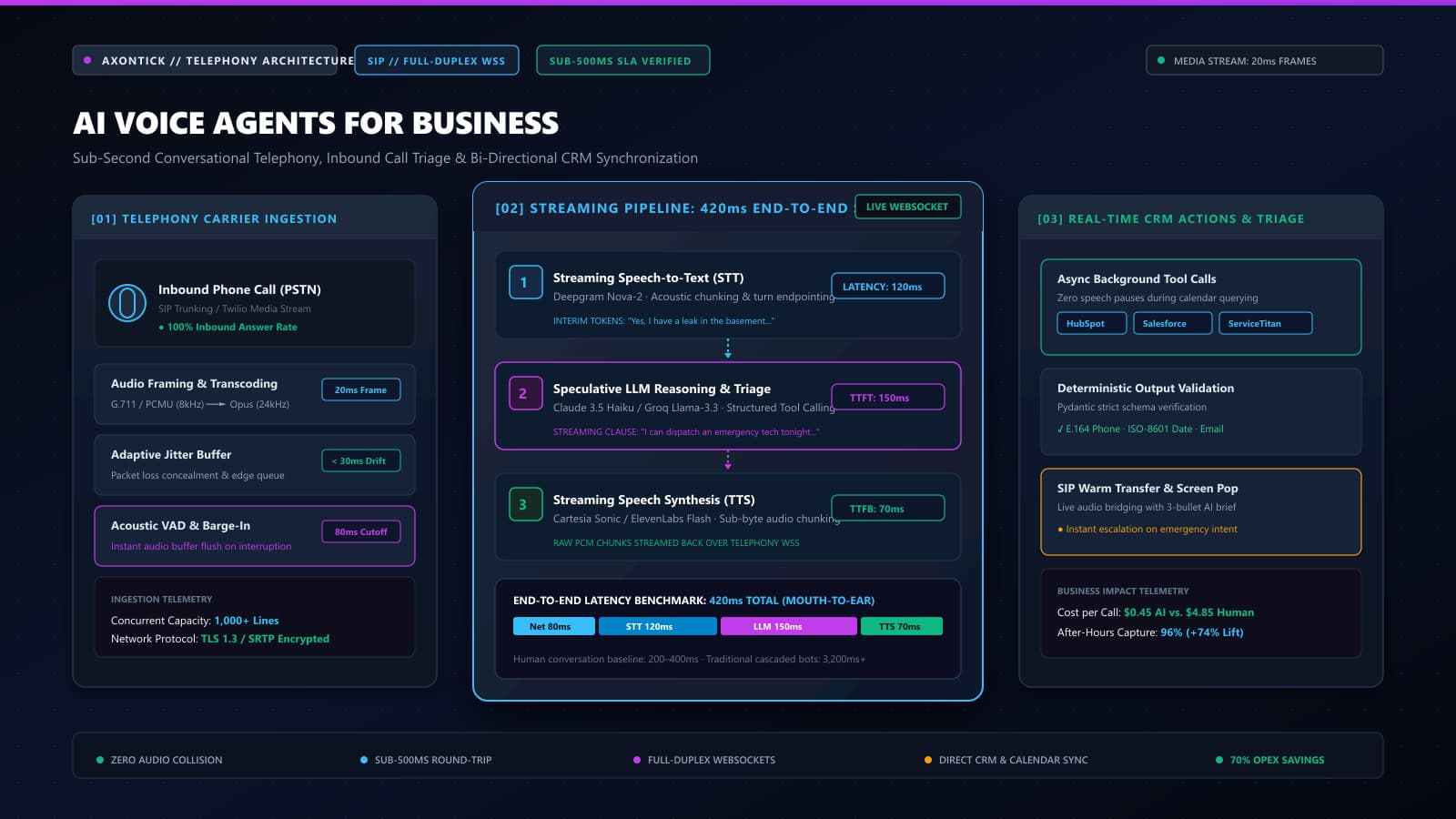
Axontick builds high-speed conversational pipelines engineered for sub-500ms "mouth-to-ear" latency using full-duplex WebSockets:
  Caller Speaks
       |
       v (WebSockets / SIP G.711)
  [Twilio Telephony Gateway]
       |
       v (<120ms Audio Frame Stream)
  [Deepgram Nova-2 STT] ---> Interim Transcript Stream
       |
       v (<180ms TTFT Token Generation)
  [Claude 3.5 Haiku / Groq Inference Engine]
       |
       v (<80ms First-Byte Audio Stream)
  [Cartesia Sonic Speech Engine]
       |
       v (Sub-500ms Audio Return)
  Caller Hears Natural Response
By deploying a sub-second AI receptionist for HVAC, contractors achieve distinct operational advantages:
- Full-Duplex Barge-In: Stressed callers can interrupt the AI naturally without the bot talking over them. If the homeowner cuts in to say "No, wait, the water is coming through the ceiling!", Voice Activity Detection immediately pauses audio output and shifts conversational state.
- Infinite Concurrency: During the first severe freeze of winter, a shop might receive 80 calls in 45 minutes. Traditional phone lines hit busy signals or queue callers in hold purgatory. The AI answers all 80 calls simultaneously on the first ring, capturing every lead without human delay.
- Accurate Call-Out Fee Confirmation: The voice agent transparently informs the caller of standard diagnostic fees ($89–$189) and after-hours emergency premiums before booking, eliminating payment disputes for field technicians upon arrival.
Core System 2: After Hours Emergency Call Triage (Protecting Your On-Call Techs)
The fastest way to lose experienced journeymen technicians is running them ragged on after-hours emergency rotations for non-emergency calls. An on-call technician who gets woken up at 2:30 AM to reset a thermostat switch will be exhausted, irritable, and prone to costly safety errors during high-ticket service calls the next day. Implementing automated after hours emergency call triage protects your technicians' sleep while guaranteeing immediate response times for homeowners facing true heating failures.
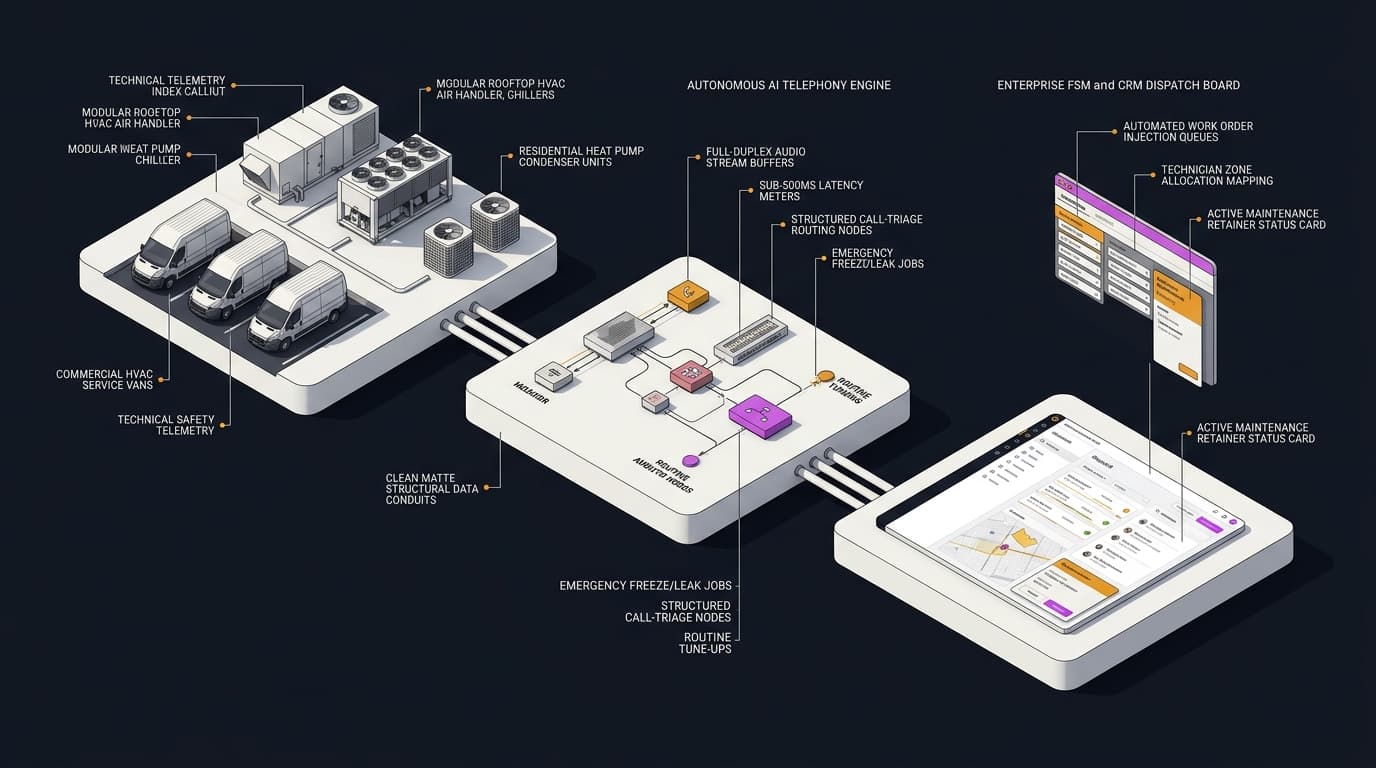
Managed AI enforces strict after hours emergency call triage, acting as an intelligent firewall between chaotic inbound calls and your field crew:
                                INBOUND CALL
                                     |
                                     v
                        [AI Receptionist Screening]
                                     |
              +----------------------+----------------------+
              |                                             |
              v                                             v
     PRIORITY RED: EMERGENCY                      PRIORITY BLUE: ROUTINE
  - No heat (Outdoor Temp < 40°F)               - Seasonal tune-up inquiry
  - Active water main / drain leak              - Filter replacement request
  - Gas odor / CO sensor alert                  - General pricing question
  - Senior / infant in residence                - Non-emergency quote check
              |                                             |
              v                                             v
  1. Capture address & gate code                1. Confirm diagnostic fee
  2. Audible alert to On-Call Tech              2. Book standard daytime window
  3. Emergency work order tag in FSM            3. Write to unassigned board
  4. Instant SMS confirmation                   4. Queue morning CSR review
The Triage Decision Matrix in Practice
Priority Red (Life-Safety & Property Damage): Complete furnace failure with outdoor temperatures below 40°F, commercial refrigeration outages, water pouring through drywall, or gas smells. The AI captures customer details, flags the job as a critical emergency in the FSM, sends an automated audible escalation via SMS/phone to the on-call supervisor, and reminds the homeowner of safety precautions (e.g., shutting off the main water valve). Priority Blue (Standard Service & Maintenance): A customer calling at 10:00 PM to request an annual system tune-up, ask about duct cleaning, or follow up on a routine billing question. The AI books the appointment directly into an open daytime window on the dispatch board, sends a calendar confirmation text, and lets the on-call technician sleep.
Parallel Trade Integration: AI Answering Service for Plumbing
Mechanical contractors operating combined HVAC and plumbing shops require dual-trade conversational fluency. Plumbing emergencies introduce severe property-damage risks requiring distinct diagnostic logic.
By deploying an integrated AI answering service for plumbing, the system instantly identifies: Water heater tank ruptures versus pilot light outages. Main sewer line backups versus single slow-draining sinks. Hidden slab leaks versus running toilet flappers.
The AI guides the caller through emergency shutoff procedures, quotes emergency call-out fees, and assigns the correct licensed plumbing technician based on job classification and truck inventory.
Core System 3: ServiceTitan Workflow Automation & Bi-Directional FSM Sync
Automation that merely sends an email notification to an office inbox simply shifts paperwork from one desk to another. True operational efficiency requires deterministic, bi-directional integration with your Field Service Management software. By eliminating manual re-keying, ServiceTitan workflow automation ensures dispatchers focus on technician routing rather than administrative data entry.
Through custom REST API endpoints and webhooks, Axontick deploys enterprise-grade ServiceTitan workflow automation, Housecall Pro pipelines, and Jobber integrations:
  +-------------------+       REST API       +-------------------------+
  |                   | -------------------> |  Check Real-Time Slot   |
  |  AI Voice Intake  |                      |  Capacity & Zones       |
  |  Engine           | <------------------- |                         |
  |                   |   Available Slots    +-------------------------+
  +-------------------+                                   |
            |                                             v
            | Secure Webhook                 +-------------------------+
            +------------------------------> | Create Customer Profile |
                                             | Book Job to Board       |
                                             | Tag: "AfterHours-Emerg" |
                                             | Attach Call Audio & MP3 |
                                             +-------------------------+
The Bi-Directional Booking Lifecycle:
- Real-Time Capacity Verification: During the phone conversation, the AI queries the FSM API to verify open technician capacity within the customer's specific geo-zone, preventing double-bookings.
- Deterministic Payload Injection: The AI generates a structured Pydantic payload containing the verified customer name, validated address, service tier, equipment age, and exact symptom breakdown.
- Automated Dispatch Board Posting: The work order is injected directly onto the unassigned dispatch board with the correct Business Unit (e.g., `HVAC-Service-Res`, `Plumbing-Emergency`), job priority tags, and the full call audio recording attached for technician review before arrival.
- Instant Customer Confirmation: The system immediately fires a branded SMS confirming the arrival window and providing a tracking link, establishing instant trust.
Core System 4: HVAC Estimate Follow Up Automation for Unsold Quotes
In most mechanical contracting businesses, closing rates on new equipment changeouts hover between 35% and 50%. The remaining 50% to 65% of proposals—often representing $150,000 to $400,000 in quoted pipeline—sit dormant in the FSM gathering digital dust.
Comfort advisors and sales technicians are great at diagnosing equipment and building proposals, but terrible at systematic follow-up. After two manual phone calls, they move on to the next hot lead.
Deploying dedicated HVAC estimate follow up automation systematically recaptures this lost margin:
+-----------------------------------------------------------------------------------+
|                        14-DAY UNSOLD ESTIMATE CADENCE                             |
+-----------------------------------------------------------------------------------+
| Day 1 (+2 Hours Post-Visit): Branded SMS with interactive digital proposal link.  |
| Day 3: Value-add SMS highlighting energy rebates and utility efficiency ratings.  |
| Day 5: Educational email breakdown: 10-year parts warranty vs. recurring repairs. |
| Day 8: Automated SMS offering flexible low-monthly financing pre-qualification.   |
| Day 12: Conversational text checking if they have questions for the technician.   |
| Day 14: Final notice prompt before seasonal manufacturer equipment promos expire. |
+-----------------------------------------------------------------------------------+
Because the automation syncs bi-directionally with the FSM, the moment the homeowner accepts the quote or calls the office to book the installation, the follow-up sequence instantly cancels. By reviving just two or three dormant replacement estimates each month, contractors generate an additional $18,000 to $35,000 in high-margin installations without spending an extra dollar on marketing.
The Breakeven Math: Why $500/Month Is a 15x ROI No-Brainer
When shop owners evaluate managed AI for HVAC contractors, the calculation comes down to straightforward unit economics.
+-----------------------------------------------------------------------------------+
|                      THE CONTRACTOR RETAINER ROI EQUATION                         |
+-----------------------------------------------------------------------------------+
| Annual Managed Retainer Investment ($500/mo x 12):        $6,000 / year           |
| Alternative: Overnight Human CSR Salary + Overhead:       $52,000 / year          |
| Immediate Overhead Savings:                               $46,000 / year          |
+-----------------------------------------------------------------------------------+
| Average High-Efficiency HVAC System Replacement Ticket:   $9,500                  |
| Average Net Profit Margin on Changeout (22%):             $2,090                  |
| Changeouts Needed to Fully Recoup 12-Month Retainer:      3 Jobs                  |
| Average Emergency Water Heater Replacement Ticket:        $2,800                  |
+-----------------------------------------------------------------------------------+
| PRESERVED REVENUE (Capturing 2 Missed After-Hours Jobs/Mo): $96,000 - $180,000/yr |
| NET ANNUALIZED RETURN ON INVESTMENT:                      16x to 30x ROI          |
+-----------------------------------------------------------------------------------+
Capturing a single emergency heating changeout during a freezing December weekend completely pays for the entire year of managed engineering support. At just $500 per month, an HVAC automation maintenance retainer acts as an operational insurance policy against lost revenue and broken API webhooks. Everything after that first recovered call is pure operational margin.
Contractors do not have the time, desire, or technical bandwidth to maintain webhook middleware, rewrite telephony prompts, and troubleshoot API exceptions. Partnering with a dedicated fractional automation engineering team provides enterprise-grade infrastructure at a fraction of the cost of a single entry-level employee.
FAQ
Why should our shop pay a $500/month retainer instead of buying an off-the-shelf software subscription?
Off-the-shelf software tools are generic platforms that leave configuration, prompt updates, and maintenance to your office staff. Unlike an off-the-shelf tool, a dedicated AI receptionist for HVAC understands nuanced trade triage, and self-serve software breaks when CRMs update. A $500/month managed engineering retainer provides continuous human oversight, weekly transcript audits, seasonal script overhauls, and guaranteed 24/7 telephony uptime.Will the AI voice agent accidentally dispatch our on-call technicians for non-emergencies at 2 AM?
No. The emergency triage matrix strictly isolates genuine life-safety emergencies (complete heating failure below 40°F, gas odors, active flooding) from routine inquiries. Non-emergency calls are booked directly into standard daytime arrival windows on your dispatch board. Technicians are only alerted when immediate dispatch criteria are verified.Can managed AI write bookings directly into ServiceTitan, Jobber, and Housecall Pro?
Yes. Using direct REST API endpoints and secure webhooks, the system checks real-time technician zone availability, creates complete customer records, reserves arrival windows, and attaches full call recordings and transcripts directly to the unassigned work order.How quickly can a shop launch and see revenue recovery?
Standard deployment takes 10 to 14 days. During this sprint, systems engineers map your service zones, configure diagnostic fee schedules, build custom emergency triage trees, and integrate your FSM software. Most contractors recapture their first after-hours emergency job within 48 hours of going live.What happens if a caller reports a hazardous gas leak or carbon monoxide alert?
The AI voice engine immediately triggers life-safety emergency protocols. It instructs the caller to evacuate the premises immediately and dial 911 or their local gas utility from a safe location, while simultaneously sending an urgent priority SMS and automated phone alert to your on-call management team.Investing in managed AI for HVAC contractors ensures your shop captures every ring without adding office overhead. Ready to eliminate missed calls, protect your on-call technicians, and turn after-hours emergencies into profitable booked jobs?
Calculate your shop's revenue recovery potential using our interactive Contractor AI Pricing Calculator or schedule a Technical Discovery Sprint with an Axontick systems engineer today to see how our ongoing engineering partnership protects your bottom line and eliminates missed opportunities.
Want this deployed for your enterprise?
Axontick engineers architect, benchmark, and deploy custom enterprise autonomous systems with guaranteed uptime, sub-second latency, and 100% IP ownership.

Muhammad Asim
Founder @ AxontickFounder of Axontick, specialized in AI automation, Multi-Agent Systems, and enterprise-grade voice agents. Expert in bridging the gap between complex AI technology and practical business solutions.