Determining which AI solution is best for business requires moving past generative novelty to mathematically evaluate operational bottlenecks, data readiness, and deterministic execution boundaries.
To determine which AI solution is best for business, enterprise leaders must evaluate two foundational variables: operational data density and task variance. The highest-return AI systems are deployed where data volume is dense, routine rules are established, and human error costs are compounding. Rather than adopting conversational tools blindly, modern executives utilize a quantitative AI feasibility matrix to audit operational workflows, prioritize high-leverage friction points, and deploy purpose-built architectures—ranging from sub-second voice telephony to multi-agent state machines—that deliver measurable operational velocity.
Automating a chaotic, unstandardized operational workflow does not create efficiency; it merely accelerates confusion. True business leverage occurs when deterministic software guardrails and autonomous models are applied to structured, high-frequency operational bottlenecks.
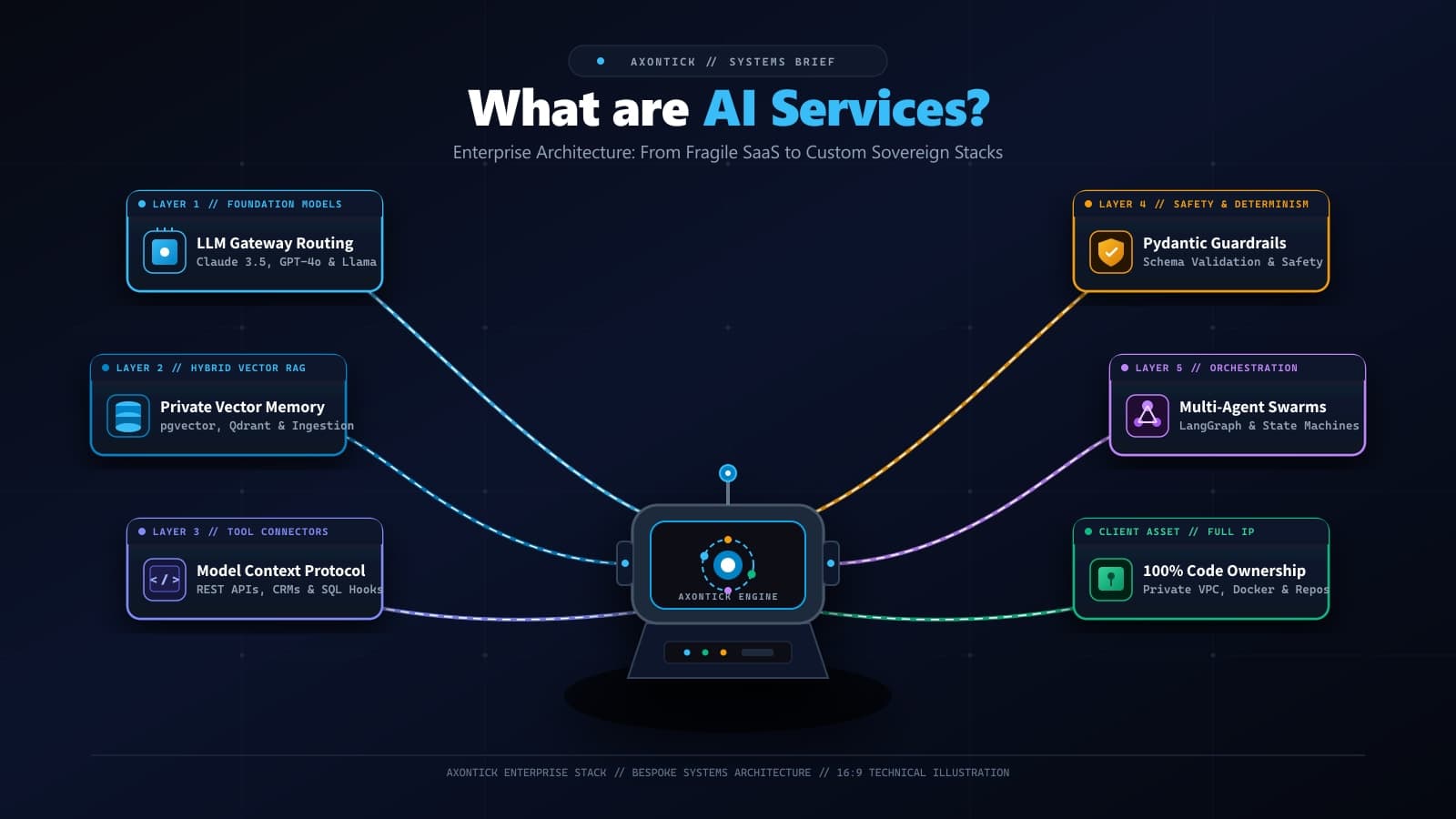
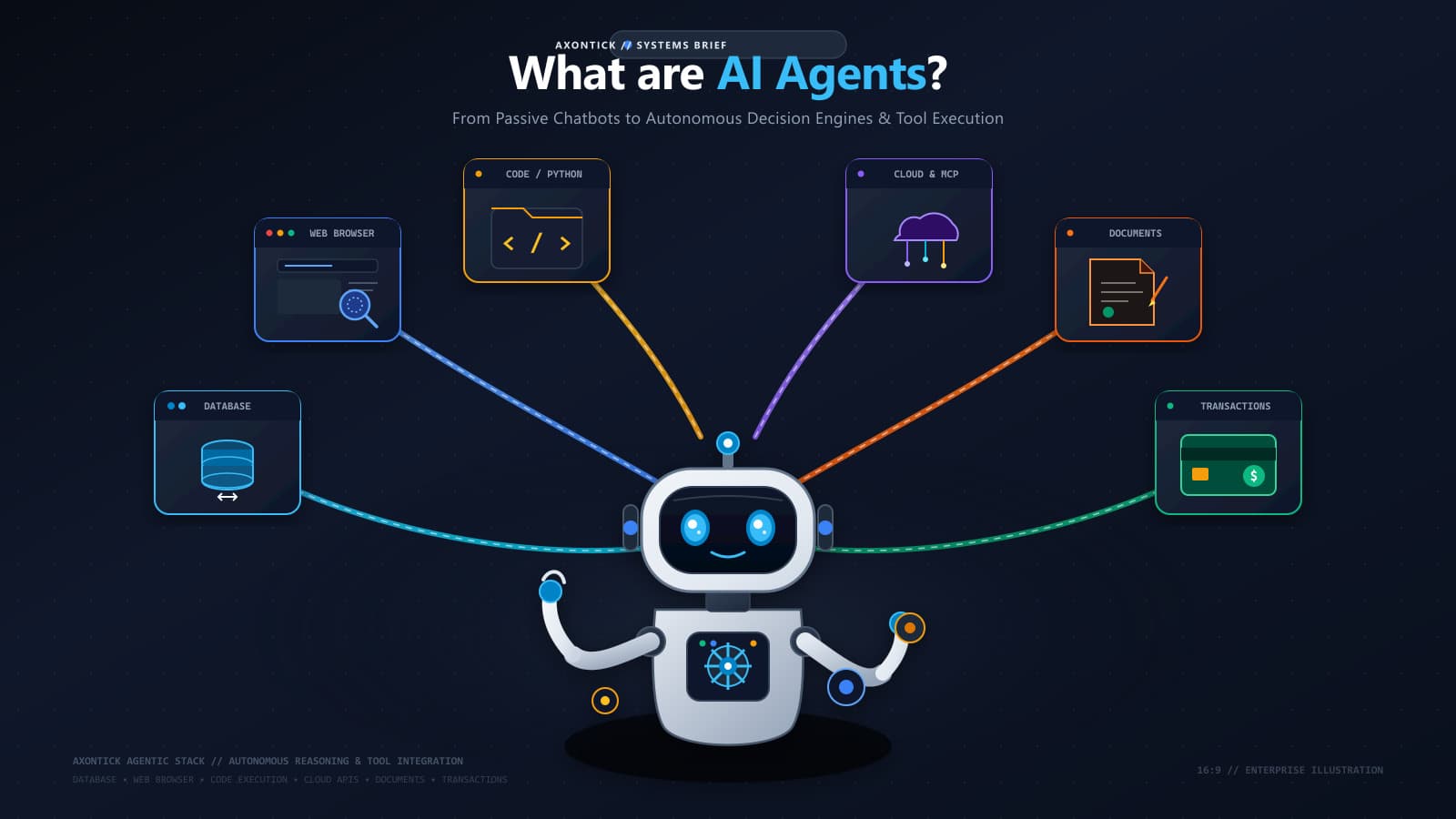
As established in our architectural explorations of What Are AI Agents? and What Are AI Services?, artificial intelligence has advanced from text completion widgets to sovereign systems of action. However, having access to advanced compute does not explain which architecture fits your company. Answering which AI solution is best for business demands an objective diagnostic methodology that eliminates guesswork and aligns engineering resources with verifiable bottom-line impact.
The Fatal Mistake: Buying AI Without an Operational Bottleneck
The single largest factor behind failed enterprise AI initiatives is the "Tool-First Trap." In 2025 and 2026, corporate boards mandated rapid AI adoption, prompting leadership teams to purchase enterprise seat licenses for commercial chatbots, generic coding assistants, and experimental SaaS point-solutions before identifying a concrete operational bottleneck.
The outcome of this approach is predictable:
- Low Seat Utilization: After an initial two-week spike of curiosity, employee engagement drops as workers realize generic prompts cannot interact with protected internal ERP or CRM records.
- Context Fragmentation: Departmental data remains trapped in isolated silos, resulting in contradictory outputs across marketing, sales, and customer support.
- Zero Bottom-Line Velocity: Despite recurring monthly software expenditures, manual labor hours, phone queue delays, and invoice processing turnaround times remain entirely unchanged.
┌────────────────────────────────────────────────────────────────────────┐
│                   THE ENTERPRISE AI ADOPTION DICHOTOMY                 │
├───────────────────────────────────┬────────────────────────────────────┤
│         THE TOOL-FIRST TRAP       │    THE BOTTLENECK-FIRST FRAMEWORK  │
├───────────────────────────────────┼────────────────────────────────────┤
│ • Starts with model hype / buzz   │ • Starts with measurable friction  │
│ • Purchases seat licenses first   │ • Quantifies manual hours wasted   │
│ • Disconnected from internal APIs │ • Connects private enterprise data │
│ • High churn, zero ROI visibility │ • Clear payback period & KPIs      │
│ • Unmanaged security & data leaks │ • Deterministic schema guardrails  │
└───────────────────────────────────┴────────────────────────────────────┘
When evaluating which AI solution is best for business, your team must reverse the discovery process. Instead of asking what foundational models are capable of generating, ask where your business hemorrhages operational velocity.
A diagnostic AI automation audit begins by reviewing three operational categories:
- Synchronous Communications Bottlenecks: Unanswered inbound customer phone calls, delayed after-hours emergency inquiries, or long receptionist wait times.
- Asynchronous Document Friction: Manual human review of multi-page invoices, insurance filings, purchase orders, construction contracts, or vendor compliance packets.
- Cross-System Synchronization Drag: Frontline personnel manually copying unstructured data from emails into CRMs, ERPs, billing portals, and project management boards.
Only when a specific operational friction point has been documented and measured in labor hours can an organization begin choosing AI solutions with predictable financial return.
The 5-Point Feasibility Scoring Matrix
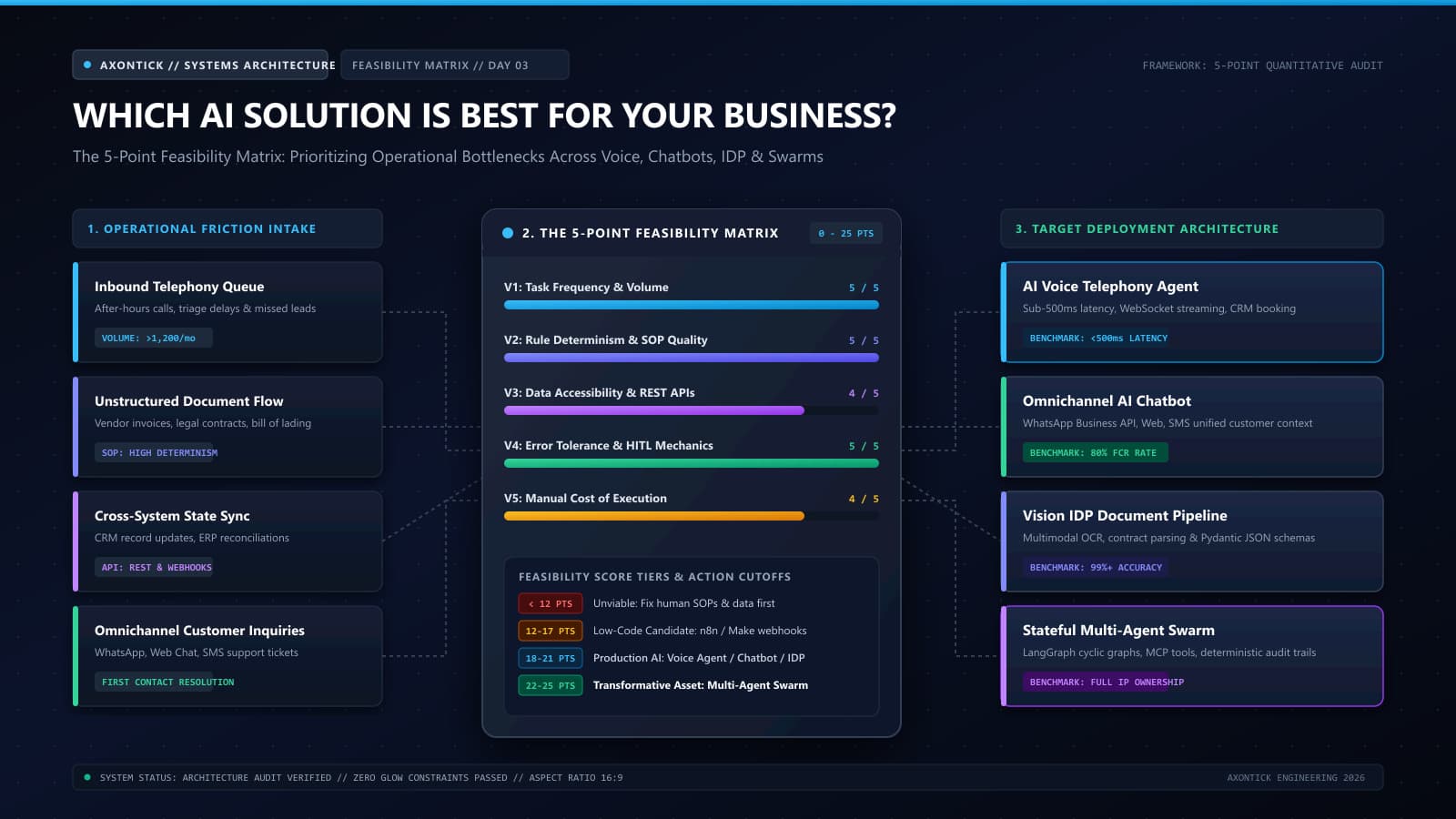
To take the subjectivity out of enterprise planning, Axontick developed the AI feasibility matrix—a quantitative, 5-point evaluation framework that assigns an objective score (1 to 5 points) across five operational vectors:
┌────────────────────────────────────────────────────────────────────────┐
│               THE 5-POINT AI FEASIBILITY SCORING MATRIX                │
├────────────────────────────────────────────────────────────────────────┤
│  VECTOR 1: TASK FREQUENCY & VOLUME               (1 - 5 Points)        │
│  Weekly transaction scale, customer touches, and processing load       │
├────────────────────────────────────────────────────────────────────────┤
│  VECTOR 2: RULE DETERMINISM & STANDARDIZATION     (1 - 5 Points)        │
│  Availability of objective SOPs, validation schemas, and logic rules   │
├────────────────────────────────────────────────────────────────────────┤
│  VECTOR 3: DATA ACCESSIBILITY & API READINESS     (1 - 5 Points)        │
│  Clean database access, REST/GraphQL endpoints, and schema structure   │
├────────────────────────────────────────────────────────────────────────┤
│  VECTOR 4: ERROR TOLERANCE & HITL MECHANICS       (1 - 5 Points)        │
│  Viability of automated confidence gating and human escalation queues  │
├────────────────────────────────────────────────────────────────────────┤
│  VECTOR 5: MANUAL COST OF EXECUTION               (1 - 5 Points)        │
│  Blended labor rate, lost revenue from latency, and opportunity drag   │
└────────────────────────────────────────────────────────────────────────┘
Let us examine each evaluation vector within the 5-point matrix in detail:
Vector 1: Task Frequency & Transaction Volume
AI engineering carries fixed deployment and scaffolding costs. If a workflow occurs only twice a month, automating it yields negligible return on invested capital. Conversely, high-volume repetitive workflows compound operational leverage instantly.
- 1 Point: Sporadic task executed fewer than 10 times per month (e.g., quarterly strategic board deck drafting).
- 2 Points: Low-frequency task executed 10 to 50 times per month.
- 3 Points: Moderate-frequency task executed 50 to 250 times per month.
- 4 Points: High-frequency task executed 250 to 1,000 times per month (e.g., daily inbound quote intake).
- 5 Points: Continuous, mission-critical workflow exceeding 1,000 transactions per month (e.g., tier-1 support tickets, inbound phone calls, invoice reconciliation).
Vector 2: Rule Determinism & Standardization
Machine learning models excel when operating within bounded parameter spaces. If a task requires unbounded emotional empathy, artistic intuition, or political diplomacy, it is ill-suited for full autonomy. If the process is governed by a documented Standard Operating Procedure (SOP), it is a prime automation candidate.
- 1 Point: Highly subjective, unstructured judgment where two experienced senior managers would frequently disagree.
- 2 Points: Semi-structured process with significant situational exceptions requiring senior intervention.
- 3 Points: Documented business process with clear guidelines, though edge cases occur in ~20% of runs.
- 4 Points: Highly standardized workflow with defined branching logic and explicit criteria for acceptable outcomes.
- 5 Points: 100% deterministic, rules-based process (e.g., "Extract line items, verify tax calculation against state tables, confirm vendor PO, update NetSuite").
Vector 3: Data Accessibility & API Infrastructure
An AI agent cannot act without sovereign access to institutional context. In an initial data readiness audit, auditing infrastructure determines whether an agent can function in milliseconds or whether months of data cleaning must occur first.
- 1 Point: Information resides on paper files, air-gapped physical storage, or audio recordings without digital transcripts.
- 2 Points: Data is scattered across unindexed, disparate legacy spreadsheets, desktop folders, and personal inboxes with zero central cataloging.
- 3 Points: Data is digitized in cloud storage (Google Drive, Notion, Sharepoint), but documentation lacks standard naming conventions and schema structure.
- 4 Points: Well-structured relational databases (PostgreSQL, MySQL) or standard SaaS platforms (HubSpot, Salesforce, Zendesk) with native REST APIs.
- 5 Points: Modern, event-driven data architecture with authenticated webhook triggers, documented REST/GraphQL microservices, and clean SQL access.
Vector 4: Error Tolerance & Recovery Mechanics
In mission-critical enterprise environments, hallucination risk cannot be tolerated. Systems must be engineered so that anomalous edge cases fail gracefully rather than corrupting live database states.
- 1 Point: Zero tolerance for error where a single incorrect prediction causes immediate legal liability or life-safety catastrophe with zero possibility of review.
- 2 Points: Low tolerance; incorrect outputs require extensive forensic auditing to detect and unwind.
- 3 Points: Moderate tolerance; automated confidence scoring can flag suspicious outputs before committing state changes.
- 4 Points: High tolerance; the system acts as a real-time copilot or draft preparer with frictionless one-click human verification.
- 5 Points: Fault-tolerant architecture; outputs are validated programmatically against Pydantic schemas, and low-confidence runs automatically route to human review queues.
Vector 5: Manual Cost of Execution
Operational velocity is calculated in dollars. To understand which AI solution is best for business, evaluate the true cost of human execution—including wages, employee turnover, onboarding friction, and lost revenue caused by latency.
- 1 Point: Low-cost manual effort consuming under 5 employee hours per week at minimal wage rates.
- 2 Points: Consumes 5 to 15 hours per week of junior staff time.
- 3 Points: Consumes 15 to 40 hours per week across operational teams ($2,000–$5,000/month in direct wage overhead).
- 4 Points: Consumes 40 to 120 hours per week of skilled specialist time ($5,000–$15,000/month) with noticeable customer friction.
- 5 Points: Massive operational bottleneck consuming 120+ hours per week of senior technical or clinical personnel ($15,000+/month) while losing immediate revenue due to slow turnaround.
Interpreting Your Feasibility Score: Cutoff Tiers
Summing your scores across the 5 vectors yields a total feasibility score between 5 and 25 points. This score establishes an enterprise AI decision framework that dictates your exact implementation pathway:
| Score Range | Feasibility Classification | Recommended Architecture | Strategic Action |
|---|---|---|---|
| 5 – 11 Points | Unviable / Process Deficient | No AI Deployment | Standardize human SOPs and clean data pipelines before investing in AI. |
| 12 – 17 Points | Low-Code Candidate | iPaaS Workflows (n8n / Make) | Deploy visual webhook pipelines to automate basic data movement. |
| 18 – 21 Points | High-Leverage Production AI | Single Autonomous Agent | Deploy dedicated Voice Agent, Omnichannel Chatbot, or Vision IDP. |
| 22 – 25 Points | Transformative Enterprise Asset | Stateful Multi-Agent Swarm | Engineer custom multi-agent architecture with private RAG and human-in-the-loop review. |
When leaders use the AI feasibility matrix to grade their backlog of operational ideas, clarity replaces debate. Deciding which AI solution is best for business against these quantitative thresholds prevents teams from falling victim to pilot paralysis. Establishing an enterprise AI decision framework ensures capital is directed exclusively toward high-impact automation candidates. Meanwhile, candidate projects scoring 18 and above are fast-tracked into technical prototyping.
Solution Architecture Breakdown: Voice Agent, Chatbot, or Multi-Agent Swarm?
Once an operational friction point achieves a feasibility score of 18 or higher, executive teams face the architectural question of choosing AI solutions that map to their channel dynamics.
Selecting the wrong technical delivery model creates immediate friction. A fundamental principle in choosing AI solutions is respecting channel latency thresholds: for example, deploying a slow multi-turn text chatbot to handle emergency dispatch will frustrate callers, while deploying a voice agent for complex 40-page contract auditing is technically nonsensical.
┌────────────────────────────────────────────────────────────────────────┐
│                   ARCHITECTURAL SELECTION DECISION TREE                │
└───────────────────────────────────┬────────────────────────────────────┘
                                    │
                  What is the primary operational medium?
                                    │
         ┌──────────────────────────┼──────────────────────────┐
         │                          │                          │
       VOICE                      TEXT                     DOCUMENTS
         │                          │                          │
    Synchronous?           Omnichannel context?       High visual layout?
    Sub-500ms SLA?         Web / WhatsApp / SMS?       PDFs / Invoices?
         │                          │                          │
    ┌────┴────┐                ┌────┴────┐                ┌────┴────┐
   YES        NO              YES        NO              YES        NO
    │         │                │         │                │         │
  Deploy    Review          Deploy     Deploy           Deploy    Deploy
  AI Voice  Call Flow      Omnichannel Internal         Vision    Text
  Agent                    AI Chatbot  Knowledge        IDP       Parser
                                       Assistant        Pipeline
1. AI Voice Agents (Telephony & Inbound Triage)
When evaluating an AI voice agent vs chatbot, latency and channel expectations are fundamentally different. Voice telephony operates in real-time; human callers expect responses within 400 to 700 milliseconds. A three-second delay on a telephone call causes conversational collision and immediate abandonment.
- Best Suited For: Inbound customer triage, after-hours emergency call routing, dental/medical appointment scheduling, dispatch logistics, and outbound qualification.
- Underlying Tech Stack: WebSocket audio streaming, sub-200ms Speech-to-Text (Deepgram Nova-2), fast LLM inference streaming (Claude 3.5 Haiku / GPT-4o-mini), and natural Text-to-Speech (Cartesia / ElevenLabs).
- Core Business Metric: 100% call answer rate, zero queue abandonment, and direct CRM calendar bookings. Explore our specialized AI Voice Agents engineering to review live telephony architecture.
2. Omnichannel AI Chatbots (Web, WhatsApp, SMS & Slack)
While an AI voice agent vs chatbot comparison highlights telephony speed, omnichannel chatbots provide persistent, cross-platform context across written mediums.
- Best Suited For: Tier-1 customer support, product recommendations, transactional status inquiries, and internal employee HR/IT helpdesks.
- Underlying Tech Stack: Official WhatsApp Business API webhooks, headless Web Chat embeds, SMS Twilio routing, and session-state memory stored in Redis.
- Core Business Metric: 75% to 85% first-contact resolution (FCR) without human specialist intervention.
3. Intelligent Document Processing (IDP) Vision Agents
Traditional OCR relies on rigid regex templates that break whenever a vendor adjusts an invoice layout. Multimodal vision agents extract structured JSON from complex documents with high spatial understanding.
- Best Suited For: Accounts payable invoice reconciliation, commercial lease abstraction, bill-of-lading freight verification, and patient intake processing.
- Underlying Tech Stack: Multimodal foundational models (Claude 3.5 Sonnet / GPT-4o Vision), document partitioners, and Pydantic schema validation.
- Core Business Metric: 90% reduction in document turnaround time and zero manual data entry errors.
4. Stateful Multi-Agent Swarms (Complex Operations)
For workflows requiring sequential reasoning, policy auditing, and multi-database updates, a single prompt cannot maintain sufficient context. Multi-agent systems assign specialized sub-tasks to dedicated agent nodes under an orchestrator coordinator.
- Best Suited For: Financial compliance audits, legal contract cross-referencing, multi-vendor procurement verification, and autonomous lead research.
- Underlying Tech Stack: LangGraph state machines, Model Context Protocol (MCP) tool connectors, hybrid vector retrieval (pgvector), and deterministic validation gates.
- Core Business Metric: Elimination of multi-day manual analytical bottlenecks. Review our deep dive on Multi-Agent Systems for enterprise architectures.
Comparative Matrix: Choosing AI Solutions by Business Function
To assist enterprise leadership teams in choosing AI solutions across departments, the table below provides a comprehensive comparison across operational domains:
| Business Function | Primary Bottleneck | Feasibility Score | Target AI Solution | Key Integration Points |
|---|---|---|---|---|
| Customer Operations | Missed calls after 5 PM & hold times | 23 / 25 | Inbound Telephony Voice Agent | Twilio, Retell, Google Calendar, HubSpot |
| Finance & Accounting | Manual invoice reconciliation & approval | 22 / 25 | Multimodal IDP Vision Pipeline | QuickBooks, NetSuite, AWS S3, Stripe |
| Sales Development | Manual lead qualification & enrichment | 20 / 25 | Autonomous Research & Enrichment Swarm | Apollo, LinkedIn Sales Nav, Salesforce |
| Legal & Compliance | Contract clause audit against policy | 19 / 25 | Stateful LangGraph Audit Swarm | pgvector, Ironclad, DocuSign, Slack |
| Internal IT Support | Password resets & software access requests | 17 / 25 | Slack/Teams Internal AI Copilot | Okta, Jira Service Desk, Notion Wiki |
Build vs. Buy vs. Partner: The Implementation Pathway
Once your enterprise AI decision framework identifies the target architecture, executive leadership must determine the delivery mechanism. Understanding which AI solution is best for business also requires evaluating your internal engineering bandwidth and timeline constraints.
The trade-offs between internal development, off-the-shelf SaaS, and partnering with an AI systems engineering firm dictate both deployment speed and asset ownership:
┌────────────────────────────────────────────────────────────────────────┐
│                   DELIVERY PATHWAY EVALUATION                          │
├───────────────────────────────────┬────────────────────────────────────┤
│ 1. BUILD IN-HOUSE                 │ • Pros: Total internal control     │
│                                   │ • Cons: 6-9 month hiring lag;      │
│                                   │   $300k+ annual engineer salaries  │
├───────────────────────────────────┼────────────────────────────────────┤
│ 2. BUY OFF-THE-SHELF SAAS         │ • Pros: Rapid setup (1-2 weeks)    │
│                                   │ • Cons: Recurring per-seat fees;   │
│                                   │   zero customization; vendor lock  │
├───────────────────────────────────┼────────────────────────────────────┤
│ 3. PARTNER WITH AI SYSTEMS AGENCY │ • Pros: 30-day production delivery;│
│    (AXONTICK METHODOLOGY)         │   turnkey IP ownership; no seats   │
│                                   │ • Cons: Requires scoped engagement │
└───────────────────────────────────┴────────────────────────────────────┘
For most mid-market and enterprise organizations, the hybrid model delivers the highest risk-adjusted return: partnering with a specialized technical agency to architect, benchmark, and deploy the system within a fixed 30-to-60 day sprint, followed by a full intellectual property and codebase handover to internal IT.
To model your organization's exact deployment timeline and engineering investment, utilize our Interactive AI Pricing Calculator.
Mapping Your First 30-Day Quick Win
To prevent organizational fatigue, enterprise AI initiatives must deliver a production quick win within 30 days. Attempting to automate an entire company simultaneously results in pilot purgatory. Instead, select a single high-scoring workflow and execute across four structured weekly milestones:
┌────────────────────────────────────────────────────────────────────────┐
│              30-DAY AI PILOT ACCELERATION TIMELINE                     │
├───────────────┬───────────────┬────────────────┬───────────────────────┤
│    WEEK 1     │    WEEK 2     │     WEEK 3     │        WEEK 4         │
│  Feasibility  │  Scaffolding  │  Benchmarking  │      Production       │
│  & Audit      │  & Guardrails │  & Staging     │      Rollout          │
├───────────────┼───────────────┼────────────────┼───────────────────────┤
│ • Run 5-point │ • Configure   │ • Run 100 test │ • Deploy private VPC  │
│   matrix      │   APIs & MCP  │   cases in     │   environment         │
│ • Map data    │ • Enforce     │   eval suite   │ • Enable HITL review  │
│   schemas     │   Pydantic    │ • Measure      │   escalation gate     │
│ • Define KPIs │   validation  │   accuracy     │ • Train operators     │
└───────────────┴───────────────┴────────────────┴───────────────────────┘
Week 1: Feasibility Audit & Data Schema Mapping
- Conduct the structured AI automation audit across target departmental workflows.
- Identify the single process scoring 18+ with the highest manual execution cost.
- Map existing database schemas, API keys, and documentation formats.
- Define unambiguous business KPIs (e.g., "Cut inbound phone queue drop-off from 24% to under 2%").
Week 2: Scaffolding, Tool Connectors & Guardrails
- Scaffolding the underlying inference pipeline (LiteLLM or direct Anthropic/OpenAI APIs).
- Integrate system tools utilizing Model Context Protocol (MCP) or secure REST microservices.
- Enforce strict deterministic output schemas with Pydantic validation to prevent malformed database writes.
- Implement input sanitization to filter out irrelevant or adversarial queries.
Week 3: Staging Evaluation with Synthetic Golden Datasets
- Never deploy an autonomous agent directly to live customers without automated benchmarking.
- Create a "Golden Dataset" of 100 real historical transactions, edge cases, and difficult scenarios.
- Run the agent through an automated LLM-as-a-judge regression evaluation suite.
- Optimize prompts, context chunking, and tool parameters until accuracy exceeds 98%.
Week 4: Production Rollout with Human-in-the-Loop Review
- Deploy the system in your private cloud environment under strict Zero-Data-Retention (ZDR) agreements.
- Implement a Human-in-the-Loop (HITL) review queue: the agent processes transactions autonomously when confidence is above 95%, while routing edge cases to human operators via Slack or Teams.
- Track real-world operational velocity and report verified labor hours reclaimed.
Review our transparent 4-Step Engineering Delivery Framework to understand how Axontick executes this four-week sprint for enterprise clients.
Frequently Asked Questions About Choosing an AI Solution
Which AI solution is best for business customer service?
When deciding which AI solution is best for business customer operations, evaluate your inbound communication channel distribution. For customer service teams handling substantial telephone volume, sub-second AI Voice Agents provide the highest ROI by capturing missed after-hours calls, booking appointments, and resolving tier-1 inquiries without human latency. For web and messaging channels, deploying an Omnichannel AI Chatbot across WhatsApp, Web, and SMS ensures customers experience unified context without repeating account information.
What is an AI automation audit, and how long does it take?
An AI automation audit is a structured technical assessment of an organization's internal workflows, transaction frequencies, manual labor costs, and API readiness. A comprehensive audit conducted by an experienced AI systems architect typically requires 3 to 5 business days, producing a quantitative feasibility roadmap and clear architecture specifications.
How does the AI feasibility matrix prevent project failures?
The AI feasibility matrix prevents failures by evaluating task determinism, data accessibility, and error tolerance before any software development begins. Projects scoring below 12 points are identified as process-deficient, allowing organizations to fix underlying SOPs and clean data repositories rather than wasting capital on unviable AI implementations.
In an AI voice agent vs chatbot comparison, how do we decide which to build first?
The operational decision between conversational channels depends on customer behavior and latency sensitivity. If your customers primarily contact your business via phone, or if missed calls result in immediate revenue loss to competitors (e.g., medical clinics, home service contractors, legal firms), an AI voice agent should be deployed first. If support inquiries are predominantly asynchronous, text-heavy, or require document attachments, prioritize an omnichannel chatbot.
How do custom AI solutions protect proprietary enterprise data?
Production custom AI systems ensure complete data privacy by deploying within private Virtual Private Clouds (VPC) on AWS, Azure, or GCP. Furthermore, models are accessed via enterprise API contracts backed by zero-data-retention (ZDR) guarantees, ensuring that private enterprise records and customer interactions are never stored or used to train public foundation models.
Conclusion: From Feasibility Audit to Scalable Asset
The modern business environment will not be won by organizations that simply buy software subscriptions. It will be won by enterprises that build sovereign, automated systems of action that compound in operational leverage over time.
Determining which AI solution is best for business is not a speculative creative exercise; it is an engineering discipline. By applying our quantitative AI feasibility matrix, auditing your core operational bottlenecks, and selecting the optimal architecture—whether telephony voice agents, intelligent vision pipelines, or multi-agent swarms—your organization transforms unpredictable technology into a durable corporate asset.
Ready to determine which AI solution is best for business in your organization?
- Run your operational workflow parameters through our interactive AI Pricing Calculator to estimate your deployment costs and ROI.
- Explore our turnkey Enterprise AI Services catalog to review our specialized engineering capabilities.
- Review our battle-tested 4-Step Engineering Delivery Process or book a technical discovery call with our engineering team today.

Muhammad Asim
Founder @ Axontick
Founder of Axontick, specialized in AI automation, Multi-Agent Systems, and enterprise-grade voice agents. Expert in bridging the gap between complex AI technology and practical business solutions.