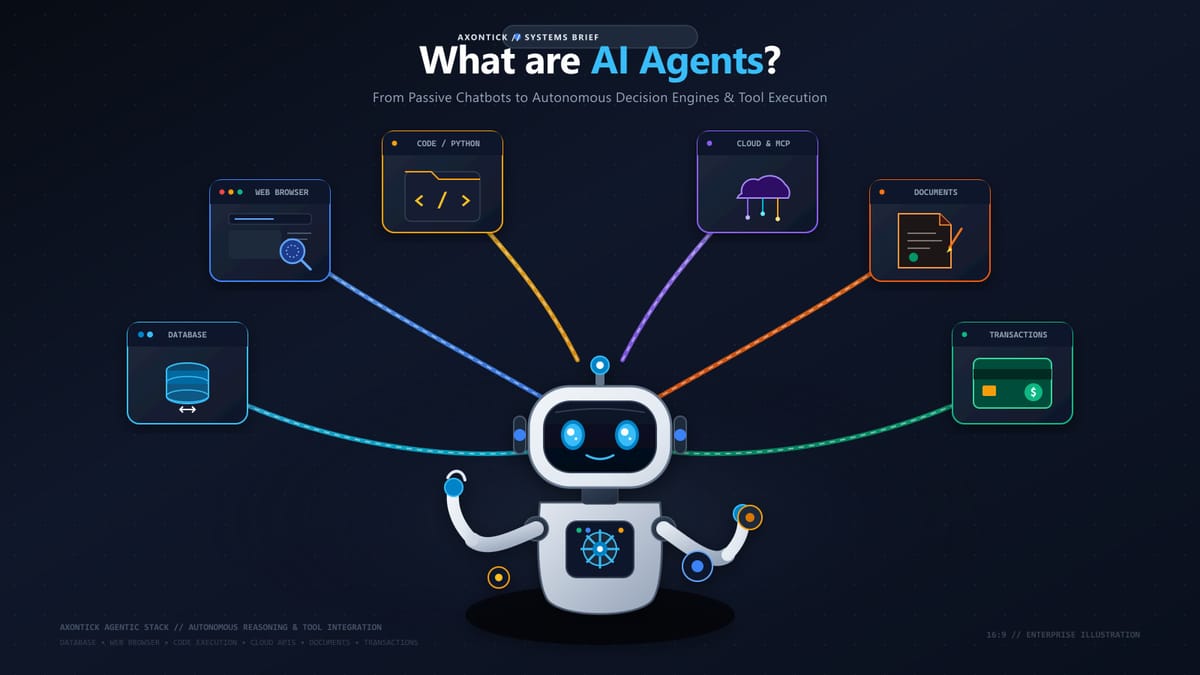
Why isolated point solutions create architectural paralysis—and how to construct an interconnected agentic automation mesh that scales across business units.
Successfully scaling AI pilots to enterprise production requires transitioning from fragmented point solutions to an interconnected automation mesh governed by unified observability, standardized tool protocols, and shared organizational context. While building an isolated proof-of-concept takes weeks in a sanitized developer sandbox, scaling intelligence across multiple business units forces systems to confront dirty production data, legacy API dependencies, security compliance barriers, and runaway token consumption. Enterprises that master this transition do not deploy disconnected chatbots; they engineer an extensible agentic architecture where specialized autonomous systems communicate seamlessly across departments.
Escaping Pilot Purgatory: Why 80% of Enterprise AI Proofs-of-Concept Stall
Building a functional artificial intelligence demo is deceptively simple. With modern frontier models, any motivated software engineer can assemble a working Retrieval-Augmented Generation (RAG) prototype or a customer support bot over a weekend. Yet, when enterprise organizations attempt to transition these isolated prototypes into mission-critical production workflows, progress screeches to a halt.
According to enterprise transformation benchmarks published by Gartner, between 78% and 87% of corporate AI initiatives fail to progress beyond the experimental stage, while 30% of generative AI projects are abandoned entirely after initial validation. Similarly, McKinsey's Global Survey on AI reveals a striking paradox: while 88% of enterprise respondents report using artificial intelligence in at least one business function, fewer than 6%—the designated "AI high performers"—have achieved meaningful bottom-line EBIT expansion.
The technical cause of this pilot purgatory AI bottleneck is not algorithmic inaccuracy; it is architectural isolation. Most corporate proofs-of-concept are engineered in artificial, frictionless vacuums. They operate on curated static PDFs, query mock customer databases, and handle isolated single-turn prompts without concurrent user loads or strict security perimeters.
+-----------------------------------------------------------------------------------+
|                        THE PILOT PURGATORY ARCHITECTURAL TRAP                     |
+-----------------------------------------------------------------------------------+
|                                                                                   |
|   SANDBOX PROOF-OF-CONCEPT                   ENTERPRISE PRODUCTION REALITY        |
|   * Static, hand-cleaned test data           * Fragmented, dirty legacy ERP data  |
|   * Single model, hard-coded API key         * Strict Zero-Trust IAM & SOC-2 PII  |
|   * Zero concurrency or rate limits          * Token spikes & upstream throttling |
|   * Isolated departmental silo               * Cross-functional dependencies      |
|                     \                                /                            |
|                      \                              /                             |
|                       v                            v                              |
|                +------------------------------------------+                       |
|                |         THE PRODUCTION GRAVEYARD         |                       |
|                |  * Unmaintainable Point-to-Point Glue    |                       |
|                |  * Security & Compliance Vetoes          |                       |
|                |  * Runaway Inference & Cloud Invoices    |                       |
|                +------------------------------------------+                       |
+-----------------------------------------------------------------------------------+
When engineering teams attempt to scale these sandboxed prototypes directly to live enterprise environments, they collide with four immediate operational failure modes:
- The Dirty Data and Ingestion Chasm: Sandboxed pilots thrive on pre-formatted Markdown or sanitized vector embeddings. Enterprise production environments feature multi-gigabyte transactional tables in SAP, deeply nested JSON in Salesforce, and unstructured communications trapped in Outlook and Slack.
- The "God Model" Anti-Pattern: Early pilots attempt to make a single massive model handle reasoning, domain translation, SQL generation, and customer empathy simultaneously. As instructions accumulate, context windows degrade, latency spikes beyond acceptable human thresholds, and hallucination rates compound exponentially.
- Point-to-Point Integration Sprawl: When every department (Customer Success, Sales, Finance, Legal) builds its own isolated AI pilot, the organization accumulates an unmanageable web of custom Webhooks, fragile Zapier recipes, and duplicate vector databases.
- Economic Uncertainty and Missing Stopping Rules: Without predetermined unit-economic metrics (such as cost per completed ticket or human review latency), organizations discover that scaling a 100-user pilot to 10,000 corporate employees increases inference costs by orders of magnitude without proportional revenue expansion.
Overcoming this pervasive pilot purgatory AI dynamic requires ditching ad-hoc scripts in favor of a formalized architectural layer designed specifically for autonomous intelligence.
From Point Solutions to the AI Automation Mesh: Architectural Foundations
In traditional distributed computing, microservices faced a nearly identical evolutionary crisis. In the early 2010s, organizations transitioning from monoliths to microservices suffered from catastrophic networking chaos: every service wrote its own authentication logic, load balancing, rate limiting, and telemetry. The solution was the Service Mesh (epitomized by Istio, Linkerd, and Envoy)—a dedicated infrastructure layer handling inter-service communication transparently.
The enterprise agentic ecosystem is undergoing this exact transition today. Deploying isolated copilots creates uncoordinated "agent sprawl." To scale sustainably, enterprises must deploy an AI automation mesh—a distributed runtime fabric that standardizes how autonomous agents authenticate, discover capabilities, exchange state, and access corporate toolsets.
+-----------------------------------------------------------------------------------+
|                  THE 4-LAYER ENTERPRISE AGENTIC RUNTIME MESH                      |
+-----------------------------------------------------------------------------------+
|                                                                                   |
|  [ LAYER 4: DISTRIBUTED ORCHESTRATION & EVENT BACKPLANE ]                         |
|  * Asynchronous Kafka / NATS Event Brokers * Multi-Agent State Synchronization   |
|  * Cross-Departmental Workflows * Idempotency Locks * Saga Pattern Rollbacks      |
|                                     |                                             |
|                                     v                                             |
|  [ LAYER 3: SHARED CONTEXT & DYNAMIC CAPABILITY REGISTRY ]                        |
|  * Model Context Protocol (MCP) * OpenAPI Registries * Semantic Vector Stores    |
|  * Ephemeral Working Memory * Enterprise Knowledge Graph Integration             |
|                                     |                                             |
|                                     v                                             |
|  [ LAYER 2: POLICY, SECURITY & GOVERNANCE GATEWAY ]                               |
|  * Zero-Trust IAM Credentials * Prompt Injection Defense * Real-time PII Scrubbing|
|  * Token Circuit Breakers * Model Fallback Routing * Strict Cost Envelopes        |
|                                     |                                             |
|                                     v                                             |
|  [ LAYER 1: SPECIALIZED EXECUTION AGENTS & TOOLS ]                                |
|  * Customer Support Agent * ERP Billing Agent * CRM Sales Bot * Logistics Agent   |
|                                                                                   |
+-----------------------------------------------------------------------------------+
This enterprise agentic architecture is organized across four foundational architectural layers:
Layer 1: Specialized Execution Agents
Rather than deploying monolithic "all-knowing" models, the mesh decomposes enterprise intelligence into modular, specialized agents. Each agent possesses a narrow operational mandate, a curated system prompt, and access to specific domain tools. A Billing Reconciliation Agent does not parse customer sentiment; a Customer Support Agent does not write directly to the general ledger.
Layer 2: Policy, Security & Governance Gateway
Every agent interaction passes through a centralized agent gateway. This layer handles enterprise authentication, enforces role-based access control (RBAC), and sanitizes inputs. If an agent attempts to transmit unmasked customer Social Security numbers or proprietary source code to a public API endpoint, the gateway scrubs the payload in real-time. Crucially, the gateway manages rate limits and token budgets, automatically terminating runaway recursive loops before they drain cloud balances.
Layer 3: Shared Context & Dynamic Capability Registry
In an ad-hoc environment, hard-coding API integrations into individual agent prompts makes systems brittle. The automation mesh introduces a dynamic capability catalog built on open standards like the Model Context Protocol (MCP). When an agent needs to check inventory levels or verify an enterprise customer's SLA tier, it dynamically queries the registry, discovers the standardized tool schema, and invokes the function without requiring custom code modification.
Layer 4: Distributed Orchestration & Event Backplane
Synchronous HTTP request-response patterns collapse when multi-step agent workflows take minutes to complete. The automation mesh leverages an asynchronous, event-driven backplane (powered by Apache Kafka, NATS, or enterprise message brokers). Agents publish state updates and subscribe to operational topics, enabling resilient cross-departmental AI orchestration across complex, long-running business processes.
The 5-Stage Blueprint for Scaling AI Pilots to Enterprise Scale
Transitioning from an isolated proof-of-concept to a resilient corporate automation mesh cannot happen overnight. It demands a phased engineering methodology that balances rapid commercial validation with long-term architectural stability.
Organizations executing a structured enterprise AI rollout strategy follow a five-stage engineering blueprint:
+-----------------------------------------------------------------------------------+
|               THE 5-STAGE ENTERPRISE AGENT SCALING BLUEPRINT                      |
+-----------------------------------------------------------------------------------+
|                                                                                   |
|  PHASE 1: THE HIGH-ROI BEACHHEAD & ECONOMIC STOPPING RULES                        |
|  * Identify narrow, high-friction workflow (e.g., Tier-1 Invoice Reconciliation)  |
|  * Establish baseline human cycle time, error rates, and unit cost per task       |
|  * Define strict 60-day Go/No-Go economic stopping criteria                       |
|                                     |                                             |
|                                     v                                             |
|  PHASE 2: DECOUPLING REASONING FROM BUSINESS TOOLING                              |
|  * Strip proprietary business logic out of LLM system prompts                     |
|  * Implement Model Context Protocol (MCP) server endpoints for core systems       |
|  * Standardize structured outputs using deterministic Pydantic JSON schemas       |
|                                     |                                             |
|                                     v                                             |
|  PHASE 3: CENTRAL CAPABILITY & MEMORY REGISTRY                                    |
|  * Deploy central Agent Registry for discovery of enterprise tools                |
|  * Establish partitioned vector memory: tenant-isolated semantic knowledge bases  |
|  * Deploy unified API Gateway for LLM token rate-limiting and fallback routing   |
|                                     |                                             |
|                                     v                                             |
|  PHASE 4: CROSS-FUNCTIONAL EVENT ORCHESTRATION                                    |
|  * Shift from synchronous chains to event-driven Pub/Sub message architecture     |
|  * Integrate multi-departmental agents (Support, Billing, CRM, Inventory)         |
|  * Implement distributed saga transaction patterns for automated rollback         |
|                                     |                                             |
|                                     v                                             |
|  PHASE 5: CONTINUOUS EVALUATION & AUTONOMOUS GOVERNANCE                           |
|  * Instrument full-stack OpenTelemetry tracing across all agent hops              |
|  * Automate synthetic regression testing (LLM-as-a-Judge test suites)             |
|  * Institute deterministic Human-in-the-Loop (HITL) checkpoints for risky actions|
|                                                                                   |
+-----------------------------------------------------------------------------------+
Stage 1: The High-ROI Beachhead with Hard Stopping Rules
The biggest mistake enterprises make is initiating broad, ill-defined "AI exploration" programs. Successful scaling begins by identifying a single, high-frequency, narrow business process where baseline metrics are already rigorously tracked. Ideal candidates include inbound dispatch routing, invoice discrepancy matching, or Tier-1 IT ticket classification.
Establish strict economic stopping rules: if the pilot cannot demonstrate a 50% cycle-time reduction, an error rate under 2%, or positive unit economics within 60 days, kill it. Top-performing enterprises maintain the discipline to prune unviable experiments before they consume operational bandwidth.
Stage 2: Decoupling Agent Reasoning from Business Tooling
Sandboxed pilots frequently embed API payloads, authentication tokens, and deterministic business rules directly inside giant system prompts. This practice creates brittle systems that break whenever underlying databases change.
In Stage 2, engineers decouple probabilistic model reasoning from deterministic execution. System prompts focus strictly on task evaluation and intent parsing, while all database operations, external API calls, and calculations are delegated to standardized tools via the Model Context Protocol (MCP) and enforced with strict Pydantic schemas. When scaling agentic systems, this separation ensures that underlying models can be swapped (e.g., from Claude 3.5 Sonnet to GPT-4o or an open-weights Llama-3 model) without rewriting enterprise business logic.
Stage 3: Deploying the Central Capability & Memory Registry
Once individual agents are decoupled from tools, the enterprise introduces a unified registry. Instead of each team maintaining separate API keys and database connectors, the central registry exposes certified tools as discoverable network resources.
Simultaneously, the engineering team deploys a partitioned semantic memory fabric. This layer cleanly separates ephemeral session memory (the immediate customer conversation) from long-term enterprise knowledge (product documentation, regulatory policies) and transactional working memory (in-flight order status).
Stage 4: Cross-Functional Event-Driven Orchestration
Isolated agents cannot deliver enterprise-wide transformation. In Stage 4, workflows transition from rigid linear chains to an event-driven pub/sub architecture. When a Customer Support Agent resolves a delivery complaint, it does not stop at writing a customer email; it emits an order.dispute.resolved event to the enterprise message bus. Downstream agents in Logistics, Billing, and Sales subscribe to this event and execute corresponding adjustments autonomously.
Stage 5: Continuous Evaluation and Autonomous Governance
In production, models drift, API endpoints change, and customer behavior shifts. Stage 5 establishes automated continuous evaluation (evals). Every week, synthetic test suites and LLM-as-a-Judge pipelines evaluate thousands of historical agent traces against gold-standard benchmarks. Any drift in accuracy, reasoning consistency, or latency triggers immediate alerts, while high-risk operational steps remain guarded by mandatory human sign-off checkpoints.
By adhering to this phased methodology, technical leaders systematically de-risk the complex challenge of scaling AI pilots to enterprise maturity.
Cross-Departmental AI Orchestration: Synchronizing Sales, Support, Finance, and Ops
In modern enterprises, business value is generated at the intersections between departments. Unfortunately, traditional corporate software enforces rigid silos: Salesforce belongs to Sales, Zendesk belongs to Support, NetSuite belongs to Finance, and SAP belongs to Operations. When a customer interaction spans multiple domains, human knowledge workers are forced to act as manual "human middleware"—copying numbers between browser tabs and sending frantic Slack messages.
Deploying multi-agent swarms without coordination merely replicates these departmental silos in code. To capture true operational velocity, companies require cross-departmental AI orchestration, where specialized agents collaborate across operational boundaries using shared event streams and strict contract interfaces.
+---------------------------------------------------------------------------------------------------+
|               CROSS-DEPARTMENTAL AGENT ORCHESTRATION: INVOICE DISPUTE TRACE                      |
+---------------------------------------------------------------------------------------------------+
|                                                                                                   |
|  [CUSTOMER]           [SUPPORT AGENT]         [FINANCE AGENT]      [SALES AGENT]    [ERP / HITL]  |
|      |                       |                       |                   |                |       |
|      | 1. "Billed twice"     |                       |                   |                |       |
|      |---------------------->|                       |                   |                |       |
|      |                       | 2. Query Invoice ID   |                   |                |       |
|      |                       |----------------------------------------------------------->|       |
|      |                       | 3. Emits 'dispute.verified'               |                |       |
|      |                       |---------------------->|                   |                |       |
|      |                       |                       | 4. Ledger Check   |                |       |
|      |                       |                       |----------------------------------->|       |
|      |                       |                       | 5. Triggers Credit Adjustment      |       |
|      |                       |                       | (High Value > $5k -> Pauses HITL)  |       |
|      |                       |                       |----------------------------------->|       |
|      |                       |                       |                   |                |       |
|      |                       |                       | 6. Notifies AE    |                |       |
|      |                       |                       |------------------>|                |       |
|      |                       |                       |                   | 7. Update CRM  |       |
|      |                       |                       |                   |--------------->|       |
|      | 8. Confirms Credit    |                       |                   |                |       |
|      |<----------------------|                       |                   |                |       |
|                                                                                                   |
+---------------------------------------------------------------------------------------------------+
Consider the real-world operational execution trace illustrated above:
- Customer Inception: An enterprise client submits a ticket stating that their monthly invoice contains a duplicate $6,500 software licensing charge.
- Support Agent Perception: The Tier-1 Support Agent parses the customer's email, extracts the billing identifier, checks company support policies, and issues a tool call to query the billing database.
- Event Emission: Discovering a verifiable duplicate transaction, the Support Agent does not simply reply with a canned apology. It emits a structured event:
billing.dispute.validated. - Finance Agent Verification: The specialized ERP Finance Agent consumes the event, queries the accounting database (e.g., NetSuite), and drafts an automated credit adjustment.
- Deterministic Policy Check (HITL Gate): Because the adjustment exceeds the automated approval ceiling ($5,000 threshold), the governance layer routes the drafted transaction directly to the Finance Director's Slack for a one-click biometric sign-off.
- Cross-Departmental Synchronization: Once approved, the Sales Account Agent receives an automated webhook update, logs the incident in Salesforce, and drafts a contextual briefing note for the Account Executive's upcoming renewal review.
- Customer Resolution: The Support Agent transmits the confirmed credit memo and updated invoice back to the customer—compressing what previously took four business days across three departments into under twelve minutes.
This synchronized operational model exemplifies how cross-functional agent coordination eliminates friction, unlocks radical labor efficiency, and preserves institutional context across the entire enterprise stack.
Engineering Governance and Centralized Observability for Scaling Agentic Systems
When managing a single pilot with a few hundred daily invocations, engineering teams can monitor system health by periodically scanning raw API logs. However, when an enterprise scales to dozens of concurrent agent swarms executing tens of thousands of autonomous tool calls daily, ad-hoc monitoring collapses.
Uncontrolled expansion leads to "Agent Sprawl"—a dangerous condition characterized by cascading API timeouts, undetectable hallucination loops, unmonitored data exfiltration risks, and explosive monthly inference bills. Establishing rigorous governance is essential when scaling agentic systems across enterprise production environments.
+-----------------------------------------------------------------------------------+
|               ENTERPRISE AGENTIC OBSERVABILITY & GOVERNANCE STACK                 |
+-----------------------------------------------------------------------------------+
|                                                                                   |
|  [ INBOUND TRAFFIC ]                                                              |
|  Customer Portals, ERP Webhooks, Employee Workflows, Scheduled Crons             |
|                                     |                                             |
|                                     v                                             |
|  [ LAYER 1: UNIFIED INFERENCE GATEWAY ]                                           |
|  * Strict Token Budget Caps ($/hr, $/dept) * Dynamic Multi-Model Load Balancing   |
|  * PII Masking & Cryptographic Audit Salts * Circuit Breakers on Runaway Loops    |
|                                     |                                             |
|                                     v                                             |
|  [ LAYER 2: DISTRIBUTED TELEMETRY & SPAN TRACING ]                                |
|  * OpenTelemetry Spans per Tool Invocation * Latency & Time-to-First-Token (TTFT) |
|  * Token Consumption by Agent ID * End-to-End Execution Graph Reconstruction      |
|                                     |                                             |
|                                     v                                             |
|  [ LAYER 3: CONTINUOUS EVALS & ADVERSARIAL AUDITING ]                             |
|  * Offline LLM-as-a-Judge Scoring * Hallucination Rate Detection                  |
|  * Output Groundedness Check (Source Vector Alignment > 92%)                      |
|  * Deterministic Pydantic Schema Validation                                       |
|                                     |                                             |
|                                     v                                             |
|  [ LAYER 4: HUMAN ESCALATION & POLICY KILL SWITCHES ]                             |
|  * Instant Global Kill Switch by Agent ID * Biometric Approval Webhooks (Slack)   |
|  * Out-of-Distribution Escalation Queues to Human Domain Specialists             |
|                                                                                   |
+-----------------------------------------------------------------------------------+
Enterprise-grade governance for autonomous systems requires four non-negotiable architectural controls:
1. Token Budgeting and Runaway Loop Circuit Breakers
Autonomous agents utilizing ReAct (Reasoning + Acting) loops can occasionally enter infinite recursive cycles when an external API returns an unexpected error or an ambiguous response. Without automated controls, an agent can exhaust millions of tokens in minutes.
Production meshes enforce strict token envelopes. Every agent task is provisioned with a maximum token ceiling (e.g., 8,000 tokens) and an absolute step limit (e.g., 6 iterative turns). If an agent exceeds these parameters without resolving the objective, a circuit breaker trips, halting execution and routing the execution trace to an engineering review queue.
2. Distributed OpenTelemetry Spans for Agent Reasoning
Traditional APM (Application Performance Monitoring) tools track server CPU and HTTP response codes, but they cannot interpret multi-hop cognitive reasoning. When an agent fails, developers need to know: Did the model select the wrong tool? Did the vector database return irrelevant chunks? Did the prompt context overflow?
Enterprises instrument agent meshes using distributed OpenTelemetry tracing frameworks (such as Langfuse, Arize Phoenix, or custom OTEL collectors). Every user prompt initiates a parent trace, with individual child spans capturing prompt tokens, completion tokens, tool arguments, vector retrieval latency, and model outputs.
3. Continuous Groundedness Auditing (LLM-as-a-Judge)
To maintain factual determinism, production systems implement continuous automated evaluation pipelines. A sample of completed agent interactions (typically 5% to 10% in high-volume environments, and 100% in regulated financial or medical workflows) is scored by an independent evaluator model against a factual rubric:
$$\text{Groundedness Score} = \frac{\text{Supported Claims in Output}}{\text{Total Claims Made}} \times 100$$
If an agent's groundedness score drops below 95%, or if cosine similarity between the generated response and retrieved source documents falls beneath certified thresholds, the system flags the interaction for review and prevents the agent from deploying automated external communications.
4. Deterministic Human-in-the-Loop (HITL) Checkpoints
Full autonomy is an operational liability for high-stakes enterprise actions. An effective governance architecture defines explicit risk tiers. While low-risk actions (tagging tickets, reading documentation, drafting emails) execute autonomously, destructive or high-liability actions (executing financial payouts, deleting database records, issuing binding legal contracts) require authenticated human authorization via encrypted mobile or Slack notifications.
Instituting these robust observability controls provides the technical safety net necessary for managing autonomous production swarms with total executive confidence.
Comparison Matrix: Isolated AI Pilots vs. Enterprise Automation Mesh
Selecting the proper deployment architecture dictates whether your artificial intelligence initiatives stall in pilot purgatory AI or transform your operating margins.
The comparison matrix below outlines the fundamental differences between ad-hoc pilots, centralized vendor monoliths, and an enterprise AI automation mesh:
| Architecture Dimension | Stage 1: Isolated Departmental Pilots | Stage 2: Centralized Vendor Suites | Stage 3: Enterprise Agentic Mesh |
|---|---|---|---|
| Underlying Topology | Disconnected scripts, custom Webhooks, fragmented point solutions | Walled-garden SaaS platform, rigid single-vendor ecosystem | Distributed micro-agent fabric, open standards (MCP), event-driven |
| Tool & API Integration | Hard-coded API keys, manual copy-pasting, brittle custom connectors | Proprietary pre-built connectors; limited legacy customizability | Dynamic Capability Registry, standardized OpenAPI & MCP protocols |
| Context & Memory Sharing | Zero cross-departmental sharing; isolated local vector embeddings | Centralized vendor data silo; vendor lock-in for enterprise IP | Partitioned semantic context fabric; decoupled vector stores |
| Governance & Security | Unmonitored employee API keys; high PII exfiltration risk | Blanket platform policies; opaque compliance and black-box logs | Centralized Policy Gateway; real-time PII scrubbing, Zero-Trust IAM |
| Failure & Loop Handling | Unhandled timeouts; recursive loop token drain; silent crashes | Basic retry logic; generic system-level error messages | Token circuit breakers, distributed OTEL tracing, automated saga rollback |
| Cross-Functional Execution | Impossible; requires human workers to bridge data between apps | Limited to workflows within the vendor's application ecosystem | Native event-driven orchestration across Sales, Support, Finance, and Ops |
| Economic Predictability | High financial variance; unmonitored and unbudgeted API bills | Expensive per-seat subscription licenses; escalating add-on fees | Transparent unit economics; strict token budgets per task/department |
Organizations deploying a forward-looking enterprise AI rollout strategy recognize that proprietary vendor suites offer short-term convenience at the cost of long-term architectural lock-in. Constructing an open, modular automation mesh ensures complete ownership of institutional IP, seamless interoperability across legacy tech stacks, and freedom from single-model dependency.
FAQ: Key Executive Considerations for Scaling Enterprise AI
What causes pilot purgatory in enterprise AI?
Pilot purgatory occurs when artificial intelligence prototypes built in sanitized, static developer sandboxes collapse upon encountering dirty legacy ERP data, unmonitored API rate limits, stringent compliance regulations, and unbudgeted inference costs across decentralized business units.
What is an agentic automation mesh?
An agentic automation mesh is a distributed architectural fabric that interconnects specialized autonomous agents, legacy databases, and enterprise applications through standardized communication protocols, universal security gateways, shared semantic memory, dynamic capability catalogs, and centralized observability.
How long should an enterprise AI pilot run before scaling?
A production-ready pilot should run for 4 to 8 weeks under strict quantitative stopping rules. If an initiative cannot demonstrate cycle-time acceleration, measurable error reduction, and viable unit economics within 60 days, leadership should prune or refactor the project.
Who owns the enterprise AI implementation roadmap?
A successful enterprise AI rollout strategy requires dual ownership: a centralized Platform and Security Architecture team that maintains the underlying agent mesh infrastructure, paired with embedded business unit leaders who hold accountability for domain prompt engineering and operational KPIs.
Architecting Your Enterprise AI Mesh with Axontick
Transitioning from speculative artificial intelligence experiments to a production-grade, revenue-generating enterprise automation mesh requires deep distributed systems engineering, rigorous data hygiene, and battle-tested governance frameworks.
At Axontick, we specialize in taking mid-market and enterprise organizations beyond sandbox demos. We architect high-performance, fault-tolerant Multi-Agent Systems that integrate seamlessly with your legacy ERPs, CRMs, and operational databases, turning chaotic manual workflows into high-velocity autonomous operations.
Whether you need to escape pilot purgatory, build an event-driven cross-departmental agent fabric, or establish enterprise-wide telemetry, our team delivers production-ready infrastructure built for long-term scalability:
- Benchmark Your Financial Leverage: Calculate precise token budgets, labor multipliers, and operational payback periods using our interactive AI Pricing Calculator.
- Review Our Production Process: Learn how our 4-step delivery lifecycle eliminates deployment risk on our Engineering Process Page.
- Design High-Velocity Centaur Teams: Discover how we empower your frontline workforce on our Workforce Transformation Solutions hub.
- Schedule an Architectural Discovery Sprint: Partner with our principal systems engineers through our Direct Contact Portal to begin scaling AI pilots to enterprise production today.
Want this deployed for your enterprise?
Axontick engineers architect, benchmark, and deploy custom enterprise autonomous systems with guaranteed uptime, sub-second latency, and 100% IP ownership.

Muhammad Asim
Founder @ AxontickFounder of Axontick, specialized in AI automation, Multi-Agent Systems, and enterprise-grade voice agents. Expert in bridging the gap between complex AI technology and practical business solutions.