Why enterprise leaders are moving beyond off-the-shelf SaaS subscriptions to invest in custom-architected AI systems that modify live business states under deterministic guardrails.
To understand what are AI services, enterprise executives must look past superficial software subscriptions and generic API wrappers. Modern AI services are custom engineering solutions delivered by specialized technical agencies that architect, build, and deploy intelligent software layers directly into your private business infrastructure. Rather than renting an isolated SaaS tool, hiring an agency for AI services means purchasing a tailored, production-grade software asset—connecting foundational large language models (LLMs) to your proprietary databases, internal tools, and operational workflows under strict enterprise security policies.
Enterprise AI services do not sell pre-built conversational widgets. They deliver custom stateful infrastructure: high-throughput retrieval pipelines, deterministic API tool execution, automated guardrail validation, and multi-agent coordination frameworks engineered specifically for your institutional data.
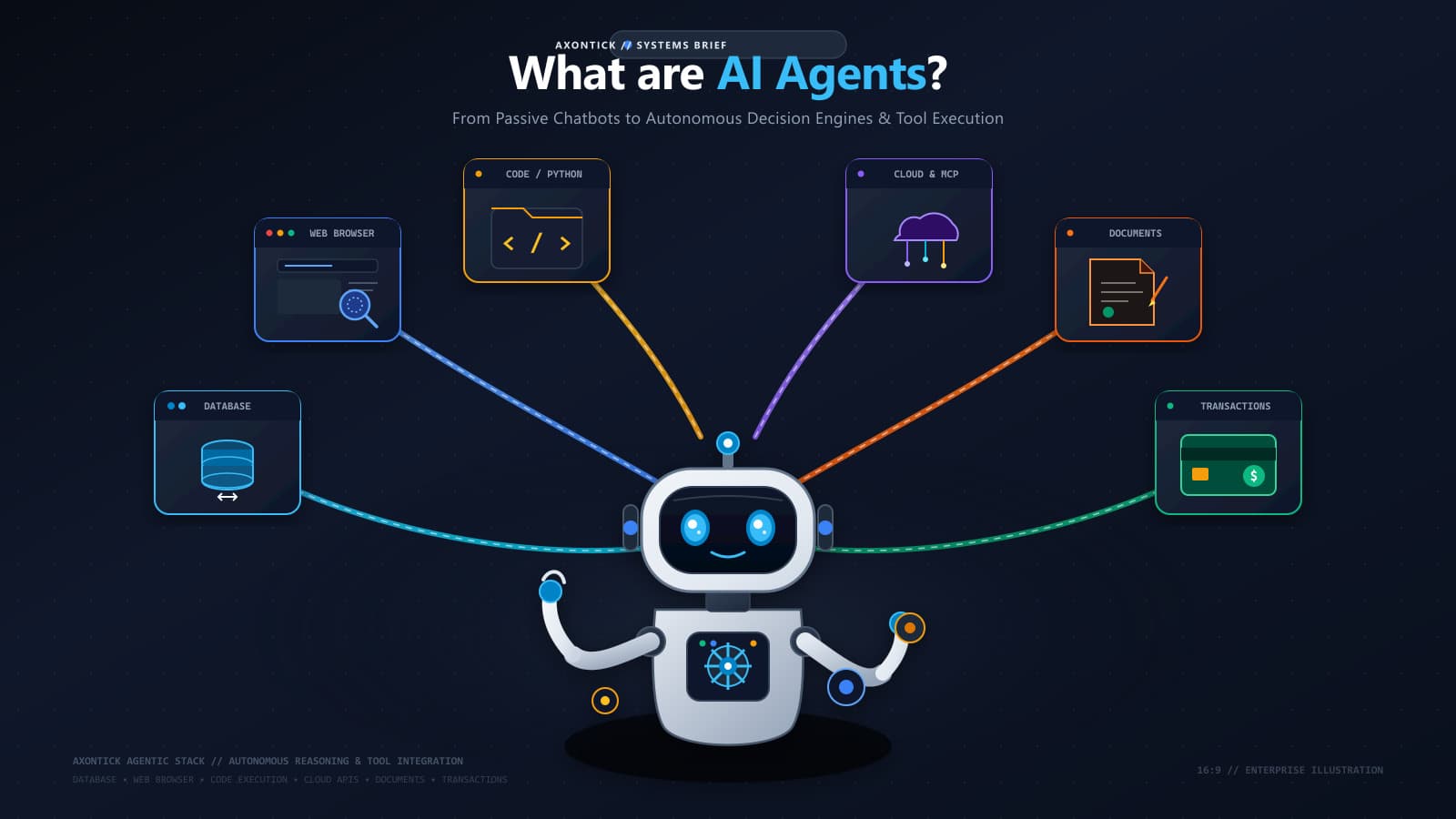
As explored in our previous technical breakdown on What Are AI Agents?, the software industry has shifted from passive conversational prompts to autonomous execution. However, while an AI agent is the autonomous runtime actor, the broader category of what are AI services encompasses the entire engineering lifecycle: architectural design, data pipeline ingestion, API tool integration, governance guardrails, and long-term MLOps maintenance required to run those agents reliably at enterprise scale.
SaaS vs. Bespoke AI Services: What Are You Actually Buying?
When evaluating how to automate core business operations, executive leadership frequently confronts a pivotal strategic choice: AI services vs SaaS.
When evaluating what are AI services from an architectural standpoint, the comparison against pre-packaged SaaS is immediate. Over the past three years, thousands of pre-packaged AI SaaS products entered the market. Most of these tools offer identical features: a monthly per-seat subscription, a polished user interface, and an API connection to an off-the-shelf model. While suitable for basic drafting or individual productivity, off-the-shelf SaaS platforms quickly reveal fatal limitations when applied to core enterprise operations.
┌────────────────────────────────────────────────────────────────────────┐
│                   THE ARCHITECTURAL DICHOTOMY                          │
├───────────────────────────────────┬────────────────────────────────────┤
│       OFF-THE-SHELF AI SAAS       │    BESPOKE ENTERPRISE AI SERVICES  │
├───────────────────────────────────┼────────────────────────────────────┤
│ • Shared multi-tenant infrastructure│ • Dedicated, private client VPC   │
│ • Generic prompt wrappers         │ • Deterministic schema enforcement │
│ • Per-seat recurring license costs│ • Turnkey client IP ownership      │
│ • Isolated data silos (no ERP API)│ • Deep bi-directional integrations │
│ • Fragile web scraping connectors │ • Native Model Context Protocol    │
└───────────────────────────────────┴────────────────────────────────────┘
The fundamental conflict in the AI services vs SaaS debate lies in the distinction between a *System of Record* and a *System of Action*. Traditional SaaS tools—such as Salesforce, HubSpot, Jira, or NetSuite—act as passive systems of record. They store records, display dashboards, and require human employees to manually review rows, execute clicks, and update database fields.
When enterprise teams purchase pre-packaged AI add-ons within these platforms, they are merely buying assisted drafting. The software does not execute cross-platform tasks autonomously.
By contrast, custom AI systems engineered through specialized enterprise AI services act as an active overlay across your entire software ecosystem. An enterprise AI service does not replace your CRM or ERP; it connects them. The custom system listens for operational triggers, extracts unstructured data from emails or PDFs, reasons across multiple software boundaries, and executes verified state changes directly via backend APIs.
Analyzing AI services vs SaaS across key operational vectors illustrates why custom architectures outperform generic tools:
| Dimension | Generic AI SaaS Product | Bespoke Enterprise AI Solutions |
|---|---|---|
| Data Privacy & Isolation | Multi-tenant cloud; risks data exposure in shared vector caches | Private client VPC deployment with zero-data-retention model agreements |
| Integration Breadth | Restricted to pre-built native apps or shallow Zapier hooks | Deep custom API integrations, internal microservices, and legacy SQL hooks |
| Deterministic Guardrails | Black-box system prompts vulnerable to prompt injection | Programmatic Pydantic validation, schema gating, and hard logic checks |
| Intellectual Property | Vendor owns the software, algorithms, and orchestration logic | Client retains 100% ownership of custom codebase, schemas, and pipelines |
| Pricing Model | Compounding per-seat monthly subscription licenses | Milestone-based development fee plus direct raw token pass-through costs |
| Execution Accuracy | Probabilistic text generation prone to subtle hallucinations | Stateful graph verification loops with automated fallback execution |
When businesses ask what are AI services worth compared to off-the-shelf software, the answer centers on autonomy and asset value. A SaaS subscription remains an indefinite operational liability. Custom AI systems are capital assets that compound in utility as your business expands.
The 5 Layers of Modern AI Agency Deliverables
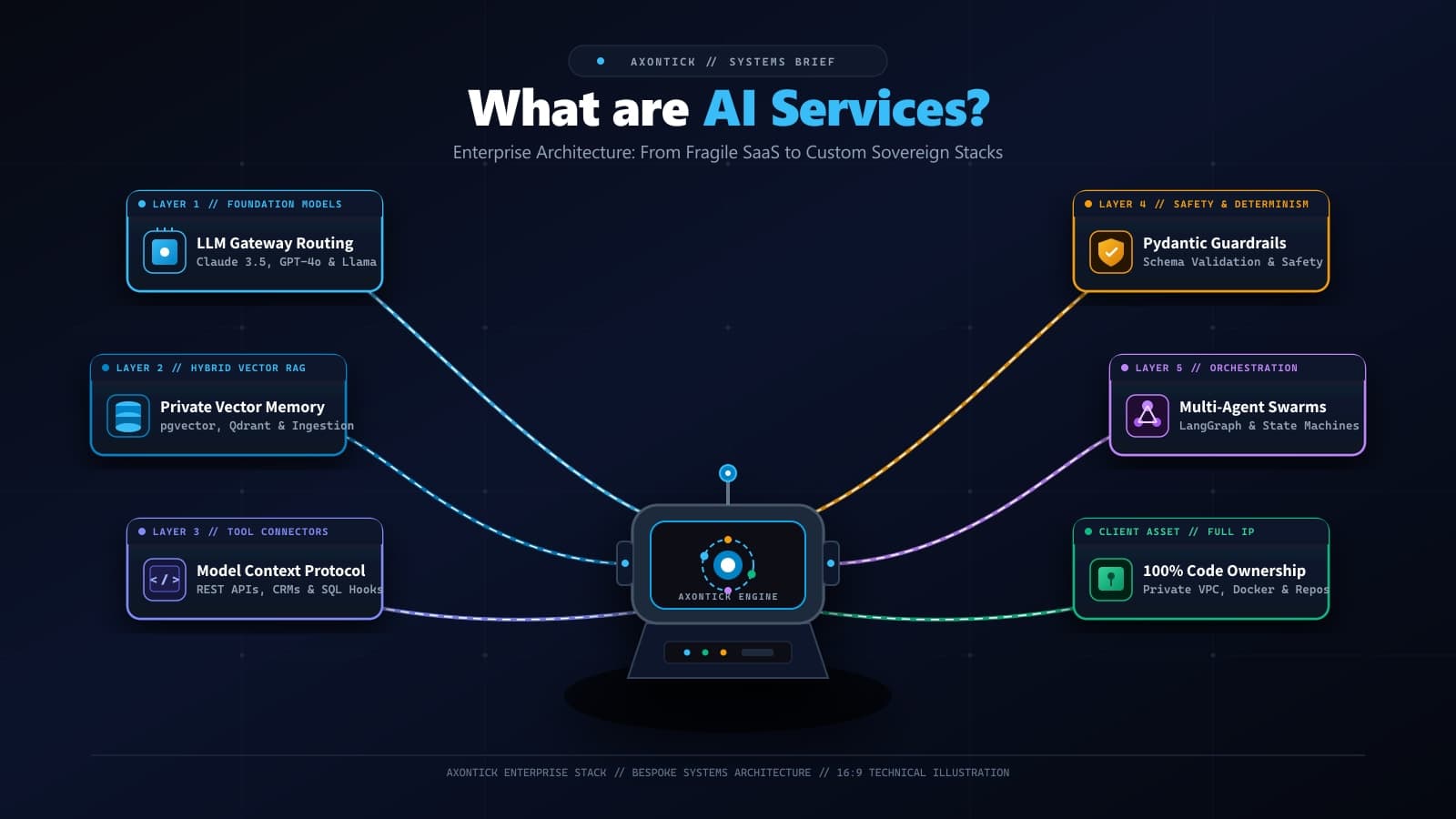
To eliminate ambiguity around AI automation agency deliverables, enterprise buyers must understand the anatomy of a production-grade AI system. Professional AI engineering agencies do not deliver isolated prompts or messy configuration scripts; they construct a modular, 5-layer software architecture tailored to your security requirements.
┌────────────────────────────────────────────────────────────────────────┐
│               THE 5-LAYER ENTERPRISE AI ARCHITECTURE                   │
├────────────────────────────────────────────────────────────────────────┤
│  LAYER 5: STATEFUL ORCHESTRATION & AGENT SWARMS                        │
│  LangGraph State Machines, Temporal Workflows, Human Approval Gates    │
├────────────────────────────────────────────────────────────────────────┤
│  LAYER 4: PROGRAMMATIC GUARDRAILS & DETERMINISM                        │
│  Pydantic Validation, NeMo Guardrails, Scope Filters, Schema Gating    │
├────────────────────────────────────────────────────────────────────────┤
│  LAYER 3: TOOL EXECUTION & EXTERNAL API CONNECTORS                     │
│  Model Context Protocol (MCP), REST Microservices, SQL Mutations       │
├────────────────────────────────────────────────────────────────────────┤
│  LAYER 2: KNOWLEDGE INGESTION & HYBRID VECTOR RAG                      │
│  Semantic Chunking, pgvector / Qdrant, Dense + BM25 Sparse Search      │
├────────────────────────────────────────────────────────────────────────┤
│  LAYER 1: FOUNDATION MODELS & INFERENCE GATEWAY                        │
│  Claude 3.5 Sonnet, GPT-4o, Llama 3.3, LiteLLM Routing, Cost Fallbacks │
└────────────────────────────────────────────────────────────────────────┘
The concrete deliverables across these five engineering tiers define the true value proposition of enterprise AI services:
Layer 1: Foundation Models & Inference Gateways
Across all AI automation agency deliverables, foundation model intelligence acts as the primary cognitive engine. A key deliverable in professional bespoke AI development is the implementation of an intelligent inference gateway (such as LiteLLM or an enterprise proxy).
Rather than hard-coding all application workflows to a single proprietary model, the gateway dynamically routes prompts based on task complexity, execution speed, and token cost:
- High-reasoning tasks (contract analysis, complex SQL generation) route to Anthropic Claude 3.5 Sonnet or OpenAI GPT-4o.
- High-volume, low-latency triage tasks route to lightweight models such as Claude 3.5 Haiku or GPT-4o-mini.
- Strict data residency tasks run on dedicated self-hosted open-weight models such as Llama 3.3 or DeepSeek-V3 hosted in private client VPCs.
Layer 2: Knowledge Ingestion & Hybrid Vector RAG
Generative models possess extensive general knowledge but zero awareness of your internal business data. Layer 2 is the Retrieval-Augmented Generation (RAG) architecture that grounds the system in institutional truth.
Key deliverables include:
- Automated Data Connectors: Scheduled ingest pipelines that crawl Notion workspaces, Google Drive folders, Confluence wikis, Zendesk tickets, and internal PostgreSQL tables.
- Context-Aware Semantic Chunking: Ingest engines that partition complex documents along semantic section boundaries rather than arbitrary character splits.
- Hybrid Search Indexing: Production vector databases (such as
pgvector, Qdrant, or Pinecone) configured for hybrid search, combining dense semantic vector embeddings with sparse BM25 keyword matching for exact product IDs and regulatory codes.
Layer 3: Tool Execution & External API Connectors
Reasoning without execution produces nothing more than conversational advice. To evaluate what are AI services capable of performing in production, look at the tool execution tier. Layer 3 delivers deterministic "hands" that allow models to interact with your enterprise software stack.
Modern agencies deliver standardized tooling utilizing Anthropic's Model Context Protocol (MCP) and structured Function Calling interfaces. Deliverables include secure microservices that perform authenticated REST queries, trigger database transactions, update ERP fields, book calendar slots, and issue customer communications through verified third-party gateways.
Layer 4: Programmatic Guardrails & Safety Architecture
Allowing an autonomous model to interact with production databases requires strict safety engineering. Layer 4 delivers deterministic guardrail layers that sandwich model inference between hard code validation.
Key deliverables include:
- Input Sanitization: Detecting and neutralizing prompt injection attacks, jailbreak attempts, and system extraction prompts before they reach the model.
- Pydantic Schema Validation: Forcing model outputs into strict JSON schemas. If an agent outputs a malformed payload or hallucinated parameter, deterministic code catches the mismatch and triggers an automated re-prompt loop without human intervention.
- Role-Based Financial & Action Caps: Hardcoded constraints that prevent the model from executing transactions exceeding designated spending thresholds or modifying restricted database tables.
Layer 5: Stateful Orchestration & Agent Swarms
For multi-step operational workflows, single-turn prompts are incapable of maintaining state. Layer 5 provides stateful orchestration engines built using frameworks like LangGraph or Temporal.
Deliverables in this tier include cyclical graph architectures where autonomous agents maintain working memory, reflect on intermediate execution results, retry failed API requests, and seamlessly escalate complex edge cases to human managers via Slack or Microsoft Teams when confidence scores fall below pre-defined thresholds.
Custom API Integrations vs. No-Code Workflows: Choosing the Right Engine
A frequent question executives ask when reviewing AI automation agency deliverables is whether their solution should be built using visual iPaaS platforms (such as n8n, Make, or Zapier) or written in full-stack, event-driven code (TypeScript, Python, FastAPI).
A fundamental question when scoping what are AI services for mid-market and enterprise firms is deciding how models communicate with operational pipelines. Both methodologies represent legitimate AI services, but they target fundamentally distinct business requirements:
┌────────────────────────────────────────────────────────────────────────┐
│                   PIPELINE SELECTION DECISION TREE                     │
└───────────────────────────────────┬────────────────────────────────────┘
                                    │
                     Is workflow high-throughput (>10k req/day)
                     or handling regulated PII/HIPAA/SOC2 data?
                                    │
                     ┌──────────────┴──────────────┐
                    YES                            NO
                     │                             │
          Deploy Full-Stack Code         Is rapid prototyping and visual
        (TypeScript / Python / VPC)       iteration by non-engineers key?
                     │                             │
        • Zero vendor lock-in             ┌────────┴────────┐
        • Sub-second execution latency   YES                NO
        • Deterministic git versioning    │                 │
        • Maximum security compliance   Deploy n8n / Make   Evaluate Hybrid
When No-Code & Low-Code Pipelines Excel
Visual workflow orchestrators like n8n and Make are ideal for mid-market businesses prioritizing implementation speed over extreme scale. They provide excellent visual debugging, rapid connector configuration across hundreds of standard SaaS platforms, and enable non-technical operations managers to inspect execution logs directly.
For workflows processing hundreds of transactions per day—such as automated social media drafting, basic inbound lead notification, or internal team summaries—low-code pipelines deliver an exceptionally fast return on investment.
When Full-Stack Code Engineering Is Mandatory
For enterprise operations processing thousands of concurrent requests, handling sensitive financial transactions, or requiring SOC 2 Type II and HIPAA compliance, custom code is mandatory:
- Execution Latency: High-performance TypeScript and Python microservices execute with sub-50ms overhead, whereas low-code cloud platforms often introduce hundreds of milliseconds of scheduling latency per step.
- Deterministic Schema Versioning: Code-based systems reside in Git repositories, supporting continuous integration (CI/CD), automated unit testing, regression test suites, and cryptographic audit trails.
- Data Governance: Custom-engineered microservices deploy directly inside your private AWS, GCP, or Azure Virtual Private Cloud (VPC), ensuring proprietary client records never pass through third-party automation servers.
At Axontick, our 4-Step Engineering Delivery Process audits your transaction volume and compliance posture upfront, ensuring you deploy the exact architecture that balances velocity with enterprise-grade resilience.
How Modern AI Engineering Delivers Turnkey Business Assets
The primary reason enterprises hire specialized agencies for what are AI services rather than treating AI as an internal experiment is the requirement for production-grade reliability. A prototype built during an afternoon hackathon can successfully answer 70% of prompts; transforming that prototype into an enterprise software asset that operates with 99.5% accuracy under real-world conditions requires rigorous systems engineering.
Professional custom AI systems provide four tangible deliverables that turn experimental technology into a lasting corporate asset:
1. Complete Intellectual Property & Codebase Ownership
Through bespoke AI development, your organization owns the source code, database migration scripts, integration schemas, and deployment configurations. Unlike closed SaaS ecosystems where your operational logic is held hostage behind monthly subscription tiers, bespoke development yields a proprietary technology asset that increases your enterprise valuation.
2. Systematic Evaluation Suites (LLM-as-a-Judge & Evals)
In conventional software development, unit tests deterministically pass or fail. In non-deterministic AI development, model outputs can subtly drift when underlying foundational model providers update weights.
A production agency deliverable includes automated regression testing pipelines. Utilizing frameworks like DeepEval or custom LLM-as-a-judge nodes, the system runs hundreds of benchmark business queries through test datasets before any code update goes live, measuring accuracy, context recall, toxicity, and hallucination rates against strict baseline thresholds.
3. Comprehensive Observability & Telemetry
Enterprise engineering teams cannot treat AI agents as black boxes. Production deliverables feature end-to-end telemetry instrumentation utilizing OpenTelemetry, LangSmith, or Arize Phoenix:
[Inbound Webhook: Quote Request #9021] ─────────────── Total Latency: 1,240ms
  ├─ Layer 1: PII Sanitization & Regex Check ────────── 12ms (Pass)
  ├─ Layer 2: Hybrid pgvector Context Retrieval ────── 85ms (Top-3 matched)
  ├─ Layer 3: Claude 3.5 Sonnet Reasoning Loop ─────── 980ms (Tokens: 412 in / 118 out)
  ├─ Layer 4: Pydantic Schema Validation ────────────── 15ms (Schema Valid)
  └─ Layer 5: HubSpot API CRM Record Mutation ──────── 148ms (Status: 200 OK)
Every execution step, token count, API latency metric, and internal reasoning thought is permanently indexed, giving compliance officers and operations managers full visibility into why an agent executed a specific business action.
Build vs. Buy vs. Partner: The Executive Decision Framework
Every C-suite executive evaluating AI implementation must confront the classical resource allocation question: Should we build this in-house, buy existing commercial software, or partner with an enterprise AI agency?
For executive teams determining what are AI services going to return on capital, comparing in-house teams against agency sprints is essential. Beyond the initial choice of AI services vs SaaS, leadership must determine long-term operational ownership.
The table below outlines the true resource requirements across these three strategic pathways:
| Strategic Vector | Build In-House | Buy Off-the-Shelf SaaS | Partner with AI Agency |
|---|---|---|---|
| Time to Production | 6 to 12 months (recruiting + building) | 1 to 2 weeks | 4 to 8 weeks (structured sprints) |
| Upfront Capital Investment | Very High ($300k-$600k+ in salaries) | Low ($500 - $3,000 setup) | Moderate (Fixed milestone sprint budget) |
| Ongoing Cost Profile | High fixed overhead (annual payroll) | Compounding per-user seat fees | Direct raw token consumption + SLA support |
| Customization Depth | High (constrained by team skill) | Zero to Minimal | 100% Tailored to proprietary stack |
| Failure Risk Profile | High (costly learning curves on production edge cases) | Low technical risk, high workflow mismatch | Low (battle-tested architectural blueprints) |
Why Forward-Thinking Companies Choose Strategic Partnerships
Attempting to hire internal machine learning and agentic systems engineers in today's talent climate is an expensive bottleneck. Top AI systems architects demand base salaries between $250,000 and $350,000, and building internal team competency on token optimization, vector retrieval architectures, and deterministic guardrail design often consumes three to four quarters before the first pipeline touches production.
Partnering with an established systems engineering agency eliminates that discovery tax. Agencies bring battle-tested architectural templates, pre-built connector libraries, and established benchmarking frameworks directly to your problem space, deploying functional production systems in 30 to 60 days.
To calculate the exact financial investment and timeline required for your operational workflow, run your parameters through our interactive AI Pricing Calculator.
Frequently Asked Questions About Enterprise AI Services
What are AI services compared to traditional IT consulting?
Traditional IT consulting focuses on software configuration, staff augmentation, and cloud infrastructure management. In contrast, specialized AI services focus specifically on non-deterministic reasoning architectures: designing hybrid RAG memory, integrating foundational LLMs into internal databases via Model Context Protocol, building deterministic Pydantic guardrails, and deploying stateful multi-agent workflows that execute operational tasks autonomously.
What are the primary AI automation agency deliverables?
Key deliverables from an enterprise AI agency include:
- Architecture & Feasibility Audits: Quantitative evaluations of your data quality, security posture, and workflow automation ROI.
- Custom Vector RAG Pipelines: High-precision data indexing systems linking private databases to foundational models.
- Deterministic Tool & API Microservices: Validated connectors enabling models to read and mutate live enterprise systems.
- Safety & Guardrail Infrastructure: Schema validation, prompt injection defenses, and human-in-the-loop review queues.
- Turnkey Codebase & IP Ownership: Complete repository transfer including Docker containers, CI/CD pipelines, and observability tracing.
How do custom AI systems prevent proprietary data leaks?
Bespoke custom AI systems achieve enterprise data privacy by deploying within private Virtual Private Clouds (VPC) on AWS, GCP, or Azure. Model access utilizes enterprise tier zero-data-retention API agreements (guaranteeing that prompts and enterprise documents are never used to train future public foundational models) or dedicated self-hosted open-weight models (such as Llama 3 or DeepSeek) running entirely inside client firewalls.
How long does an enterprise AI implementation take from audit to production?
A production-grade implementation engineered by an experienced agency typically follows a structured 4-to-8 week sprint cadence:
- Weeks 1–2: Architectural audit, data pipeline ingestion, and feasibility benchmarking.
- Weeks 3–5: Core agent logic, tool integration, and deterministic guardrail scaffolding.
- Weeks 6–7: Automated eval benchmark testing, edge-case hardening, and staging integration.
- Week 8: Production deployment, telemetry dashboard handover, and staff enablement.
What is the typical pricing model for bespoke AI development?
Professional enterprise AI development generally operates on milestone-based project deliverables (typically ranging from $15,000 to $65,000+ depending on architectural complexity, data density, and integration endpoints), followed by an optional monthly MLOps maintenance retainer covering model updates, vector database re-indexing, and continuous evaluation monitoring. Infrastructure costs (token consumption, cloud hosting, vector database fees) pass directly through to client cloud accounts with zero agency markup.
Conclusion: Moving from Superficial AI Experiments to Scalable Assets
The corporate landscape has graduated from the novelty phase of generative AI. Enterprise leadership teams no longer reward flashy demonstration prototypes or generic chat widgets that fail to impact bottom-line efficiency.
Understanding what are AI services allows organizations to make informed, strategic investments in sovereign software assets. By investing in custom AI systems with private vector memory and strict guardrails, enterprises secure sustainable operational advantages. Whether your strategic priority is deploying sub-second AI Voice Agents to eliminate customer phone queues, constructing Multi-Agent Systems to automate complex compliance workflows, or engineering turnkey data integration pipelines, the defining factor of success is systems architecture.
By combining foundational intelligence with private institutional context, deterministic validation schemas, and enterprise guardrails, custom AI services transform unpredictable language models into dependable, tireless digital workers.
Ready to architect custom enterprise AI services for your organization?
- Calculate your estimated development timeline and hosting costs with our interactive AI Pricing Calculator.
- Review our transparent 4-Step Engineering Delivery Framework to understand how we move from initial audit to production in 30 days.
- Explore our comprehensive Enterprise Services Catalog or schedule a direct architectural consultation with our engineering team today.

Muhammad Asim
Founder @ Axontick
Founder of Axontick, specialized in AI automation, Multi-Agent Systems, and enterprise-grade voice agents. Expert in bridging the gap between complex AI technology and practical business solutions.